Any growth strategy should start with identifying the clients the firm wants to pursue — but don’t worry if they’re “ideal.”
“We have to be really clear on who our target clients are,” Jon Hubbard, a shareholder and chief growth officer at Boomer Consulting, recently told a group of accountants. “And note that I’m not saying your ‘ideal’ clients. That brings a lot of emotional baggage. My grandmother is ideal, but she’s not a target client.”
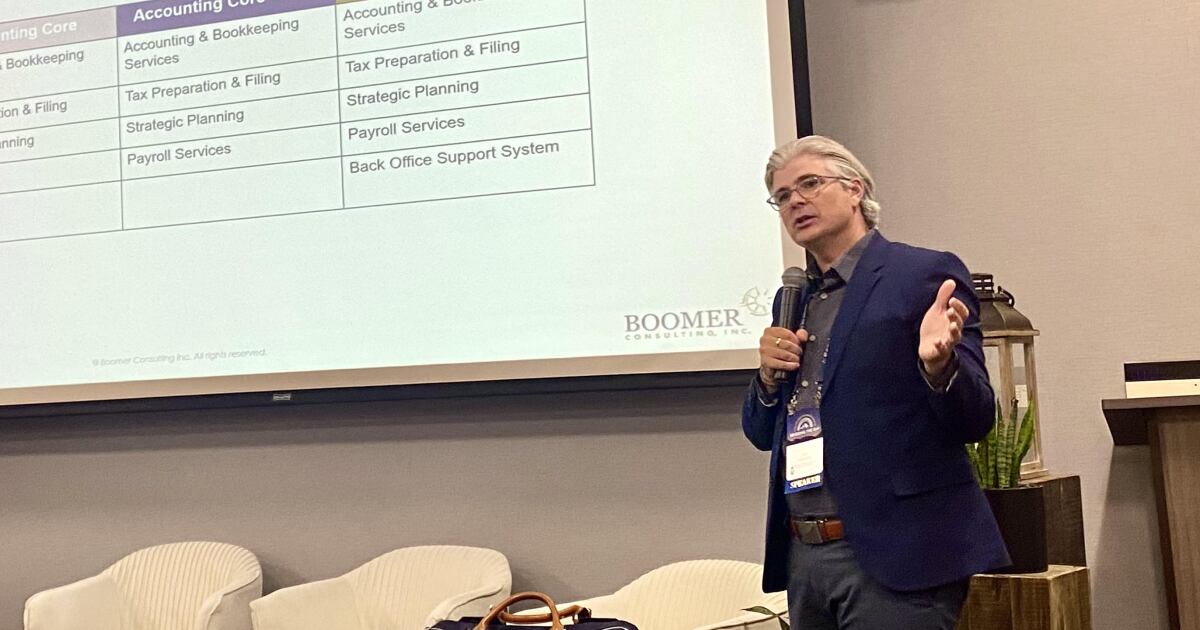
Speaking during at a session on “The Tech-Enabled Playbook for Firm Growth” at the 2025 Bridging the Gap Conference this week in Denver, Hubbard stressed the central importance of clearly identifying the firm’s target clients, but he recommended taking a step back before diving in and slicing and dicing your current client base in Excel.
Jon Hubbard at Bridging the Gap 2025
“Before you start with spreadsheets, answer these questions,” he suggested: “Who do you want more of? What are their best characteristics? What are their most challenging characteristics? What do they value?”
The last two are particularly important to be able to serve your target clients better. For instance, knowing that your “A” clients may demand more of you or expect more proactive service than your Bs or Cs allows you to plan for the extra capacity you’ll need as you bring on more As. Similarly, having a better handle on what they value allows you to adjust your deliverables appropriately in advance.
“Often, what you’re delivering isn’t necessarily what they think they’re getting,” Hubbard warned.
After answering those first four questions, you can begin considering Hubbard’s next three, which are more quantifiable: “How much revenue do they generate for the firm? What are three common service lines this client would have? What are three additional services this client could grow into?”
The temptation may be to jump instantly to ranking clients based on the results, but there’s another set of input you want to get: What is the sentiment about your current client base around the firm?
“Ask staff,” Hubbard advised. “You can start with individual clients’ professionalism and courtesy, deliverable timeliness, how well they fit with the firm, and ‘Would you want to work with this client again?'”
Once you have staff feedback on your clients through a survey tool, Hubbard recommends bringing that information together with all the other details you can glean from your practice management system, your customer relationship management system, and your time and billing software to create a client ranking dashboard that you can review on a regular basis to see who’s a good fit, and to help further refine who your target clients are.
How much value gets placed on each factor — a client’s profitability versus whether they’re in a core industry the firm wants to focus on, for instance — will vary depending on your priorities, but staff sentiment needs to play a central role.
“I know firms that put a 20% weight on staff sentiment, and one that puts a 50% weight, because they want to show their staff that they’re really listening,” Hubbard said. “Know that if you ask for feedback on clients, they expect you to do something with that feedback.”
It’s important to bear in the mind that this is an evolutionary process, one firms should revisit annually to continue moving their client base closer to their targets.
While there may be quick wins in the form of jettisoning particularly terrible clients, Hubbard noted that the most significant benefits begin to appear over two to three years.
“You want to evolve it over time,” he said, citing the example of a firm he worked with recently: “Three years ago, 60% of their revenue came from C and D clients, and now it’s down to 40%,” he said. “They’re doing a better job of winning the right kinds of clients.”
Finally, remember that these are your target clients — there may be “ideal” clients who fall outside the parameters you establish.
“Too often, what I see in the target profile conversation is that people want to leapfrog to, ‘What’s going to happen to people who don’t match this profile? Are we going to automatically turn them away?'” Hubbard said. “If an amazing client comes in who doesn’t fit this profile, go ahead and take them on — but it helps to have a clear idea of who you’re going after.”
The accounting profession is undergoing a fundamental structural transition as enterprise finance departments shift from periodic month-end closes toward automated continuous accounting models. By integrating specialized machine learning algorithms directly into enterprise resource planning (ERP) platforms, chief accounting officers are transforming financial reporting from a retrospective exercise into a real-time operational asset.
The Shift from Periodic Close to Continuous Financial Reporting
Traditional accounting workflows heavily relied on manual data reconciliation, spreadsheet calculations, and multi-week closing cycles at the end of each fiscal period. In contrast, continuous accounting frameworks utilize automated software agents to process, validate, and post transactional data in real time as business activities occur.
Automated bank reconciliation tools cross-reference incoming bank feeds, invoice records, and purchase orders automatically. By resolving transactional variances instantly throughout the month, corporate accounting teams eliminate the traditional workload spikes associated with quarterly and annual closes.
Machine Learning in Audit Trails and Anomaly Detection
Advanced natural language processing (NLP) and machine learning tools are redefining internal audit and financial control environments. Automated systems analyze 100% of general ledger entries, identifying anomalous transactions, duplicate payments, and unauthorized journal entries in real time.
Rather than relying on random statistical sampling, corporate internal auditors can focus their attention on high-risk flags automatically surfaced by algorithmic monitoring platforms. This continuous risk assessment strengthens internal controls over financial reporting (ICFR) and significantly reduces fraud risk.
Evolving Roles for Accounting Professionals
As routine data entry and manual reconciliation tasks become fully automated, the skill set required for accounting professionals is shifting toward data analysis, system design, and strategic business advisory.
– Systems Governance: Accountants are increasingly responsible for monitoring algorithmic accuracy and managing data integration pipelines.
– Business Partnership: Finance professionals leverage real-time financial dashboards to advise operational leaders on margin management and working capital allocation.
– Regulatory Compliance Management: Accounting teams utilize automated platforms to ensure compliance with dynamic tax codes and international accounting standards.
Core Implementation Recommendations
1. Deploy Automated Reconciliation Tools: Integrate continuous transaction processing modules into existing enterprise ERP architectures.
2. Establish Algorithmic Governance Controls: Implement strict internal testing protocols to ensure automated accounting rules comply with GAAP/IFRS standards.
3. Reskill Accounting Teams: Invest in training finance staff on data analytics, workflow automation, and predictive financial modeling.
Corporate accounting departments face expanding reporting expectations as international sustainability disclosure standards achieve regulatory enforcement across major global jurisdictions. Chief Accounting Officers (CAOs) and corporate controllers are establishing rigorous internal accounting controls to treat Environmental, Social, and Governance (ESG) metrics with the same data precision, auditability, and governance as traditional financial statements.
Regulatory Harmonization Under Global Sustainability Frameworks
The implementation of standardized sustainability reporting frameworks—notably rules established by international sustainability accounting boards—has created unified expectations for public and large private enterprises. Corporations must report standardized metrics covering greenhouse gas emissions (Scope 1, 2, and material Scope 3), energy utilization, workforce demographics, and supply chain governance.
In Europe and other participating international jurisdictions, double materiality principles are mandatory. Under double materiality, organizations must report both how external sustainability risks impact corporate financial performance, and how internal corporate operations affect surrounding environmental and social structures.
Integrating Sustainability Metrics into Core ERP Systems
To provide auditable non-financial data, enterprise organizations are integrating specialized carbon accounting and ESG management platforms directly into core ERP systems. Automated data collectors capture energy utility invoices, logistics fuel consumption metrics, and vendor compliance records in real time.
Establishing automated, traceable data pipelines ensures that non-financial reporting is supported by clear audit trails. This structured approach allows external financial auditors to provide reasonable assurance on sustainability disclosures during annual corporate reporting cycles.
Financial Impacts and Capital Market Disclosure
Accurate ESG reporting directly influences corporate cost of capital and institutional credit ratings. Commercial lenders and institutional asset managers systematically incorporate sustainability metrics into risk pricing models. Companies that demonstrate transparent, verifiable progress in operational energy efficiency and climate risk mitigation benefit from expanded access to green bond markets and lower debt pricing.
Action Steps for Accounting Leadership
1. Implement Double Materiality Frameworks: Conduct comprehensive assessments to identify material financial and operational sustainability metrics.
2. Build Auditable Non-Financial Data Pipelines: Automate ESG data collection within core accounting software to ensure data integrity.
3. Align Sustainability with Annual Financial Filings: Prepare non-financial disclosures concurrently with financial statements to satisfy regulatory audit expectations.
Internal audit departments and corporate risk managers are modernizing internal control frameworks by shifting from periodic sampling techniques to continuous monitoring and machine learning analytics. As operational data volumes increase across enterprise organizations, automated control testing ensures financial integrity, prevents corporate fraud, and streamlines annual audit engagements.
The Limitation of Periodic Audit Sampling
Historically, internal and external auditors evaluated internal controls by reviewing random samples of financial transactions—often analyzing less than five percent of total ledger entries. In complex enterprise environments, periodic sampling methods carry inherent risks of overlooking localized financial misstatements, unauthorized disbursements, or operational control breakdowns.
In 2026, progressive internal audit functions are utilizing automated continuous monitoring platforms that evaluate one hundred percent of financial transactions in real time. Continuous control auditing systems continuously monitor general ledger entries, procurement approvals, and expense reimbursements across all operating subsidiaries.
AI-Powered Fraud Detection and Anomaly Identification
Machine learning models trained on historical corporate financial data excel at identifying subtle transactional anomalies that indicate potential fraud or operational error. Automated systems instantly flag duplicate invoice payments, unapproved vendor creation, unusual journal entry timing, and unauthorized override of authority thresholds.
When an anomaly is detected, the automated auditing platform generates an instant risk alert, allowing internal audit teams to investigate root causes immediately. Early detection prevents minor operational errors from escalating into material weaknesses in financial reporting.
Streamlining External Audit Preparation
Continuous internal control monitoring delivers significant benefits during annual external financial audits. External audit firms can review continuous audit logs and automated control testing documentation, reducing the time required for manual field testing.
This integrated approach lowers overall audit compliance fees, reduces administrative burdens on corporate accounting staff, and provides senior management and audit committees with real-time visibility into the organization’s overall risk profile.
Core Implementation Guidelines
1. Transition to 100% Data Testing: Replace legacy sampling methods with automated continuous audit monitoring systems.
2. Deploy Anomaly Detection Algorithms: Implement machine learning models to identify unauthorized transactions and operational control overrides.
3. Align Internal and External Audit Workflows: Coordinate continuous control testing protocols with external auditors to optimize annual compliance cycles.