The battle for control of Congress has topped $10 billion as the two parties vie for outsized influence over taxes, spending and the implementation of the next president’s agenda.
It’s a staggering and potentially historic sum, based on OpenSecrets data, considering that only about a 10th of congressional races are actually competitive. Yet, it outpaces spending on the hard-fought presidential election.
The whopping figure reflects the colossal stakes. Control of Congress is pivotal to economic policy. The expiration next year of the 2017 tax law puts trillions of dollars in tax provisions in play. The Senate can block the appointment of key financial-industry regulators. Legislative battles are shaping up over prescription drug prices and regulation of the crypto industry, energy, artificial intelligence and social media.
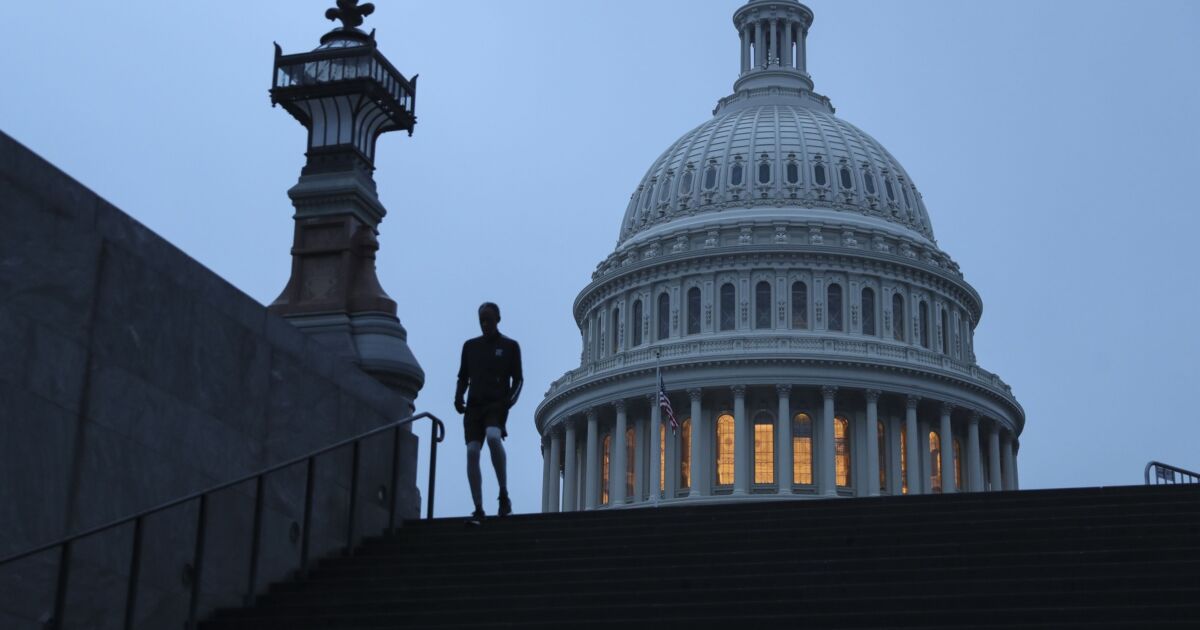
A runner stands near the U.S. Capitol in Washington.
Oliver Contreras/Bloomberg
Republicans are currently favored to gain the Senate majority based on a favorable map, while minority Democrats have at least an even chance to take control of the House, potentially reversing both chambers and continuing a divided government. Many races remain tight and the outcome may not be known for days after the Nov. 5 election.
Here are some key races to watch:
The Senate: Montana
Democrats’ hopes in the Senate largely hinge on Montana, where three-term incumbent Jon Tester has trailed Republican Tim Sheehy, a political newcomer, businessman and former Navy Seal. That race is set to break records with about $250 expected to be spent per resident of the sparsely populated state on advertising alone, according to AdImpact data.
Tester, a third-generation farmer, has long relied on his folksy charm and a reputation for delivering resources to his state to overcome its Republican tilt. This year, Democrats hope Tester’s support for abortion rights will help him and other vulnerable candidates hold on.
But former President Donald Trump is expected to win in Montana by double digits, so Tester will need many Montanans to split their ticket between the parties, a practice that has become less common as the electorate has become more polarized.
Ohio
Even if Tester pulls out a win, Democrats would likely need to win every other tossup race, including Ohio, where Sherrod Brown is trying to defend his seat against car dealer Bernie Moreno. Advertising alone has cost more than $530 million in that race, according to AdImpact.
As in Montana, Trump is expected to win Ohio easily, which could give Moreno a boost despite Brown’s popularity with many White working-class voters who form the former president’s base.
Democrats also need to keep seats in the presidential “Blue Wall” battlegrounds of Pennsylvania, Wisconsin and Michigan — all states where races have tightened — as well as in Arizona and Nevada, where the party’s Senate candidates have held larger leads in polls.
Wild cards
If Tester loses, Democrats would need an upset win somewhere else. That would likely require Colin Allred to defeat Senator Ted Cruz in Texas or Debbie Mucarsel-Powell to beat Senator Rick Scott in Florida. A wild card race in Nebraska, where independent union leader Dan Osborn has been running neck-and-neck with incumbent Republican Deb Fischer, could also scramble the outcome on election night.
Democrats’ best-case scenario is likely a 50-50 Senate, with control of the chamber depending on the outcome of the presidential race, because the vice president breaks ties.
Republicans, however, could win as many as 55 seats if they sweep the tossup races. A larger majority would widen the aperture for GOP tax cuts and other legislation if they control both chambers of Congress and the White House. In 2017, the party’s thin majority led to the defeat of efforts to repeal the Affordable Care Act via a thumb down from then-Senator John McCain.
The GOP has hoped that popular former Governor Larry Hogan would pull off an against-the-grain win in heavily Democratic Maryland, but Prince George’s County Executive Angela Alsobrooks has had double-digit leads in recent polls despite significant super political action committee spending on Hogan’s behalf, including $10 million from billionaire Ken Griffin.
The House: New York and California
Democrats’ chances are significantly better in the House, where Republicans now hold only a slim majority and must defend many areas won by President Joe Biden in 2020, including in heavily Democratic states like New York and California. The party needs a net gain of just four seats to hand the speaker’s gavel to Hakeem Jeffries of New York, and with it the power over the federal purse and House investigative subpoenas.
In addition to 10 New York and California seats in play, Democrats have targeted Heartland districts in Nebraska and Iowa now held by Republicans, as well as battlegrounds in New Jersey and Arizona.A Des Moines Register poll published Sunday showed Democratic challengers in Iowa leading incumbent Republican Representative Mariannette Miller-Meeks by 16 percentage points and incumbent Republican Representative Zach Nunn by 7 points among likely voters. The poll showed a surge for Democrats among women and disproportionate enthusiasm among them for voting in a state that imposed a ban on abortions after about six weeks with limited exceptions.In Louisiana, a newly reconfigured, majority-Black district favors a Democrat succeeding GOP Representative Garret Graves, who decided not to seek reelection. In Alabama, another redrawn district, similarly designed to give Black voters more voting representation, could bring another seat shift toward Democrats.
Meanwhile, Speaker Mike Johnson of Louisiana — who unexpectedly ascended to the job late last year after the tumultuous ouster of his predecessor — is scrambling to save his gavel. He has aggressively stumped and raised money nationwide, including a string of events in key New York districts that helped the GOP flip the House two years ago.
Republicans have sought to capitalize on voter discontent on issues like inflation and immigration, targeting open-race seats of retiring Democrats in Michigan, and incumbents in states including New Mexico and Pennsylvania as well as those in districts won by Trump in 2020, like Jared Golden in Maine and Mary Peltola in Alaska.
The first results on election night could come from Virginia, where polls close at 7 p.m. New York time, with each party having a pickup opportunity. Republicans hope to take the central Virginia seat being vacated by Democrat Abigail Spanberger, who is running for governor next year, while Democrats try to defeat incumbent Republican Jen Kiggans in a coastal district.
The nonpartisan Cook Political Report rates 208 seats as leaning, likely or solidly Republican compared to 205 for the Democrats, with 22 tossup seats; 218 are needed to ensure a majority.
The accounting profession is undergoing a fundamental structural transition as enterprise finance departments shift from periodic month-end closes toward automated continuous accounting models. By integrating specialized machine learning algorithms directly into enterprise resource planning (ERP) platforms, chief accounting officers are transforming financial reporting from a retrospective exercise into a real-time operational asset.
The Shift from Periodic Close to Continuous Financial Reporting
Traditional accounting workflows heavily relied on manual data reconciliation, spreadsheet calculations, and multi-week closing cycles at the end of each fiscal period. In contrast, continuous accounting frameworks utilize automated software agents to process, validate, and post transactional data in real time as business activities occur.
Automated bank reconciliation tools cross-reference incoming bank feeds, invoice records, and purchase orders automatically. By resolving transactional variances instantly throughout the month, corporate accounting teams eliminate the traditional workload spikes associated with quarterly and annual closes.
Machine Learning in Audit Trails and Anomaly Detection
Advanced natural language processing (NLP) and machine learning tools are redefining internal audit and financial control environments. Automated systems analyze 100% of general ledger entries, identifying anomalous transactions, duplicate payments, and unauthorized journal entries in real time.
Rather than relying on random statistical sampling, corporate internal auditors can focus their attention on high-risk flags automatically surfaced by algorithmic monitoring platforms. This continuous risk assessment strengthens internal controls over financial reporting (ICFR) and significantly reduces fraud risk.
Evolving Roles for Accounting Professionals
As routine data entry and manual reconciliation tasks become fully automated, the skill set required for accounting professionals is shifting toward data analysis, system design, and strategic business advisory.
– Systems Governance: Accountants are increasingly responsible for monitoring algorithmic accuracy and managing data integration pipelines.
– Business Partnership: Finance professionals leverage real-time financial dashboards to advise operational leaders on margin management and working capital allocation.
– Regulatory Compliance Management: Accounting teams utilize automated platforms to ensure compliance with dynamic tax codes and international accounting standards.
Core Implementation Recommendations
1. Deploy Automated Reconciliation Tools: Integrate continuous transaction processing modules into existing enterprise ERP architectures.
2. Establish Algorithmic Governance Controls: Implement strict internal testing protocols to ensure automated accounting rules comply with GAAP/IFRS standards.
3. Reskill Accounting Teams: Invest in training finance staff on data analytics, workflow automation, and predictive financial modeling.
Corporate accounting departments face expanding reporting expectations as international sustainability disclosure standards achieve regulatory enforcement across major global jurisdictions. Chief Accounting Officers (CAOs) and corporate controllers are establishing rigorous internal accounting controls to treat Environmental, Social, and Governance (ESG) metrics with the same data precision, auditability, and governance as traditional financial statements.
Regulatory Harmonization Under Global Sustainability Frameworks
The implementation of standardized sustainability reporting frameworks—notably rules established by international sustainability accounting boards—has created unified expectations for public and large private enterprises. Corporations must report standardized metrics covering greenhouse gas emissions (Scope 1, 2, and material Scope 3), energy utilization, workforce demographics, and supply chain governance.
In Europe and other participating international jurisdictions, double materiality principles are mandatory. Under double materiality, organizations must report both how external sustainability risks impact corporate financial performance, and how internal corporate operations affect surrounding environmental and social structures.
Integrating Sustainability Metrics into Core ERP Systems
To provide auditable non-financial data, enterprise organizations are integrating specialized carbon accounting and ESG management platforms directly into core ERP systems. Automated data collectors capture energy utility invoices, logistics fuel consumption metrics, and vendor compliance records in real time.
Establishing automated, traceable data pipelines ensures that non-financial reporting is supported by clear audit trails. This structured approach allows external financial auditors to provide reasonable assurance on sustainability disclosures during annual corporate reporting cycles.
Financial Impacts and Capital Market Disclosure
Accurate ESG reporting directly influences corporate cost of capital and institutional credit ratings. Commercial lenders and institutional asset managers systematically incorporate sustainability metrics into risk pricing models. Companies that demonstrate transparent, verifiable progress in operational energy efficiency and climate risk mitigation benefit from expanded access to green bond markets and lower debt pricing.
Action Steps for Accounting Leadership
1. Implement Double Materiality Frameworks: Conduct comprehensive assessments to identify material financial and operational sustainability metrics.
2. Build Auditable Non-Financial Data Pipelines: Automate ESG data collection within core accounting software to ensure data integrity.
3. Align Sustainability with Annual Financial Filings: Prepare non-financial disclosures concurrently with financial statements to satisfy regulatory audit expectations.
Internal audit departments and corporate risk managers are modernizing internal control frameworks by shifting from periodic sampling techniques to continuous monitoring and machine learning analytics. As operational data volumes increase across enterprise organizations, automated control testing ensures financial integrity, prevents corporate fraud, and streamlines annual audit engagements.
The Limitation of Periodic Audit Sampling
Historically, internal and external auditors evaluated internal controls by reviewing random samples of financial transactions—often analyzing less than five percent of total ledger entries. In complex enterprise environments, periodic sampling methods carry inherent risks of overlooking localized financial misstatements, unauthorized disbursements, or operational control breakdowns.
In 2026, progressive internal audit functions are utilizing automated continuous monitoring platforms that evaluate one hundred percent of financial transactions in real time. Continuous control auditing systems continuously monitor general ledger entries, procurement approvals, and expense reimbursements across all operating subsidiaries.
AI-Powered Fraud Detection and Anomaly Identification
Machine learning models trained on historical corporate financial data excel at identifying subtle transactional anomalies that indicate potential fraud or operational error. Automated systems instantly flag duplicate invoice payments, unapproved vendor creation, unusual journal entry timing, and unauthorized override of authority thresholds.
When an anomaly is detected, the automated auditing platform generates an instant risk alert, allowing internal audit teams to investigate root causes immediately. Early detection prevents minor operational errors from escalating into material weaknesses in financial reporting.
Streamlining External Audit Preparation
Continuous internal control monitoring delivers significant benefits during annual external financial audits. External audit firms can review continuous audit logs and automated control testing documentation, reducing the time required for manual field testing.
This integrated approach lowers overall audit compliance fees, reduces administrative burdens on corporate accounting staff, and provides senior management and audit committees with real-time visibility into the organization’s overall risk profile.
Core Implementation Guidelines
1. Transition to 100% Data Testing: Replace legacy sampling methods with automated continuous audit monitoring systems.
2. Deploy Anomaly Detection Algorithms: Implement machine learning models to identify unauthorized transactions and operational control overrides.
3. Align Internal and External Audit Workflows: Coordinate continuous control testing protocols with external auditors to optimize annual compliance cycles.