Anthony Pugliese, president and CEO of the Institute of Internal Auditors, is traveling the world as his organization expands globally, while laying the groundwork for priorities in the decade ahead.
The IIA released its Vision 2035 report at its international conference in Washington, D.C. in July. Pugliese wants to ensure the internal audit profession is where it should be by 2035.
“There are a lot of misconceptions about what internal audit is,” he told Accounting Today. “The current perceptions do not align with what the profession actually does.”
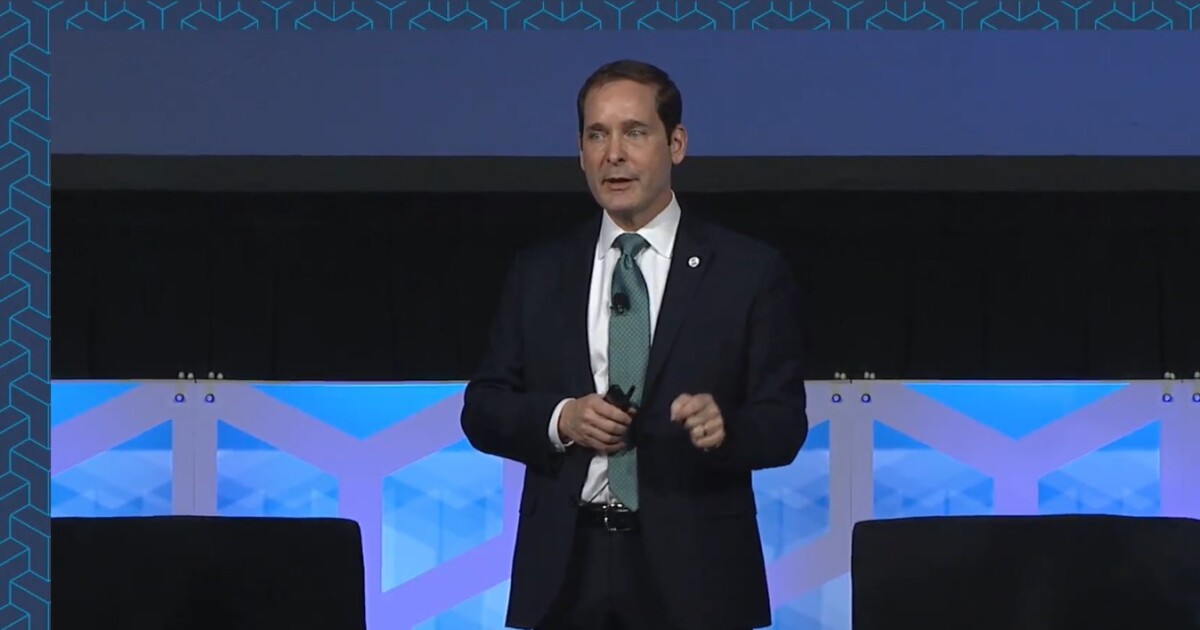
Institute of Internal Auditors president and CEO Anthony Pugliese speaking at the IIA’s General Audit Management conference in Las Vegas
The report points to the need for internal auditors to embrace advanced technology. “We can see our members all basically think technology is critical, but we’re not seeing the kind of uptake that would actually demonstrate that we’re going to be known for being technology savvy,” said Pugliese.
The report recommends internal auditors need to expand the entire scope of the work they’re doing. That aligns with a separate set of Risk in Focus studies that the IIA issued in September. “We don’t want to be only Sarbanes-Oxley or just internal controls over financial reporting, but we want to be known for these other things that a lot of our members are already doing,” said Pugliese. “Expansion of scope is important.”
Other priorities include connecting internal audit with the strategy of a company as well as growing the pipeline of internal auditors.
“When we position internal audit in front of a bunch of accounting students, the reaction is actually really positive,” said Pugliese. “They see it as a completely different path, and one that doesn’t carry the reputation negatively of public accounting, which I think they’re trying to get away from. Actually we’ve seen a lot of students get excited by the fact that they can become internal auditors and still work for a big firm. So the two can actually co-exist on their resume, on their CV, and that’s really attractive.”
Internal auditors have increasingly become fraud fighters. “We found out in our Vision project that more and more internal auditors are becoming responsible for functions other than internal audit,” said Pugliese. “What we’re seeing now is that they’re moving functions like compliance or fraud into internal audit’s bailiwick.”
Pugliese is seeing growing interest in climate change and sustainability risks.
“Last year, in 2023 our members around the world rated climate change sustainability reporting as the 14th most prevalent risk, and then this year, it moved to 13,” he said. “But in three years, our members predict it’ll be either four or five.”
The IIA released its updated Global Internal Audit Standards in January 2024 and they are set to take effect in January 2025, going deeper now on individual topics. “We started a big project that we call topical requirements, which is the first time we’ve actually started to require minimum levels of work to be done before an internal auditor can issue an assurance level opinion on certain topics,” said Pugliese. “The first one out of the gate is cyber. We think of it as a cyber standard. They have to follow it as members, but it was really because the area is somewhat mature. Cyber issues have been around since the late 1990s, early 2000s, and it’s a mature topic, but one that’s getting more and more risky over time. I think AI made that worse, so the need for standards is to ensure we’ve got a minimum level of performance occurring anywhere in the world.”
The IIA has been releasing tools to help internal auditors adjust to the updated standards. “Getting ready for the standards has been a big deal for us,” said Pugliese. “We’ve been releasing tool after tool after tool, some free, some we charge for, because the world that relies on internal audit is affected as well.”
The IIA is seeing more demand for such material as the organization expands globally. “You could pick up an internal auditor’s opinion on cyber and it would carry the same weight in Africa as it would in Latin America or North America, that there could be a level of reliance, and that’s because of all of our advocacy work, that we felt that was important,” said Pugliese. “We get out there and tell governments, you can rely on internal auditors to help you do some of this work. Having a standard around topics is not very unusual in the accounting world, but it is in the internal audit world.”
The IIA has been growing and has now crossed the 250,000-member mark. “We’ll end up this year probably at 255,000 with a lot of growth occurring in Asia and the Middle East, which is great,” said Pugliese. “We really didn’t have a strong market in the Middle East even five years ago, so we’re happy about that.”
He has been finding growing interest in Saudi Arabia, Oman and other Gulf countries, as well as parts of Asia like China and Japan. The Saudi Minister of Audit sits on the IIA’s global board.
“When they give out awards to say this is the best internal audit team of the year, or the most innovative team of the year, it’s a really big deal,” said Pugliese.
He noted that many countries around the world have what they call Supreme Audit Institutions, SAIs, and there’s an association for these Supreme Audit Institutions known as INTOSAI, the International Organization of Supreme Audit Institutions. The IIA has been getting more involved in such groups.
In the U.S., the IIA has also been working more closely with the Public Company Accounting Oversight Board after clashing last year over some parts of the PCAOB’s confirmation standard that seemed to unfairly blame internal auditors. “The standard basically stated that external audit should control the entire process, and the example they gave was that because employees like internal auditors would be more apt to change the confirmation,” said Pugliese. “We asked for what data supported that in the United States or anywhere else in the world, and we realized that they were unable to produce any data to support that.”
The IIA started a letter-writing campaign and met with four of the PCAOB’s board members, including a former internal auditor, Christina Ho. Eventually the objectionable section was deleted in the final version of the standard, and the PCAOB even apologized in the disposition of comments.
“You couldn’t ask for a better outcome,” said Pugliese. “It was no disrespect, no harm intended. But, because of that, we started a relationship and now, when they call and they want to have a really solid task force on any given topic, they’ll reach out to us for an internal auditor, and that really is nice. So it was kind of lemonade out of lemons as a result of that, but it was not a fun process to go up against the PCAOB.”
The IIA started its own political action committee last year and plans to do more advocacy work in the U.S. and abroad. “We’re introducing some advanced advocacy strategies next year to start lobbying national governments outside of the United States,” said Pugliese. “They’re not quite used to the system that we have in place, where you hire people in Washington, and they target the right people setting laws that are relevant to you, and you go talk to them, and hopefully you get an output. This is very different. We’re doing it in Africa and we’re trying to make sure that their advocacy needs are met. We’ll probably have one in the Middle East, which is very unusual, but that’s more of an informing function for the countries that are more monarchy based. You don’t typically lobby a monarchy. In Latin America as well, we’re going to start lobbying those governments to more adequately recognize what internal audit does.”
The accounting profession is undergoing a fundamental structural transition as enterprise finance departments shift from periodic month-end closes toward automated continuous accounting models. By integrating specialized machine learning algorithms directly into enterprise resource planning (ERP) platforms, chief accounting officers are transforming financial reporting from a retrospective exercise into a real-time operational asset.
The Shift from Periodic Close to Continuous Financial Reporting
Traditional accounting workflows heavily relied on manual data reconciliation, spreadsheet calculations, and multi-week closing cycles at the end of each fiscal period. In contrast, continuous accounting frameworks utilize automated software agents to process, validate, and post transactional data in real time as business activities occur.
Automated bank reconciliation tools cross-reference incoming bank feeds, invoice records, and purchase orders automatically. By resolving transactional variances instantly throughout the month, corporate accounting teams eliminate the traditional workload spikes associated with quarterly and annual closes.
Machine Learning in Audit Trails and Anomaly Detection
Advanced natural language processing (NLP) and machine learning tools are redefining internal audit and financial control environments. Automated systems analyze 100% of general ledger entries, identifying anomalous transactions, duplicate payments, and unauthorized journal entries in real time.
Rather than relying on random statistical sampling, corporate internal auditors can focus their attention on high-risk flags automatically surfaced by algorithmic monitoring platforms. This continuous risk assessment strengthens internal controls over financial reporting (ICFR) and significantly reduces fraud risk.
Evolving Roles for Accounting Professionals
As routine data entry and manual reconciliation tasks become fully automated, the skill set required for accounting professionals is shifting toward data analysis, system design, and strategic business advisory.
– Systems Governance: Accountants are increasingly responsible for monitoring algorithmic accuracy and managing data integration pipelines.
– Business Partnership: Finance professionals leverage real-time financial dashboards to advise operational leaders on margin management and working capital allocation.
– Regulatory Compliance Management: Accounting teams utilize automated platforms to ensure compliance with dynamic tax codes and international accounting standards.
Core Implementation Recommendations
1. Deploy Automated Reconciliation Tools: Integrate continuous transaction processing modules into existing enterprise ERP architectures.
2. Establish Algorithmic Governance Controls: Implement strict internal testing protocols to ensure automated accounting rules comply with GAAP/IFRS standards.
3. Reskill Accounting Teams: Invest in training finance staff on data analytics, workflow automation, and predictive financial modeling.
Corporate accounting departments face expanding reporting expectations as international sustainability disclosure standards achieve regulatory enforcement across major global jurisdictions. Chief Accounting Officers (CAOs) and corporate controllers are establishing rigorous internal accounting controls to treat Environmental, Social, and Governance (ESG) metrics with the same data precision, auditability, and governance as traditional financial statements.
Regulatory Harmonization Under Global Sustainability Frameworks
The implementation of standardized sustainability reporting frameworks—notably rules established by international sustainability accounting boards—has created unified expectations for public and large private enterprises. Corporations must report standardized metrics covering greenhouse gas emissions (Scope 1, 2, and material Scope 3), energy utilization, workforce demographics, and supply chain governance.
In Europe and other participating international jurisdictions, double materiality principles are mandatory. Under double materiality, organizations must report both how external sustainability risks impact corporate financial performance, and how internal corporate operations affect surrounding environmental and social structures.
Integrating Sustainability Metrics into Core ERP Systems
To provide auditable non-financial data, enterprise organizations are integrating specialized carbon accounting and ESG management platforms directly into core ERP systems. Automated data collectors capture energy utility invoices, logistics fuel consumption metrics, and vendor compliance records in real time.
Establishing automated, traceable data pipelines ensures that non-financial reporting is supported by clear audit trails. This structured approach allows external financial auditors to provide reasonable assurance on sustainability disclosures during annual corporate reporting cycles.
Financial Impacts and Capital Market Disclosure
Accurate ESG reporting directly influences corporate cost of capital and institutional credit ratings. Commercial lenders and institutional asset managers systematically incorporate sustainability metrics into risk pricing models. Companies that demonstrate transparent, verifiable progress in operational energy efficiency and climate risk mitigation benefit from expanded access to green bond markets and lower debt pricing.
Action Steps for Accounting Leadership
1. Implement Double Materiality Frameworks: Conduct comprehensive assessments to identify material financial and operational sustainability metrics.
2. Build Auditable Non-Financial Data Pipelines: Automate ESG data collection within core accounting software to ensure data integrity.
3. Align Sustainability with Annual Financial Filings: Prepare non-financial disclosures concurrently with financial statements to satisfy regulatory audit expectations.
Internal audit departments and corporate risk managers are modernizing internal control frameworks by shifting from periodic sampling techniques to continuous monitoring and machine learning analytics. As operational data volumes increase across enterprise organizations, automated control testing ensures financial integrity, prevents corporate fraud, and streamlines annual audit engagements.
The Limitation of Periodic Audit Sampling
Historically, internal and external auditors evaluated internal controls by reviewing random samples of financial transactions—often analyzing less than five percent of total ledger entries. In complex enterprise environments, periodic sampling methods carry inherent risks of overlooking localized financial misstatements, unauthorized disbursements, or operational control breakdowns.
In 2026, progressive internal audit functions are utilizing automated continuous monitoring platforms that evaluate one hundred percent of financial transactions in real time. Continuous control auditing systems continuously monitor general ledger entries, procurement approvals, and expense reimbursements across all operating subsidiaries.
AI-Powered Fraud Detection and Anomaly Identification
Machine learning models trained on historical corporate financial data excel at identifying subtle transactional anomalies that indicate potential fraud or operational error. Automated systems instantly flag duplicate invoice payments, unapproved vendor creation, unusual journal entry timing, and unauthorized override of authority thresholds.
When an anomaly is detected, the automated auditing platform generates an instant risk alert, allowing internal audit teams to investigate root causes immediately. Early detection prevents minor operational errors from escalating into material weaknesses in financial reporting.
Streamlining External Audit Preparation
Continuous internal control monitoring delivers significant benefits during annual external financial audits. External audit firms can review continuous audit logs and automated control testing documentation, reducing the time required for manual field testing.
This integrated approach lowers overall audit compliance fees, reduces administrative burdens on corporate accounting staff, and provides senior management and audit committees with real-time visibility into the organization’s overall risk profile.
Core Implementation Guidelines
1. Transition to 100% Data Testing: Replace legacy sampling methods with automated continuous audit monitoring systems.
2. Deploy Anomaly Detection Algorithms: Implement machine learning models to identify unauthorized transactions and operational control overrides.
3. Align Internal and External Audit Workflows: Coordinate continuous control testing protocols with external auditors to optimize annual compliance cycles.