
Accounting
Accountants tackle tariff increases after ‘Liberation Day’

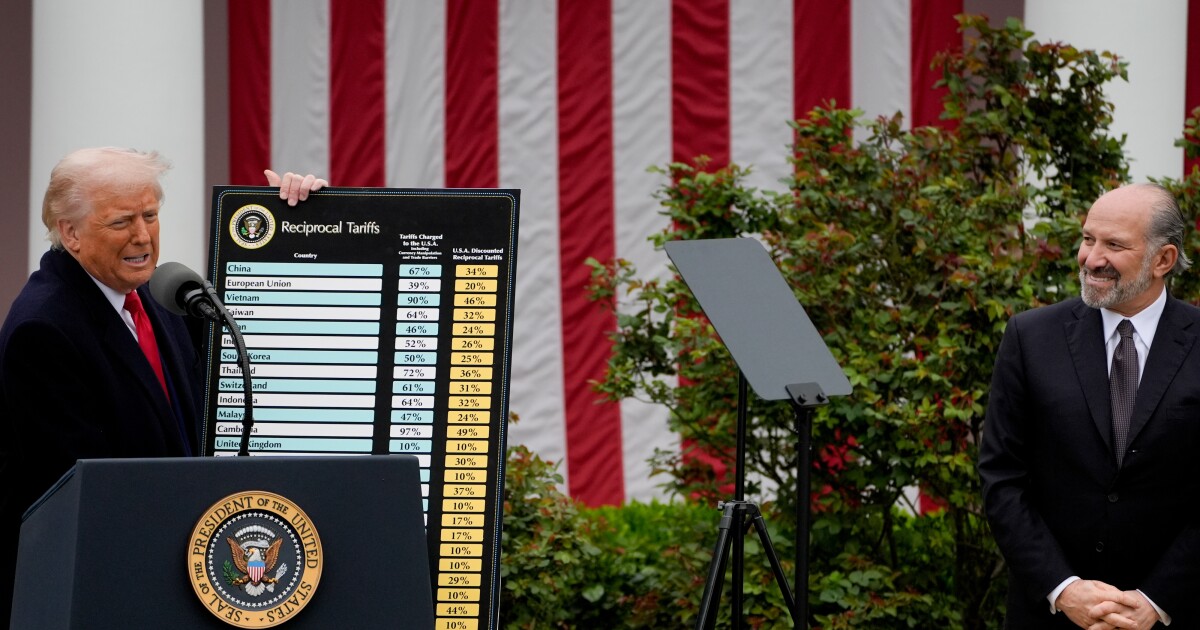

President Trump’s imposition of steep tariffs on countries around the world is likely to drive demand for accounting experts and consultants to help companies adjust and forecast the ever-changing percentages and terms.
On April 2, which Trump dubbed “Liberation Day,” he announced a raft of reciprocal tariffs of varying percentages on trading partners across the globe and signed an
“A lot of CFOs are thinking they are going to pass along the tariffs to their customer base, and about another half are thinking we’re going to absorb it and be more creative in other ways we can save money inside our company,” said Tom Hood, executive vice president for business engagement and growth at the AICPA & CIMA.
The AICPA & CIMA’s most recent
“CFOs in our community are telling us that, effectively, they’re looking at this a lot like what happened over COVID with a big disruption out of nowhere,” said Hood. “This one, they could see it coming. But the point is they had to immediately pivot into forecasting and projection with basically forward-looking financial analysis to help their companies, CEOs, etc., plan for what could be coming next. This is true for firms who are advising clients. They might be hired to do the planning in an outsourced way, if the company doesn’t have the finance talent inside to do that.”
The tariffs are not set in stone, and other countries are likely to continue to negotiate them with the U.S., as Canada and Mexico have been doing in recent months.
“The one thing that I think we can all count on is a certain amount of uncertainty in this process, at least for the next several months,” said Charles Clevenger, a principal at UHY Consulting who specializes in supply chain and procurement strategy. “It’s hard to tell if it’s going to go beyond that or not, but it certainly feels that way.”
Accountants will need to make sure their companies and clients stay compliant with whatever conditions are imposed by the U.S. and its trading partners. “This is a more complex tariff environment than most companies have experienced in the past, or that seems to be where we’re headed, and so ensuring compliance is really important,” said Clevenger.
Big Four firms are advising caution among their clients.
“Our point of view is we’re advising all of our clients to do a few things right out of the gate,” said Martin Fiore, EY Americas deputy vice chair of tax, during a webinar Thursday. “Model and analyze the trade flows. Look at your supply chain structures. Understand those and execute scenario planning on supply chain structures that could evolve in new environments. That is really important: the ability for companies to address the questions they’re getting from their C-suite, from their stakeholders, is critical. Every company is in a different spot according to the discussions we’ve had. We just are really emphasizing, with all the uncertainty, know your structure, know your position, have modeling put in place, so as we go through the next rounds of discussions over many months, you have an understanding of your structure.”
Scenario planning will be especially important amid all the unpredictability for companies large and small. “They’re going to be looking at all the different countries they might have supply chains in,” said Hood. “And then even the smaller midsized companies that might not be big, giant global companies, they might be supplying things to a big global company, and if they’re in part of that supply chain, they’ll be impacted through this whole cycle as well.”
Accountants will have to factor the extra tariffs and import taxes into their costs and help their clients decide whether to pass on the costs to customers, while also keeping an eye out for pricing among their competitors and suppliers.
“It’s just like accounting for any goods that you’re purchasing,” said Hood. “They often have tariffs and taxes built into them at different levels. I think the difference is these could be bigger and they could be more uncertain, because we’re not even sure they’re going to stick until you see the response by the other countries and the way this is absorbed through the market. I think we’re going through this period of deeper uncertainty. Even though they’re announced, we know that the administration has a tendency to negotiate, so I’m sure we’re going to see this thing evolve, probably in the next 30 days or whatever. The other thing our CFOs are reminding us of is that the stock market is not the economy.”
Amid the market fluctuations, companies and their accountants will need to watch closely as the rules and tariff rates fluctuate and ensure they are complying with the trading rules. “Do we have country of origin specified properly?” said Clevenger. “Are we completing the right paperwork? When there are questions, are we being responsive? Are we close to our broker? Are we monitoring our customs entries and all the basic things that we need to do? That’s more important now than it has been in the past because of this increase in complexity.”





U.S.-China AI Competition Intensifies as Washington Pushes Allies to Choose Sides

Nvidia’s Potential $3 Billion SB Energy Investment Could Reshape AI Infrastructure

U.S. Retail Sales Fall for the First Time in Nine Months as Consumer Spending Slows

Armanino adds Strategic Accounting Outsourced Solutions

New 2023 K-1 instructions stir the CAMT pot for partnerships and corporations

Tax Strategy: Employee Retention Credit update
-
 Economics1 week ago
US Inflation Matches Wall Street Projections as Core CPI Cools to 2.5%: Key Implications for Economy and Markets
-
 Economics6 days ago
U.S. Retail Sales Fall for the First Time in Nine Months as Consumer Spending Slows
-

 Economics1 week ago
Macroeconomic Impact of Global Energy Shocks and Shipping Route Realignment in 2026
-

 Accounting1 week ago
AI-Driven Automation and Continuous Accounting Frameworks
-

 Finance1 week ago
Cross-Border Settlement Innovation and Real-Time Payment Architecture
-

 Personal Finance1 week ago
Navigating Residential Real Estate and Mortgage Strategy
-
 Economics4 days ago
Nvidia’s Potential $3 Billion SB Energy Investment Could Reshape AI Infrastructure
-

 Technology1 week ago
The Shift to On-Device Edge AI and Advanced Microprocessor Architecture in 2026