
Accounting
Business leaders see risks in economy, cyber threats and talent

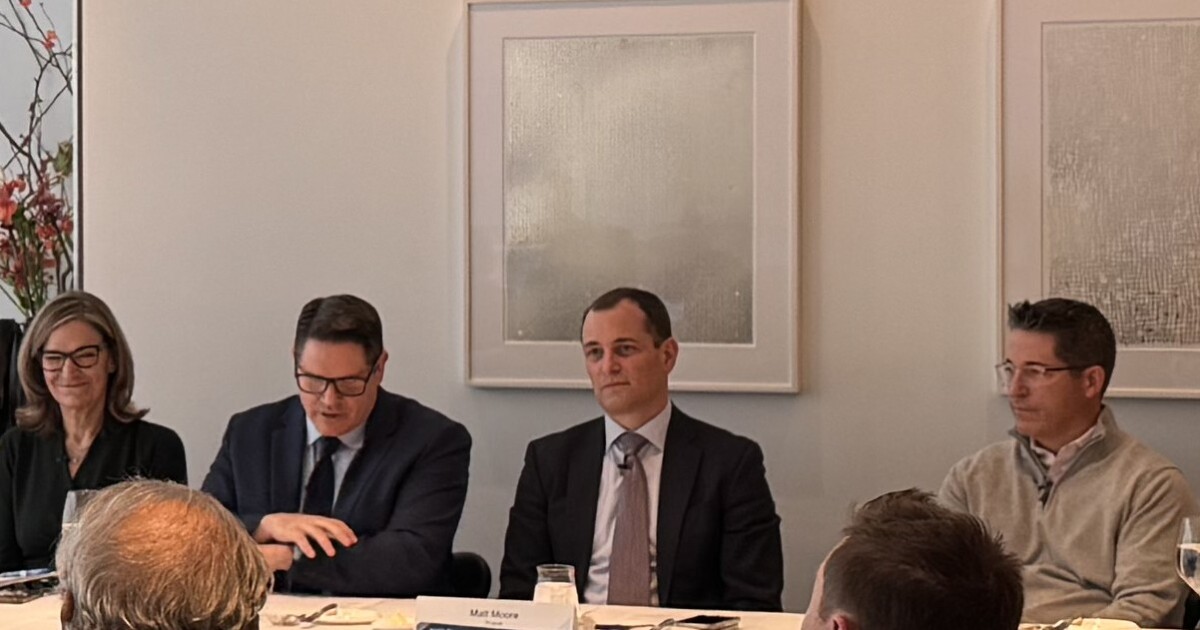

The economy is the No. 1 risk cited by a group of business leaders, according to a new
When asked about the most pressing business risks over the next two to three years, as well as a decade later, the 1,215 board members and C-suite executives who responded to the survey believe economic uncertainty and volatility will persist as leaders grapple with inflation, tariffs, geopolitical upheaval, growth in AI and other emerging technologies, and upcoming policy changes from new administrations globally.
“It’s really difficult to silo these risks,” said Joe Kornik, senior director of editorial programs at Protiviti, during a panel discussion. “As business becomes more interconnected, the risks themselves also become more interconnected. The pace of change continues to accelerate, and one of the notable changes from previous years of the survey is that business leaders are feeling more battle tested, a little more resilient and a little bit more confident in their ability to operate amid uncertainty and volatility. It’s certainly a skill set that I think will bode well for those business leaders, certainly in 2025 and I suspect, well into the future, as long as those business organizations stay resilient to change and to uncertainty.”
The top 10 global risks over the next two to three years:
1. Economic conditions, including inflationary pressures;
2. Cyber threats ;
3. Ability to attract, develop and retain top talent, manage shifts in labor expectations, and address succession challenges;
4. Talent and labor availability;
5. Increases in labor costs;
6. Heightened regulatory change, uncertainty and scrutiny;
7. Third-party risks;
8. Rapid speed of disruptive innovations enabled by new and emerging technologies and/or other market forces;
9. Adoption of AI and other emerging technologies requiring new skills in short supply;
10. Emergence of new risks from implementing artificial intelligence.
This is the 13th annual survey for Protiviti and North Carolina State. “We do a lot of sub-analysis on this report, and particularly dive deeper into differences in perspective by position,” said Dr. Mark Beasley, professor of enterprise risk management, director of North Carolina State University’s ERM Initiative and co-author of the report. “What are board members thinking versus a CEO versus a CFO?”
Boards and C-suite leaders ranked cyber threats as the second most concerning risk over the next two to three years, outranked only by the economy. Cyber threats also represent the most cited long-term operational risk for executives, with 31% selecting it among their two most concerning operational risk issues for the next decade.
“We’ve come out of a period of tremendous change and volatility,” said Julia Coronado, president and founder of MacroPolicy Perspectives. “The pandemic presented challenges to businesses and to macroeconomic policy makers that we hadn’t even imagined before. Then we recovered from that, and now we have a shift in policy from a change in administration that’s presenting a whole new set of crosscurrents and potential changes.”
The study asked respondents to rank their top two risks a decade out across three risk categories:
Macroeconomic risk outlook:
1. Economic conditions, including inflationary pressures;
2. Talent and labor availability.
Strategic risk outlook:
1. Heightened regulatory change, uncertainty and scrutiny;
2. Rapid speed of disruptive innovations enabled by new and emerging technologies and/or other market forces.
Operational risk outlook:
1. Cyber threats;
2. Ability to attract, develop and retain top talent, manage shifts in labor expectations, and address succession challenges.
“It’s pretty common practice for organizations to subject themselves to stress tests on their operations, their financials, and they typically do that by running multiple scenarios and introducing a discrete set of shocks,” said Matt Moore, global leader of risk and compliance at Protiviti. “I was speaking with a client recently who said, for all the planning that we did and stress testing in even our most adverse scenarios, we never contemplated what we’re considering: the shock and awe scenario of everything hitting all at once from all different directions, and there being such uncertainty around what will stick and what will go.”
Protiviti plans to host a





U.S.-China AI Competition Intensifies as Washington Pushes Allies to Choose Sides

Nvidia’s Potential $3 Billion SB Energy Investment Could Reshape AI Infrastructure

U.S. Retail Sales Fall for the First Time in Nine Months as Consumer Spending Slows

Armanino adds Strategic Accounting Outsourced Solutions

New 2023 K-1 instructions stir the CAMT pot for partnerships and corporations

Tax Strategy: Employee Retention Credit update
-

 Economics1 week ago
US Inflation Matches Wall Street Projections as Core CPI Cools to 2.5%: Key Implications for Economy and Markets
-
 Economics6 days ago
U.S. Retail Sales Fall for the First Time in Nine Months as Consumer Spending Slows
-

 Economics7 days ago
Macroeconomic Impact of Global Energy Shocks and Shipping Route Realignment in 2026
-

 Accounting7 days ago
AI-Driven Automation and Continuous Accounting Frameworks
-

 Finance7 days ago
Cross-Border Settlement Innovation and Real-Time Payment Architecture
-
 Personal Finance7 days ago
Navigating Residential Real Estate and Mortgage Strategy
-
 Economics4 days ago
Nvidia’s Potential $3 Billion SB Energy Investment Could Reshape AI Infrastructure
-
 Technology7 days ago
The Shift to On-Device Edge AI and Advanced Microprocessor Architecture in 2026