
Accounting
House passes tax administration bills

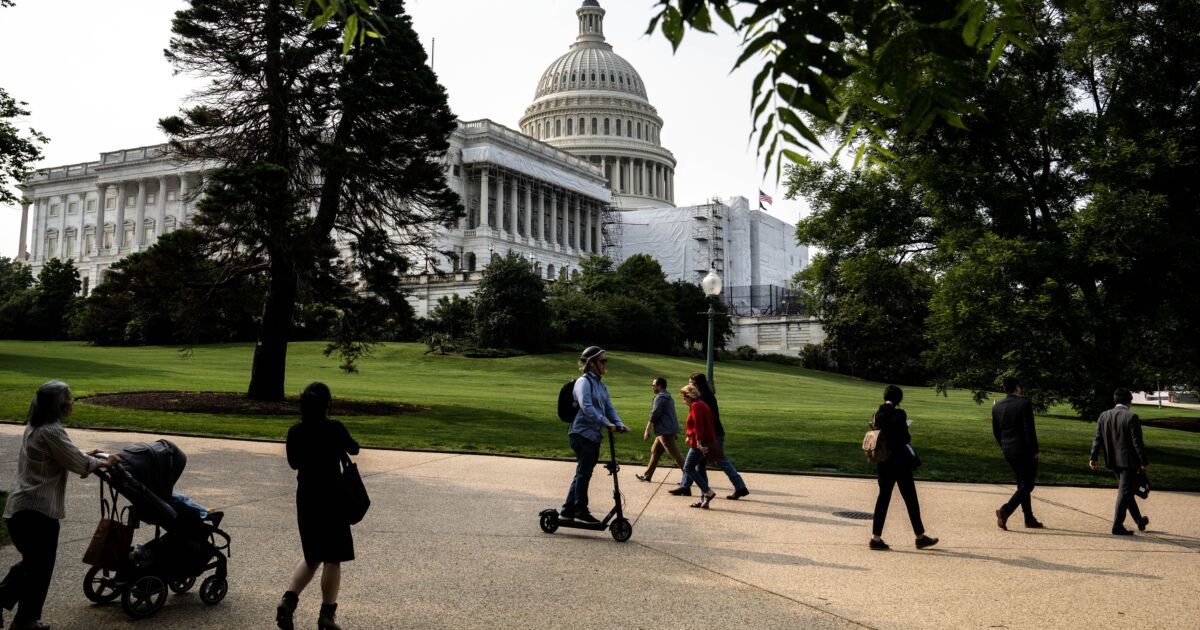

The House unanimously passed four bipartisan bills Tuesday concerning taxes and the Internal Revenue Service that were all
- H.R. 1152, the Electronic Filing and Payment Fairness Act, sponsored by Rep. Darin LaHood, R-Illinois, Suzan Delbene, D-Washington, Randy Feenstra, R-Iowa, Brad Schneider, D-Illinois, Brian Fitzpatrick, R-Pennsylvania and Jimmy Panetta, D-California. The bill would apply the “mailbox rule” to electronically submitted tax returns and payments to allow the IRS to record payments and documents submitted to the IRS electronically on the day the payments or documents are submitted instead of when they are received or reviewed at a later date. The AICPA believes this would offer clarity and simplification to the payment and document submission process while protecting taxpayers from undue penalties.
- H.R. 998, the Internal Revenue Service Math and Taxpayer Help Act, sponsored by Rep. Randy Feenstra, R-Iowa, and Brad Schneider, D-Illinois, which would require notices describing a mathematical or clerical error to be made in plain language, and require the Treasury to provide additional procedures for requesting an abatement of a math or clerical error adjustment, including by telephone or in person, among other provisions.
- H.R. 517, the Filing Relief for Natural Disasters Act, sponsored by Rep. David Kustoff, R-Tennessee, and Judy Chu, D-California. The process of receiving tax relief from the IRS following a natural disaster typically must follow a federal disaster declaration, which can often come weeks after a state disaster declaration. The bill would provide the IRS with authority to grant tax relief once the governor of a state declares either a disaster or a state of emergency and expand the mandatory federal filing extension under Section 7508(d) of the Tax Code from 60 days to 120 days, providing taxpayers with more time to file tax returns after a disaster.
- H.R. 1491, the Disaster related Extension of Deadlines Act, sponsored by Rep. Gregory Murphy, R-North Carolina, and Jimmy Panetta, D-California, would extend the amount of time disaster victims would have to file for a tax refund or credit (i.e., the lookback period) by the amount of time afforded pursuant to a disaster relief postponement period for taxpayers affected by major disasters. This legislative solution would place taxpayers on equal footing as taxpayers not impacted by major disasters and would afford greater clarity and certainty to taxpayers and tax practitioners regarding this lookback period.
“The AICPA has long supported these proposals and will continue to work to advance comprehensive legislation that enhances IRS operations and improves the taxpayer experience,” said Melanie Lauridsen, vice president of tax policy and advocacy for the AICPA, in a statement Tuesday. “We are pleased to work closely with each of these Representatives on common-sense reforms that will benefit taxpayers, tax practitioners and tax administration and we’re encouraged by their passage in the House. We look forward to continuing to work with Congress to improve the taxpayer experience.”
The bills were also included in a recent Senate
The House also passed two other tax-related bills Tuesday that weren’t endorsed in the recent AICPA letter.
- H.R. 1155, Recovery of Stolen Checks Act, sponsored by Rep. Nicole Malliotakis, R-New York, would require the IRS to create a process for taxpayers to request a replacement via direct deposit for a stolen paper check. If a check is determined to be stolen or lost, and not cashed, a taxpayer will receive a replacement check once the original check is cancelled, but many taxpayers are having their replacement checks stolen as well. Taxpayers who have a check stolen are then unable to request that the replacement check be sent via direct deposit. The bill would require the Treasury to establish processes and procedures under which taxpayers, who are otherwise eligible to receive an amount by paper check in replacement of a lost or stolen paper check, may elect to receive such amount by direct deposit.
- H.R. 997, National Taxpayer Advocate Enhancement Act, sponsored by Rep. Randy Feenstra, R-Iowa, would prevent IRS interference with National Taxpayer Advocate personnel by granting the NTA responsibility for its attorneys. In advocating for taxpayer rights, the National Taxpayer Advocate often requires independent legal advice. But currently, the staff members hired by the National Taxpayer Advocate are accountable to internal IRS counsel, not the Taxpayer Advocate, creating a potential conflict of interest to the detriment of taxpayers. The bill would authorize the National Taxpayer Advocate to hire attorneys who report directly to her, helping establish independence from the IRS.
House Ways and Means Committee Chairman Jason Smith, R-Missouri, applauded the bipartisan House passage of the various bills, which had been unanimously passed by the committee.
“President Trump was elected on the promise of finally making the government work better for working people,” Smith said in a statement Tuesday. “This bipartisan legislation helps fulfill that mandate and makes improvements to tax administration that will make it easier for the American people to file their taxes. Those who are rebuilding after a natural disaster particularly need help filing taxes, which is why this set of bills lightens the load for taxpayers in communities struck by a hurricane, tornado or some other disaster. With Tax Day just a few days away, we must look for common-sense, bipartisan ways to make filing taxes less of a hassle.”





How to understand Intel $15B Stock Offering

Economic Profile of the United States of America (2026–2030 Horizon)

Top 10 Largest Economies by 2030: IMF & World Bank GDP Projections for Global Powerhouses

Armanino adds Strategic Accounting Outsourced Solutions

New 2023 K-1 instructions stir the CAMT pot for partnerships and corporations

Tax Strategy: Employee Retention Credit update
-

 Economics7 days ago
U.S. Retail Sales Fall for the First Time in Nine Months as Consumer Spending Slows
-

 Finance1 week ago
Cross-Border Settlement Innovation and Real-Time Payment Architecture
-

 Accounting1 week ago
AI-Driven Automation and Continuous Accounting Frameworks
-

 Economics1 week ago
Macroeconomic Impact of Global Energy Shocks and Shipping Route Realignment in 2026
-

 Personal Finance1 week ago
Navigating Residential Real Estate and Mortgage Strategy
-

 Economics5 days ago
Nvidia’s Potential $3 Billion SB Energy Investment Could Reshape AI Infrastructure
-

 Leaders1 week ago
Modern Executive Leadership: Navigating Hybrid Work Dynamics and Outcome-Based Governance
-
 Economics13 hours ago
Top 10 Largest Economies by 2030: IMF & World Bank GDP Projections for Global Powerhouses