Connect with us

Personal Finance

How Republican ‘one big beautiful bill’ targets immigrant finances

Published

on

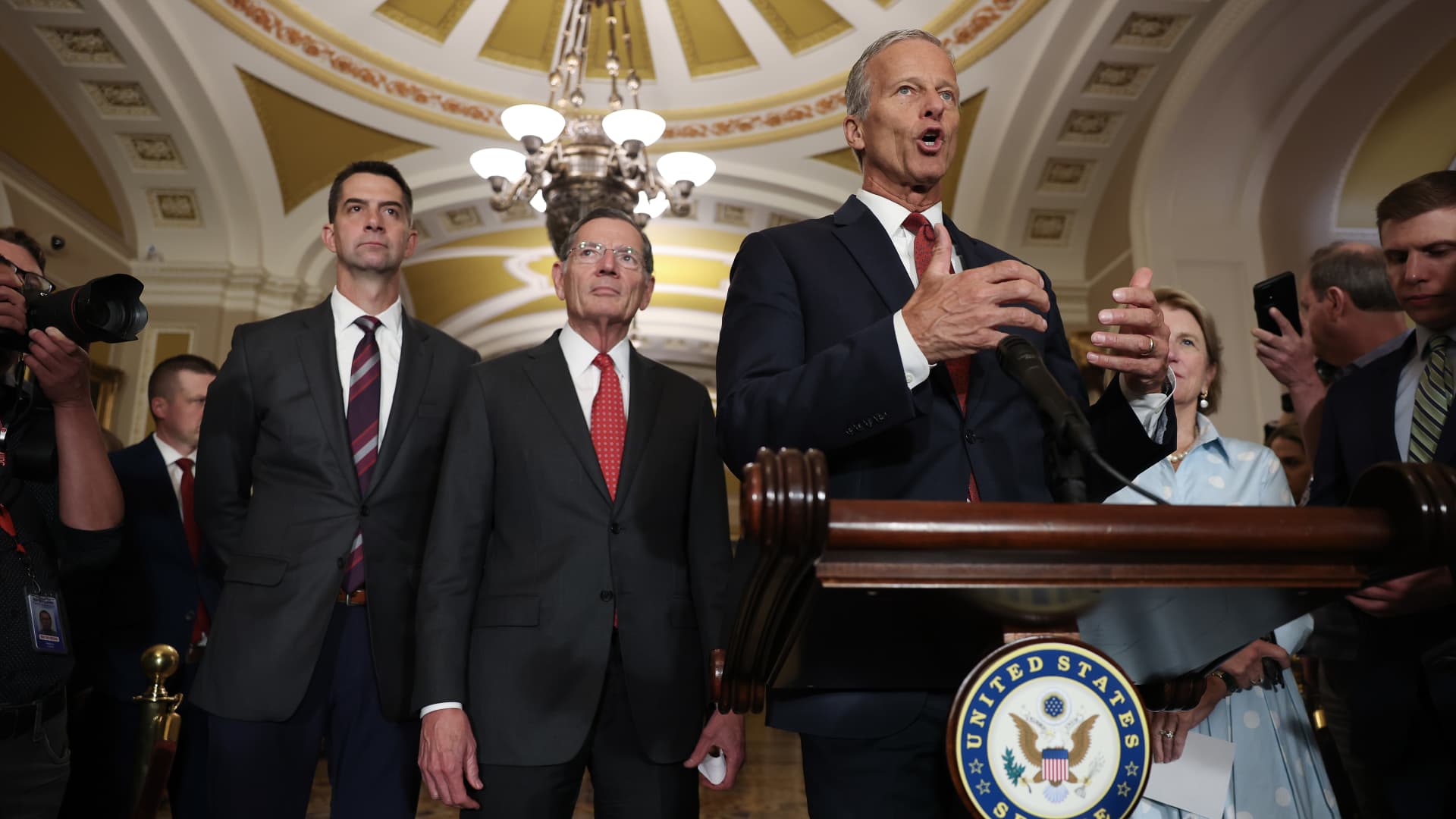
Senate Majority Leader John Thune (R-SD) speaks to reporters at Capitol Hill on June 24, 2025 in Washington.

Tasos Katopodis | Getty Images News | Getty Images

A Republican megabill that lawmakers are trying to pass by the Fourth of July would clamp down on the finances of immigrant households, including those in the U.S. legally, economists and policy experts said.

The legislation, championed by President Donald Trump, would restrict access to tax benefits like the child tax credit. Republican lawmakers in the House and Senate have also included a tax on the money immigrants send abroad, called remittances, and a $1,000 fee for those who seek asylum.

The provisions “make life harder for immigrants in the U.S., both legal and undocumented immigrants,” said Tara Watson, director of the Center for Economic Security and Opportunity at the Brookings Institution.

“I think this will make a significant difference” in their financial lives, Watson said.

More from Personal Finance:
GOP megabill proposes new Medicaid work requirements
House, Senate tax bills both end many clean energy credits
GOP bill may add to medical debt for households

The Republican-majority House Judiciary Committee, chaired by Rep. Jim Jordan, R-Ohio, said in a statement last month that some of the financial measures aim to make immigration services “self-sustaining.”

“This is about providing resources to enforce our immigration laws … and implement responsible fiscal policy,” the committee said.

Republicans are cutting safety net spending more broadly to help finance their so-called one big beautiful bill, the centerpiece of which is a multitrillion-dollar package of tax cuts. The benefits of those largely accrue to wealthy households, data shows.

The cuts also come as the Trump administration pursues an aggressive deportation agenda.

House GOP tax bill would add $2.8 trillion to U.S. deficit, CBO says: What it means for the economy

The legislation is still in flux and differs somewhat between House and Senate versions. The Senate may vote on its measure as soon as this week.

In some cases, GOP lawmakers may not be able to restrict benefits to the extent they’d like.

For example, the Senate parliamentarian, a nonpartisan procedural advisor, ruled in recent days that the GOP must strip a provision from the legislation that would curb some immigrants’ eligibility for Supplemental Nutrition Assistance Program benefits, formerly known as food stamps.

The parliamentarian also dealt a blow to Republicans’ proposals to deny certain legal immigrants from federal health benefits, according to a Senate Budget Committee release on Thursday. The bill text included provisions to cut access to Medicaid, Medicare and Affordable Care Act insurance subsidies from refugees and individuals seeking asylum, among others.

It’s unclear how Republicans may alter the legislation to reconcile these rulings.

Barring immigrants from tax benefits

A view of the Internal Revenue Service (IRS) building in Washington, D.C., U.S., February 16, 2025.

Annabelle Gordon | Reuters

Among the most impactful tax changes is one that would restrict the child tax credit, Watson said.

A 2017 tax law enacted during Trump’s first term barred parents from claiming the credit for children who don’t have a Social Security number. The House and Senate would make this provision permanent, impacting an estimated 1 million children.

GOP lawmakers would further cut access for kids whose parents don’t have a Social Security number. The change would “exclusively” impact kids who are U.S. citizens or legal residents, according to the Institute on Taxation and Economic Policy.

The House bill’s language on this issue is stricter than the Senate, Watson said.

In the House bill, kids would be ineligible for the credit if either of their parents doesn’t have a Social Security number, she said. The Senate would allow a child to receive the benefit if at least one parent has a work-eligible SSN.

The House bill’s policy would cut access to about 4.5 million children with Social Security numbers, according to the Center for Migration Studies.

The five states in which the largest estimated number of kids would be impacted are California (910,000), Texas (875,000), Florida (247,000), New York (226,000) and Illinois (196,000), the center said.

Parents and caregivers with the Economic Security Project gather outside the White House to advocate for the Child Tax Credit in advance of the White House Conference on Hunger, Nutrition, and Health on Sept. 20, 2022.

Larry French | Getty Images Entertainment | Getty Images

“If a U.S. citizen is married to an undocumented immigrant, or if a citizen child has an undocumented parent, then the House bill considers the citizen to have forfeited their right to a range of tax breaks,” ITEP researchers Carl Davis and Sarah Austin wrote in an analysis in May.

Beyond the child tax credit, those also include existing tax breaks like the American Opportunity Tax Credit and Lifetime Learning Credit and new benefits proposed in the legislation, from so-called Trump accounts to tax breaks for tips and overtime, experts said.

Many immigrants are members of such mixed-status families, Davis and Austin wrote.

The policy debate comes as the Trump administration is trying to end birthright citizenship, the precedent that anyone born on U.S. soil automatically gets citizenship at birth. The Supreme Court is expected to soon rule on the policy.

The House bill also requires all parents to file a joint tax return if they are married and claiming the child tax credit, according to the National Immigration Law Center.

This provision would also impact nonimmigrant households in which married couples typically file separate tax returns, as happens if one spouse has substantial student loan debt or has been a victim of identity theft, for example, Davis and Austin wrote.

Tax on remittances

A man works on the street exchanging dollars for lempiras (official Honduran currency) in Tegucigalpa on April 8, 2024. Guatemala, El Salvador, Honduras, and Nicaragua together received almost US$42 billion in family remittances in 2023, according to AFP calculations based on official data from central banks and the intergovernmental Central American Monetary Council, a record figure that represents a quarter of the combined GDP of these countries.

Orlando Sierra | Afp | Getty Images

Republicans would put a tax on “remittances.” These are transfers of money such as earnings to family members and others abroad.

Remittances have been “growing rapidly” and have become the largest source of foreign income for many developing countries, Dilip Ratha, lead economist for migration and remittances at the World Bank, wrote in 2023.

India, Mexico, China, the Philippines and Pakistan are the top five recipients for global remittances, according to World Bank data from last year. The U.S. was the largest source of global remittances in 2023, it said.

The House and Senate bills would put a 3.5% tax on remittances, to be paid by the sender.

Such taxes would come on top of remittance fees that providers like banks or money transfer services like Western Union already charge to send money abroad electronically. Such fees can be high, perhaps 10% or more, Ratha wrote.

There are some differences. For example, the House would require this tax for all noncitizens, while the Senate would do so for those without Social Security numbers, according to the National Immigration Law Center. Others would be able to claim a tax credit for any taxes they pay on remittances.

Rep. Jason Smith: Senate can't make 'fatal changes' to GOP reconciliation bill

New fees for asylum, other applicants

The Senate and House bills would add fees for immigrants who apply for asylum or interact with many other levers of the U.S. immigration system.

According to the National Immigration Law Center, the fees include, among others:

  • A $1,000 application fee for asylum, a protection that lets individuals remain in the U.S. instead of being deported to a nation where they fear persecution or harm. (There’s no current fee.)
  • Asylees would need to pay at least another $550 every six months to get work authorization. (There’s no current fee.)
  • A $500 application fee for Temporary Protected Status. (The current fee is $50 and another $30 for biometrics.)
  • A $5,000 fee for anyone apprehended between ports of entry and determined inadmissible. (There’s no current fee.)

These are minimum fees without waivers, and the legislation provides for regular annual increases, according to the National Immigration Law Center.


Continue Reading
Click to comment

Leave a Reply

Your email address will not be published. Required fields are marked *

Personal Finance

What that means for consumer loans

Published

on

Fed in 'neutral' as consumers are feeling okay but not great: The Conference Board CEO Steve Odland

The Federal Reserve held interest rates steady at the conclusion of its policy meeting on Wednesday. 

In what could be Jerome Powell’s last as chair before President Donald Trump’s yet-to-be-confirmed nominee Kevin Warsh takes the helm, central bankers maintained the federal funds rate in a target range of 3.5% to 3.75%. 

Inflation has surged since the war with Iran began, leaving policymakers with limited room to act, according to Sean Snaith, the director of the University of Central Florida’s Institute for Economic Forecasting. “We’re in a kind of suspended animation — between Iran and the Fed transition,” Snaith said.

Read more CNBC personal finance coverage

Before the oil shock, inflation was holding above the Fed’s 2% target but not worsening. Now the jump in energy costs could have longer-term inflationary effects, economists say.

For Americans struggling in the face of higher gas prices and overall affordability challenges, the central bank’s decision to keep interest rates unchanged does little to ease budgetary pressures. “The cavalry isn’t coming anytime soon,” Snaith said.

How the Fed decision impacts you

The Fed’s benchmark sets what banks charge each other for overnight lending, but also has a trickle-down effect on many consumer borrowing and savings rates.

Short-term rates are more closely pegged to the prime rate, which is typically 3 percentage points above the federal funds rate. Longer-term rates, such as home loans, are more influenced by inflation and other economic factors.

Credit cards

Most credit cards have a short-term rate, so they track the Fed’s benchmark.

After the Fed cut rates three times in the second half of 2025, the average annual percentage rate has stayed just under 20%, according to Bankrate.

“Without Fed rate cuts, there’s not much reason to expect meaningful declines anytime soon, so carrying a balance will remain very expensive,” said Matt Schulz, chief credit analyst at LendingTree. 

Mortgage rates

Fixed mortgage rates, on the other hand, don’t directly track the Fed but typically follow the lead of long-term Treasury rates. 

Concerns about how the Iran war will impact the U.S. economy have already pushed the average rate for a 30-year, fixed-rate mortgage up to 6.38% as of Tuesday, from 5.99% at the end of February, according to Mortgage News Daily.

That leaves homeowners with existing low mortgage rates “feeling stuck,” said Michele Raneri, vice president and head of U.S. research and consulting at TransUnion. “Mortgages, more than any other credit type, work on a churn,” she said, referring to how a dip in rates can boost borrowing activity.

Student loans

Federal student loan rates are also fixed and based in part on the 10-year Treasury note, so most borrowers are somewhat shielded from Fed moves and recent economic uncertainty.

Current interest rates on undergraduate federal student loans made through June 30 are 6.39%, according to the U.S. Department of Education. Interest rates for the upcoming school year will be based in part on the May auction of the 10-year note.

Car loans

Auto loan rates are tied to several factors, including the Fed’s benchmark. Because financing costs remain elevated, new car buyers are taking on longer loans to keep their monthly payments manageable, according to the latest data from Edmunds.

Even so, with the rate on a five-year new car loan near 7%, the average monthly payment on a new car rose to $773 in the first quarter of 2026, an all-time high.

“Car buyers are in a tough spot right now because they’re getting squeezed from both ends: high sticker prices and high interest rates, with neither showing any signs of letting up,” said Joseph Yoon, consumer insights analyst at Edmunds.

“Until the rate picture shifts, buyers will keep stretching loan terms to make payments work, which only adds to the total cost of ownership down the road,” Yoon said.

Savings rates

While the Fed has no direct influence on deposit rates, the yields tend to be correlated with changes in the target federal funds rate. So, although rates on certificates of deposit and high-yield savings accounts have fallen from recent highs, they are holding above the annual rate of inflation.

For now, top-yielding online savings accounts and one-year CD rates pay around 4%, according to Bankrate.

“Yields on high-yield savings accounts and certificates of deposit are down from their peaks of a few years ago, but they’re still strong compared to what we’ve seen for most of the past decade,” Schulz said.

Subscribe to CNBC on YouTube.

Choose CNBC as your preferred source on Google and never miss a moment from the most trusted name in business news.

Continue Reading

Personal Finance

Average tax refund is 11.2% higher, latest IRS filing data shows

Published

on

Milan Markovic | E+ | Getty Images

The average tax refund is 11.2% higher this season, compared with about the same period in 2025, according to the latest IRS filing data.

As of April 10, the average refund amount for individual filers was $3,397, up from $3,055 about one year ago, the IRS reported on Friday.

The IRS data reflects about 114 million individual returns received, out of about 164 million expected through Tax Day. Next week’s filing update is expected to include data through the April 15 deadline.

Read more CNBC personal finance coverage

President Donald Trump‘s 2025 legislation, rebranded to the “working families tax cuts,” was a key talking point for Republicans on Tax Day.

With the November midterm elections approaching and Republicans defending slim majorities in Congress, many GOP lawmakers have highlighted Trump’s tax breaks and higher average refunds.

Meanwhile, affordability has been top of mind for many Americans amid rising costs of gas, electricity, food and other living expenses.

For filers who expected a refund this season, nearly one-quarter, or 23%, planned to use the funds to pay down credit card debt, and the same share said they would save the payment, according to the CNBC and SurveyMonkey Quarterly Money Survey, released in April. It polled 3,494 U.S. adults at the end of March.

Who benefited from Trump’s ‘big beautiful bill’ 

“It’s been a great tax season for the American people,” many of whom have benefited from Trump’s tax breaks, Treasury Secretary Scott Bessent said during a White House press briefing on Wednesday. 

More than 53 million filers claimed at least one of Trump’s “signature new tax cuts” — the deductions for tip income, overtime earnings, seniors and auto loan interest — the Department of the Treasury also announced on Wednesday.

Those filers, who claimed the deductions on Schedule 1-A, have seen an average tax cut of over $800, according to the Treasury. Tax cuts can trigger a higher refund or reduce taxes owed, depending on the filer’s situation. 

Tax refunds are higher on average this year than last, according to the IRS: Here's what to know

Some filers who itemize tax breaks have also seen benefits from the bigger federal deduction limit for state and local taxes, known as SALT. Trump’s legislation raised that cap to $40,000, up from $10,000, for 2025.

The latest SALT deduction limit change is expected to primarily benefit higher earners, according to a May 2025 analysis of various proposals from the Tax Foundation.

The Treasury has not released data on how many filers have claimed the SALT deduction during the 2026 filing season. 

Choose CNBC as your preferred source on Google and never miss a moment from the most trusted name in business news.

Continue Reading

Personal Finance

Stocks have touched record highs despite Iran war. Here’s why

Published

on

Traders work at the New York Stock Exchange on April 16, 2026.

NYSE

U.S. stocks climbed to record highs on Thursday against a backdrop of war, an oil supply shock and economic forecasts warning of stunted growth amid a protracted conflict.

Many investors may be thinking: Why?

Largely, it’s because the stock market is a barometer of what investors think will happen in the future, rather than an assessment of the present day, according to economists and market analysts.

Investors are essentially shrugging off the Middle East conflict as a blip that will be resolved relatively quickly, they said.

“The stock market isn’t trying to price what’s happening today,” said Joe Seydl, a senior markets economist at J.P. Morgan Private Bank. “The stock market is always trying to price what the world is going to look like six to 12 months from now.”

Why stocks have been ‘resilient’

The S&P 500, a U.S. stock index, fell about 8% in the initial weeks of the Iran war, from the start of the conflict on Feb. 28 to a recent low on March 30.

But stocks have rebounded since then, erasing all losses since the beginning of the war. The S&P 500 closed at an all-time high on Thursday — about 11% higher than its nadir at the end of March. That followed a record close on Wednesday.

“The market has remained very resilient in the face of the war and has rallied strongly on the prospect that it will be resolved,” said Mark Zandi, chief economist at Moody’s.

Tom Lee: Stock market is in better position now than the all-time highs earlier this year

A ship waits to pass through the Strait of Hormuz following the two-week temporary ceasefire between the US and Iran, which is conditional on the opening of the strait, in Oman on April 8, 2026.

Shady Alassar | Anadolu | Getty Images

And while investors cheered the possibility of a diplomatic off-ramp to the conflict, the temporary ceasefire has appeared tenuous, with the U.S. and Iran each accusing the other of breaking the agreement.

Nations haven’t been able to reach a peace deal ahead of the ceasefire’s end. Vice President JD Vance said ​U.S. officials ⁠left peace talks in Pakistan over the weekend after the Iranian delegation refused to agree to American demands not to develop a nuclear weapon.

The markets ‘have memory’

Read more CNBC personal finance coverage

Economists pointed to a recent example of this dynamic: in April 2025 during so-called liberation day, when the Trump administration levied a host of tariffs on U.S. trading partners.

Within days — after the stock market had cratered more than 12% — Trump announced a 90-day pause on those tariffs. Stocks then saw one of their biggest daily rallies in history following Trump’s reversal.

Investors remember that Trump often de-escalates geopolitical shocks — which is why they’ve seized on positive headlines that hint at progress in peace talks, for example, Seydl said.

“The markets have memory,” Seydl said.

AI stocks and the ‘tech boom’

Traders celebrating at the New York Stock Exchange on April 15, 2026, as the S&P 500 closed above the 7,000 level for the first time.

NYSE

There are other factors underpinning market resilience during wartime, economists said.

One is the investors’ enthusiasm for artificial intelligence and technology stocks, which account for almost half of the S&P 500’s market capitalization, Zandi said.

“Those stocks run on their own dynamic independent of anything, including the war in Iran,” Zandi said. “I think we would have been down a lot more and it would have been harder for us to recover had it not been for the very, very optimistic perspectives on AI.”

We’re in the middle of a “tech boom” — and investors are likely to remain optimistic until they think the tech cycle has run its course, Seydl said.

How to build an investing playbook at record highs

More broadly, stock investors are essentially making a bet on the future earnings growth of a company — and the earnings backdrop has been “pretty solid,” Seydl said.

Consumer spending appears to be stable, for example, economists said. And companies are getting a boost to their after-tax earnings from the GOP’s so-called “big beautiful bill,” which, among other things, made it easier to write off investments upfront and therefore reduce their tax liability, Zandi said.

Going forward

Even if the conflict is short-lived — as the broad market expects — stocks are unlikely to march much higher until it’s clear the U.S. is on the other side of the war and its economic fallout, Zandi said.

If investors are incorrect, and President Trump doesn’t back down or quickly extricate the U.S. from the war, the stock market may see a “full-blown correction” or worse, Zandi said. A stock market correction is a decline of at least 10% from recent highs.

“Everyone thinks they know what the script is,” Zandi said. “Now they just need to follow the script. If they don’t, the market will have some real problems.”

The uncertainty provides yet another example of why the average investor with a long time horizon should stick to their investment plan and ignore the noise, experts said.

“Trying to time the market is very difficult if not impossible for the average investor,” Seydl said. “It’s better to take a long-term perspective and ride out bouts of volatility.”

Choose CNBC as your preferred source on Google and never miss a moment from the most trusted name in business news.

Continue Reading

Trending