
Accounting
Taxpayers can get disaster tax relief through personal casualty loss deductions

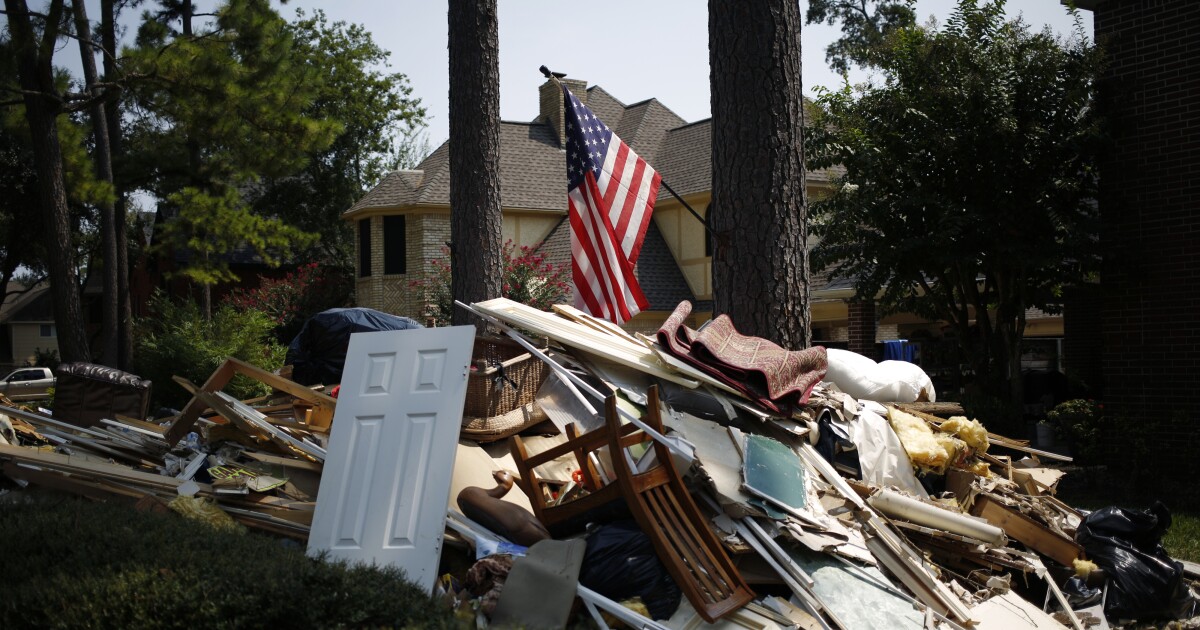

The pace of natural disasters seems to be accelerating with climate change, prompting taxpayers and tax preparers to search for ways to deduct catastrophic losses.
The Federal Disaster Tax Relief Act of 2023, which Congress actually passed in December 2024, enables taxpayers who have been affected by federally declared disasters to deduct personal casualty losses without itemizing deductions and without the typical reduction of $100 per casualty loss and 10% of adjusted gross income. Instead, the deduction would be reduced by $500 per casualty loss. The tax relief applies to any area where the president declared a major disaster between Jan. 1, 2020, and Feb. 10, 2025. The Internal Revenue Service recently clarified in its
“We have questions coming in from California all the way down to Florida about whether or not a local or a regional disaster is eligible for tax relief,” said Mike Smith, a principal at Top 10 Firm
The new rules are more expansive. “Because of all the hurricane activity that has been happening over the last two or three years, Congress finally passed the Federal Disaster Relief Act of 2023, and that reinstated a special category of losses known as qualified disaster losses,” said Smith. “There’s a special set of rules that you have to run through to figure out whether or not your loss is a qualified disaster loss.”
The effect of the law is to suspend the 10% AGI threshold, so taxpayers can take a personal casualty loss without having to itemize. “As you can imagine, that’s a huge relief for a lot of people, if your disaster qualifies for this relief,” said Smith.
The IRS
“More recently, what they did with the legislation is laid out a new set of parameters,’ said Smith. “It expanded this definition, so if you have a disaster that was declared by the president between the periods of Jan. 1, 2020, and Feb. 10, 2025, and the storm in question had a start date between Dec. 28, 2019 and Dec. 12, 2024, and an end date by Jan. 11, 2025, if you fall into each one of those criteria, then the storm qualifies.”
The timing limits the potential budgetary impact of the law, which is especially significant in the wake of last month’s California wildfires. “They wanted to make sure that they understood the full universe of disasters at the time the bill was enacted,” said Smith. “It allows them to understand what their spending is going to be. You can only imagine, if this captured the California wildfires, or if this was just open ended, or if they had extended that beginning date another month, you would have added billions and billions of dollars to the cost of this bill.”
Taxpayers who have been hit by natural disasters may have a difficult time finding their financial records if they plan to file an amended return as a result of the legislation. “Hopefully they’ll have their records,” said Smith. “There may be some leeway. There might be some safe harbors for certain types of losses if you wanted to get a qualified appraisal, but even that’s difficult. Asking an appraiser to value something three years in arrears might not be that easy, but you might be able to hire somebody to do some market research to see what the decline in fair value was of your property as a result of the disaster going back a few years. But it’s much more advisable to do that when a disaster actually occurs.”
This could be an opportunity for accountants to help clients who have fallen victim to a natural disaster to claim casualty losses from years ago by filing an amended return.
“We have some clients who might have filed a return, let’s say last year, before this was enacted,” said Smith. “Let’s say you’re somebody in Florida who suffered from one of the hurricanes last year. You might have filed a return with us, and your disaster loss would have been subject to that 10% AGI threshold. This gives us an opportunity to file an amended return and claim a refund, potentially.”
The American Institute of CPAs would like to see further relief for taxpayers affected by a disaster. Earlier this month, the AICPA sent a letter to the IRS asking it to incorporate a checkbox and Federal Emergency Management Agency disaster number space into various tax returns to provide an alternative method for taxpayers to ensure they receive the appropriate disaster relief and help prevent errors that lead to incorrect notices being issued to affected taxpayers.
The AICPA’s recommendation would supplement the current IRS Disaster Hotline self-identification services and serve as a backup to the Individual Master File and Business Master File taxpayer accounts where the zip codes in affected taxpayers’ accounts do not readily indicate that such taxpayers are eligible for disaster relief.
The AICPA recommended the IRS add a checkbox and space for the FEMA declaration number to the first page of at least the following tax returns:
- Form 1040, U.S. Individual Income Tax Return, series;
- Form 1065, U.S. Return of Partnership Income, series;
- Form 1065, U.S. Return of Partnership Income, series;
- Form 1120, U.S. Corporation Income Tax Return, series;
- Form 990, Return of Organization Exempt from Income Tax, series;
- Form 1041, U.S. Income Tax Return for Estates and Trusts, series;
- Form 706, United States Estate (and Generation-Skipping Transfer) Tax Return, series; and,
- Form 709, United States Gift (and Generation-Skipping Transfer) Tax Return.
“Although IRS systems automatically mark taxpayer accounts as eligible for disaster relief based upon zip codes from a disaster declaration, such methodology does not capture all eligible taxpayers,” said Daniel Hauffe, senior manager of AICPA tax policy and advocacy, in a statement. “The AICPA’s recommendations would serve as a backup to the IRS’s current automated process of identifying taxpayers eligible for disaster relief.”
Some taxpayers worry the Trump administration might deny them tax relief if the disaster occurs in blue states like California. Last month,
“On the one hand, if you use prior disasters as a benchmark, I think there’s a certain level of bipartisanship and sympathy between the parties, because what happens in California this year could happen to Florida next year, and there’s a certain amount of empathy that the members of Congress might have with each other, notwithstanding the fact they might be from different parties,” said Smith.
Alternatively, disaster tax relief might be used by lawmakers as an incentive to pass another needed piece of legislation, such as lifting the debt ceiling or extending the expiring provisions of the Tax Cuts and Jobs Act.
“The TCJA is a whole different animal in terms of what shape that’s going to take,” said Smith. “They’ve talked about budget reconciliation. There’s one group in the Senate that wants to do two bills this year, one involving border security, energy and maybe some defense spending, and then a separate bill later this year with tax items like TCJA extenders. That’s the two-bill approach that I think John Thune wants to pursue as the Senate majority leader. And then if you go and look at the House, a good portion of the House are in the one-bill camp. They want to take border security, energy, tax, and roll it into one ‘big, beautiful bill,’ and pass that.”





U.S.-China AI Competition Intensifies as Washington Pushes Allies to Choose Sides

Nvidia’s Potential $3 Billion SB Energy Investment Could Reshape AI Infrastructure

U.S. Retail Sales Fall for the First Time in Nine Months as Consumer Spending Slows

Armanino adds Strategic Accounting Outsourced Solutions

New 2023 K-1 instructions stir the CAMT pot for partnerships and corporations

Tax Strategy: Employee Retention Credit update
-

 Economics1 week ago
US Inflation Matches Wall Street Projections as Core CPI Cools to 2.5%: Key Implications for Economy and Markets
-
 Economics5 days ago
U.S. Retail Sales Fall for the First Time in Nine Months as Consumer Spending Slows
-

 Economics6 days ago
Macroeconomic Impact of Global Energy Shocks and Shipping Route Realignment in 2026
-

 Finance6 days ago
Cross-Border Settlement Innovation and Real-Time Payment Architecture
-

 Accounting6 days ago
AI-Driven Automation and Continuous Accounting Frameworks
-

 Personal Finance6 days ago
Navigating Residential Real Estate and Mortgage Strategy
-

 Technology6 days ago
The Shift to On-Device Edge AI and Advanced Microprocessor Architecture in 2026
-
 Economics3 days ago
Nvidia’s Potential $3 Billion SB Energy Investment Could Reshape AI Infrastructure