
Accounting
Trump dismisses last-gasp EU push to stop tariffs kicking in

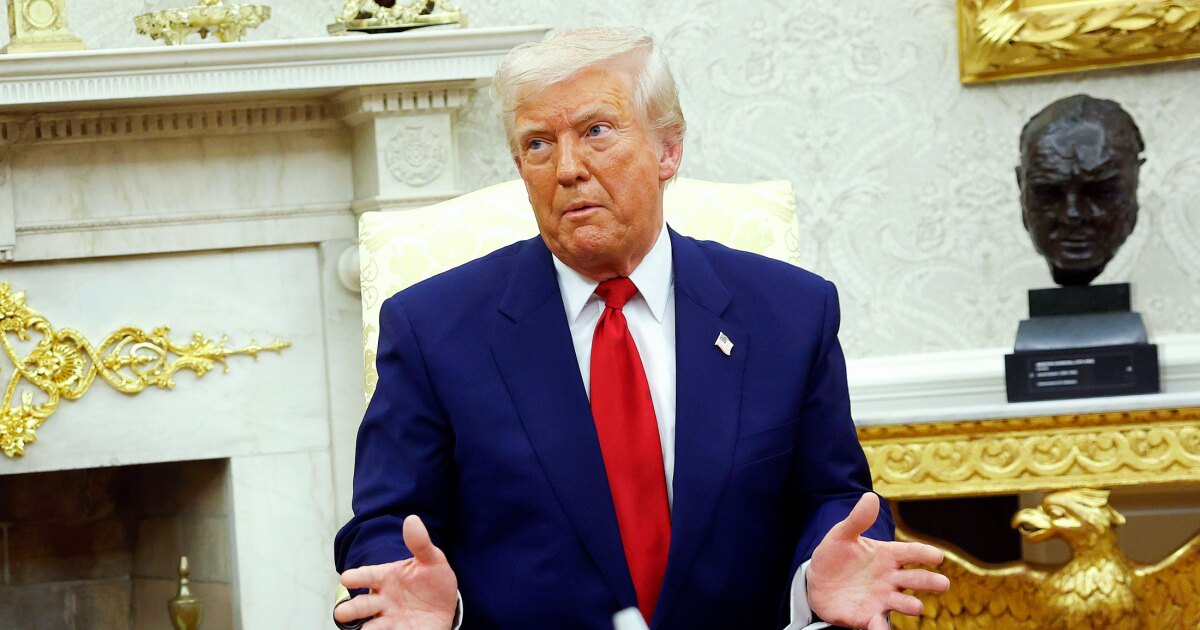

President Donald Trump rejected a European Union proposal to drop tariffs on all bilateral trade in industrial goods with the U.S., meaning that his 20% tariff on all EU imports is due to come into force Wednesday.
Speaking at the White House on Monday, Trump said the offer from European Commission President Ursula von der Leyen is not enough to reset the transatlantic trading relationship, accusing the EU of maintaining other barriers to trade.
“The European Union has been very bad to us,” he said. “We’re paying them to guard them militarily and they are screwing us on trade, so that’s not a good combination.”
EU trade officials have been trying to calibrate their response to the U.S. tariff proposals, seeking to project a degree of firmness and also to avoid escalation.
The EU plans to begin consulting with member states and industry early next week on how it plans to retaliate against the across-the-board tariffs, along with levies targeting the auto industry.
Olof Gill, a commission spokesman, said Tuesday that the bloc’s executive arm plans to discuss its response before coming up with a final set of measures to be voted on at a later date by member states.
On Monday, the commission dropped plans for a 50% retaliatory tariff on American whiskey as part of a separate dispute over Trump’s decision last month to put levies on aluminum and steel imports. The initial list targeted some €22 billion ($24.1 billion) in products, before a few categories were removed.
Instead, the bloc’s executive arm is proposing tariffs on a selection of U.S. goods that includes diamonds, motorcycles, pleasure boats, household appliances, safety glass, playing cards, tobacco, poultry and other agricultural products.
Most face a 25% tariff, but a few would be hit with a 10% rate, according to a document seen by Bloomberg. Several member states had pushed for whiskey to be excluded after Trump threatened to introduce a 200% tariff on European wine and champagne producers in response.
Earlier, von der Leyen noted the EU has previously offered to zero out tariffs on industrial products, including autos, if the U.S. does the same, but that Washington hasn’t engaged.
Now, Europeans are struggling to prevent the dispute spinning out of control, with the U.S. singling out the EU and China as two of the main targets of his trade policy.
Trump on Monday promised to impose an additional 50% tariff on Chinese imports on top of two separate levies — of 34% and 20% — that he’d already announced after Beijing announced that it would retaliate. Those new levies are also due to kick in on Wednesday.
In his comments on Monday, Trump railed against European trade policy, asserting that the EU has blocked access to U.S. cars and agricultural products, and demanding that European countries buy more energy from the U.S.
The EU “was formed to really do damage to the U.S. on trade, that’s the reason it was formed,” Trump said, who repeated his complaints that the U.S. has been paying for Europe’s defense since other NATO allies haven’t been spending enough on defense.
Even so, Trump hasn’t been specific about what kind of concessions he’s looking for, and EU officials have struggled to engage with their U.S. counterparts. Von der Leyen has yet to meet with Trump since he took office.
EU Trade Commissioner Maros Sefcovic suggested he’s open to discussing non-tariff issues as the U.S. has demanded, as long as there’s a mutual benefit for both sides. But he said that the value-added tax, which Trump has criticized, is an important source of income for member states and the EU won’t change this system.
Treasury Secretary Scott Bessent told Bloomberg Television on Monday that he doesn’t expect any deals with countries before the higher tariffs kick in on Wednesday.
EU trade ministers meeting in Luxembourg on Monday to formulate their response signaled readiness to deploy a full spectrum of countermeasures including potential taxes on U.S. tech companies in response to the sweeping tariffs that have tipped global markets into freefall since Trump announced them.
“If we can’t find an agreement we also have measures available,” Jens Spahn, a German conservative who is one of the frontrunners to be economy minister in the next government, said Tuesday in an interview with Deutschlandfunk radio. “I would mention the taxation of digital companies — Amazon, Meta, Apple — all of those present. It’s a clear indication of what we can also do.”
Some $10 trillion has been wiped off the value of global equities since Trump’s Rose Garden presentation last week with investors pricing in fears that the escalating trade war will trigger a global recession.
BlackRock Inc. Chief Executive Officer Larry Fink said Monday that most CEOs he talks to think the U.S. is already in a recession, warning that stock markets could decline further as Trump destabilizes the global economy.
In Luxembourg, all 27 EU members backed the commission’s approach to negotiate and prepare countermeasures if talks fail, giving the commission a solid mandate to move ahead with its plan, senior EU diplomats said.
“While the EU remains open and prefers negotiations, we will not wait endlessly,” Sefcovic told reporters.





U.S.-China AI Competition Intensifies as Washington Pushes Allies to Choose Sides

Nvidia’s Potential $3 Billion SB Energy Investment Could Reshape AI Infrastructure

U.S. Retail Sales Fall for the First Time in Nine Months as Consumer Spending Slows

Armanino adds Strategic Accounting Outsourced Solutions

New 2023 K-1 instructions stir the CAMT pot for partnerships and corporations

Tax Strategy: Employee Retention Credit update
-
 Economics1 week ago
US Inflation Matches Wall Street Projections as Core CPI Cools to 2.5%: Key Implications for Economy and Markets
-
 Economics5 days ago
U.S. Retail Sales Fall for the First Time in Nine Months as Consumer Spending Slows
-

 Economics6 days ago
Macroeconomic Impact of Global Energy Shocks and Shipping Route Realignment in 2026
-

 Accounting6 days ago
AI-Driven Automation and Continuous Accounting Frameworks
-

 Finance6 days ago
Cross-Border Settlement Innovation and Real-Time Payment Architecture
-

 Personal Finance6 days ago
Navigating Residential Real Estate and Mortgage Strategy
-

 Technology6 days ago
The Shift to On-Device Edge AI and Advanced Microprocessor Architecture in 2026
-
 Economics4 days ago
Nvidia’s Potential $3 Billion SB Energy Investment Could Reshape AI Infrastructure