
Accounting
Trump tariffs take effect hiking trade levies to a 100-year high

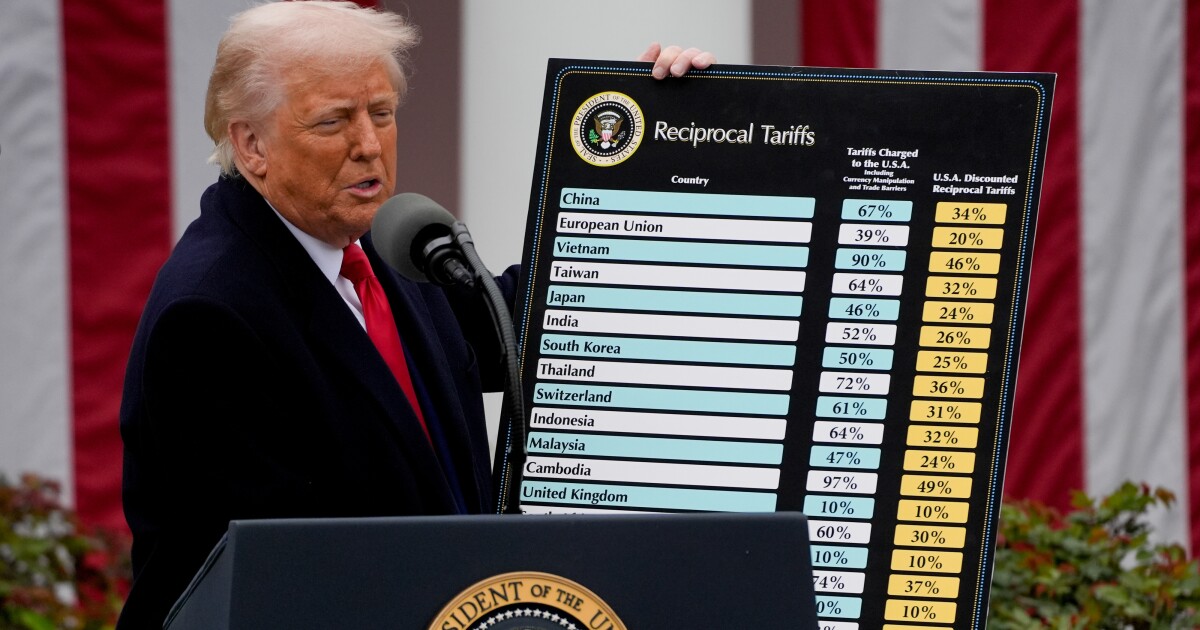

President Donald Trump’s so-called reciprocal tariffs are now in place, dealing a thunderous blow to the world economy as he pushes forward efforts to drastically reorder global trade.
Trump’s latest tariffs push levies imposed on China this year to as high as 104%, along with import taxes on roughly 60 trading partners that run trade surpluses with the U.S. That comes after a 10% baseline tariff for most US trading partners
The moves raise tariffs to their highest level in more than a century.
China announced retaliatory measures at 7 p.m. Beijing time, raising tariffs on U.S. goods from 34% to 84% from April 10, according to a statement.
Treasuries extended their selloff, with 30-year yields soaring briefly above 5%, and Asian shares and European shares fell in Wednesday trading. U.S. futures fell sharply after China announced retaliation. Markets had
Asian countries are bearing the brunt of the measures, with Cambodia facing 49% and Vietnam 46%. Imports from the European Union will be taxed at a 20% rate.
“The tariffs are on and the money is pouring in at a level that we’ve never seen before, and it’s going to be great for us. It’s going to be great for other countries. We’ve been ripped off and abused by countries for many years,” Trump said Tuesday at a White House event.
In the hours before implementation — at 12:01 a.m. Wednesday in Washington — the White House insisted the duties were indeed coming, squelching market speculation for any last-minute reprieve.
U.S. levies on China now include previous 20% levies tied to fentanyl trafficking, a 34% “reciprocal” tariff derived from a calculation based on the bilateral trade balance, and an additional 50% duty Trump announced after Beijing said it would respond by taxing U.S. exports to China.
The president welcomed appeals from U.S. allies who want him to lower their rates, saying Tuesday that teams from Japan and South Korea were en route to hammer out agreements. Trump hosted Israeli Prime Minister Benjamin Netanyahu earlier this week for talks, while Italian Prime Minister Giorgia Meloni will travel to Washington
“We’re doing very well in making, I call them tailored deals, not off-the-rack,” Trump said. “It’s been amazing what’s happened. Sometimes you have to mix it up a little bit.”
Still, risks to the world economy abound with Trump’s approach.
China has been defiant in the face of Trump’s tariffs, declaring plans to “fight to the end.” The escalation in tensions makes any imminent call between Trump and Chinese President Xi Jinping less likely and the latest comments raised the risk of a prolonged trade war between the world’s two largest economies.
Xi’s No. 2, Li Qiang, said his country has ample
Other economic powers are striking back as well. In Canada, a 25% counter-tariff to the auto tariffs Trump imposed on his northern neighbor last week also took effect a minute after midnight. In Europe, both France and Germany are
The White House has been on defense since last week when Trump unveiled his latest tariff plan. Trump argues that the taxes will boost U.S. prosperity and revive domestic manufacturing, but his approach has drawn criticism from Wall Street, economists and some in Trump’s own party, who have questioned the administration’s methodology and warned of an economic fallout that could include higher consumer prices and slower growth, if not a recession.
“Whose throat do I get to choke if this proves to be wrong?” Senator Thom Tillis, a North Carolina Republican facing a competitive reelection race next year, asked during a congressional hearing Tuesday. He was one of a number of lawmakers voicing anxiety as constituents see their retirement funds fluctuate.
Speaking to U.S. Trade Representative Jamieson Greer, Tillis also asked if voters will feel results from the tariffs in about a year. “I wish you well, but I am skeptical,” he said.
Greer told lawmakers: “We will have the president’s plan going into effect and we’re coupling that with immediate negotiations with our partners.”
Since Trump’s announcement, the administration has offered mixed messages on the path forward. Some have said the tariffs will unlock talks that see other countries lower barriers on U.S. exports, and perhaps result in Trump reducing his rates as well. But White House trade advisor Peter Navarro has repeatedly pushed back on the notion Trump is merely using tariffs as a negotiating tool.
For Trump, who has long argued for tariffs as a solution for his trade grievances, this plan will reassert U.S. power, revive domestic manufacturing and extract geopolitical concessions.
Urgent diplomacy
Affected nations were rushing to win better terms and weighing their responses ahead of the April 9 deadline, while grappling with a process that many described as chaotic and opaque.
A top Vietnamese official visited Washington for last-minute meetings seeking to blunt one of the highest tariff rates applied on any U.S. partner. The nation has been engaging in urgent diplomacy and its representatives have conveyed to Trump administration officials that it is working to address a trade imbalance.
Trump said Tuesday he spoke with the South Korean interim leader Han Duck-soo “about their tremendous and unsustainable Surplus, Tariffs, Shipbuilding” and “large scale purchase” of U.S. liquid natural gas. He also discussed “their joint venture in an Alaska Pipeline, and payment for the big time Military Protection we provide to South Korea.”
The U.S. president described the discussion as a “great call” and posted on social media that “things are looking good.” South Korea said it’s seeking to cut a
Japan sent senior officials to Washington to lay the groundwork for tariff negotiations, following a call on Monday between Trump and Japanese Prime Minister Shigeru Ishiba. On Wednesday, ministers kept urging the U.S. to review its tariffs while a plunge in stocks and bonds prompted officials from the central bank and the finance ministry to hold a meeting to soothe frayed nerves.
EU officials were working on next steps after the U.S. president rejected a proposal to drop tariffs on bilateral trade in industrial goods, saying Monday that it was not enough to reset the trading relationship.
Wall Street
A series of Wall Street executives criticized the plan this week, including JPMorgan Chase & Co. Chief Executive Officer Jamie Dimon, who in his annual shareholder letter Monday called for a quick resolution to trade policy uncertainty and warned against a potentially “disastrous” fragmentation of America’s long-term economic alliances.
Also
While Trump’s aides have offered a chorus of support for the tariffs, some tensions among his team have started to show. Tesla Inc. CEO Elon Musk, who advises Trump, called Navarro a “moron” in a social media post after Navarro called him a “car assembler” rather than a car manufacturer. White House Press Secretary Karoline Leavitt dismissed the clash, saying “boys will be boys.”
Trump, undaunted, is planning more.
Long-promised tariffs on pharmaceutical drugs will be announced “
And Trump is set to
All of this, the president and his administration
“We’re going to win the midterm elections, and we’re going to have a tremendous, thundering landslide,” Trump told Republican lawmakers and donors Tuesday. “I really believe that.”





U.S.-China AI Competition Intensifies as Washington Pushes Allies to Choose Sides

Nvidia’s Potential $3 Billion SB Energy Investment Could Reshape AI Infrastructure

U.S. Retail Sales Fall for the First Time in Nine Months as Consumer Spending Slows

Armanino adds Strategic Accounting Outsourced Solutions

New 2023 K-1 instructions stir the CAMT pot for partnerships and corporations

Tax Strategy: Employee Retention Credit update
-
 Economics1 week ago
US Inflation Matches Wall Street Projections as Core CPI Cools to 2.5%: Key Implications for Economy and Markets
-
 Economics5 days ago
U.S. Retail Sales Fall for the First Time in Nine Months as Consumer Spending Slows
-

 Economics6 days ago
Macroeconomic Impact of Global Energy Shocks and Shipping Route Realignment in 2026
-

 Finance6 days ago
Cross-Border Settlement Innovation and Real-Time Payment Architecture
-
 Accounting6 days ago
AI-Driven Automation and Continuous Accounting Frameworks
-

 Personal Finance6 days ago
Navigating Residential Real Estate and Mortgage Strategy
-

 Technology6 days ago
The Shift to On-Device Edge AI and Advanced Microprocessor Architecture in 2026
-
 Economics3 days ago
Nvidia’s Potential $3 Billion SB Energy Investment Could Reshape AI Infrastructure