Personal Finance
What the national debt, deficit mean for your money
Published
11 months agoon
Annabelle Gordon/Bloomberg via Getty Images
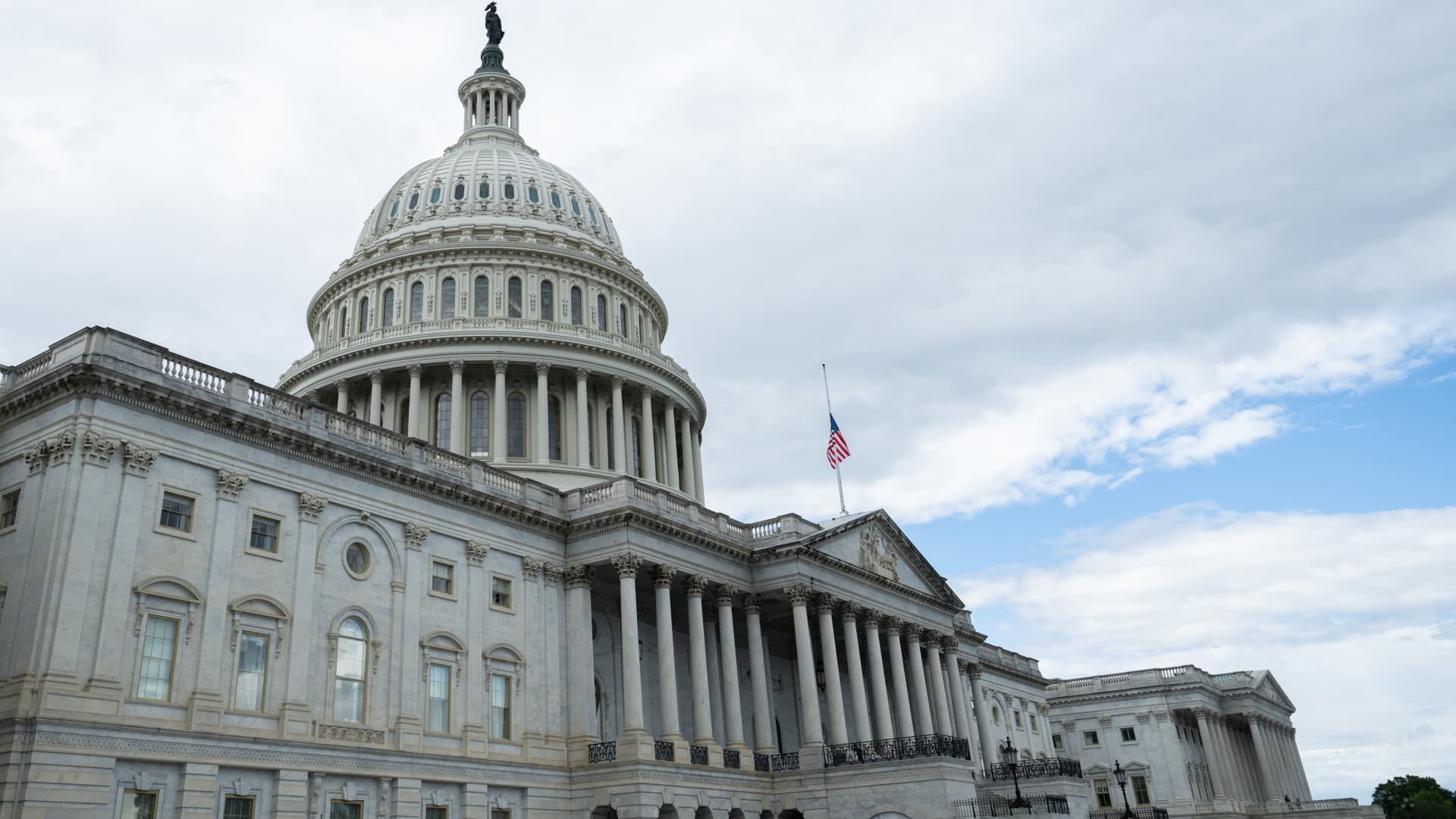
The massive package of tax cuts House Republicans passed in May is expected to increase the U.S. debt by trillions of dollars — a sum that threatens to torpedo the legislation as the Senate starts to consider it this week.
The Committee for a Responsible Federal Budget estimates the bill, as written, would add about $3.1 trillion to the national debt over a decade with interest, to a total $53 trillion. The Penn Wharton Budget Model estimates a higher tally: $3.8 trillion, including interest and economic effects.
Rep. Thomas Massie of Kentucky was one of two Republicans to vote against the House measure, calling it a “debt bomb ticking” and noting that it “dramatically increases deficits in the near term.”
“Congress can do funny math — fantasy math — if it wants,” Massie said on the House floor on May 22. “But bond investors don’t.”
A handful of Republican Senators have also voiced concern about the bill’s potential addition to the U.S. debt load and other aspects of the legislation.
“The math doesn’t really add up,” Sen. Rand Paul, R-Kentucky, said Sunday on CBS.
The legislation comes as interest payments on U.S. debt have surpassed national spending on defense and represent the second-largest outlay behind Social Security. Federal debt as a percentage of gross domestic product, a measure of U.S. economic output, is already at an all-time high.
The notion of rising national debt may seem unimportant for the average person, but it can have a significant impact on household finances, economists said.
“I don’t think most consumers think about it at all,” said Tim Quinlan, senior economist at Wells Fargo Economics. “They think, ‘It doesn’t really impact me.’ But I think the truth is, it absolutely does.”
Consumer loans would be ‘a lot more’ expensive
A much higher U.S. debt burden would likely cause consumers to “pay a lot more” to finance homes, cars and other common purchases, said Mark Zandi, chief economist at Moody’s.
“That’s the key link back to us as consumers, businesspeople and investors: The prospect that all this borrowing, the rising debt load, mean higher interest rates,” he said.

The House legislation cuts taxes for households by about $4 trillion, most of which accrue for the wealthy. The bill offsets some of those tax cuts by slashing spending for safety-net programs like Medicaid and food assistance for lower earners.
Some Republicans and White House officials argue President Trump’s tariff policies would offset a big chunk of the tax cuts.
But economists say tariffs are an unreliable revenue generator — because a future president can undo them, and courts may take them off the books.
How rising debt impacts Treasury yields
U.S. Speaker of the House Mike Johnson (R-Louisiana) speaks to the media after the House narrowly passed a bill forwarding President Donald Trump’s agenda at the U.S. Capitol on May 22, 2025.
Kevin Dietsch | Getty Images News | Getty Images
Ultimately, higher interest rates for consumers ties to perceptions of U.S. debt loads and their effect on U.S. Treasury bonds.
Common forms of consumer borrowing like mortgages and auto loans are priced based on yields for U.S. Treasury bonds, particularly the 10-year Treasury.
Yields (i.e., interest rates) for long-term Treasury bonds are largely dictated by market forces. They rise and fall based on supply and demand from investors.
The U.S. relies on Treasury bonds to fund its operations. The government must borrow, since it doesn’t take in enough annual tax revenue to pay its bills, what’s known as an annual “budget deficit.” It pays back Treasury investors with interest.
More from Personal Finance:
How GOP tax bill could change in the Senate
3 key moves to consider while Fed keeps rates higher
Trump administration axes barrier for crypto in 401(k) plans
If the Republican bill — called the “One Big Beautiful Bill Act” — were to raise the U.S. debt and deficit by trillions of dollars, it would likely spook investors and Treasury demand may fall, economists said.
Investors would likely demand a higher interest rate to compensate for the additional risk that the U.S. government may not pay its debt obligations in a timely way down the road, economists said.
Interest rates priced to the 10-year Treasury “also have to go up because of the higher risk being taken,” said Philip Chao, chief investment officer and certified financial planner at Experiential Wealth based in Cabin John, Maryland.
Moody’s cut the U.S.’ sovereign credit rating in May, citing the increasing burden of the federal budget deficit and signaling a bigger credit risk for investors. Bond yields spiked on the news.
How debt may impact consumer borrowing
Zandi cited a general rule of thumb to illustrate what a higher debt burden could mean for consumers: The 10-year Treasury yield rises about 0.02 percentage points for each 1-point increase in the debt-to-GDP ratio, he said.
For example, if the ratio were to rise from 100% (roughly where it is now) to 130%, the 10-year Treasury yield would increase about 0.6 percentage points, Zandi said. That would push the yield to more than 5% relative to current levels of around 4.5%, he said.
“It’s a big deal,” Zandi said.

A fixed 30-year mortgage would rise from almost 7% to roughly 7.6%, all else equal — likely putting homeownership further “out of reach,” especially for many potential first-time buyers, he said.
The debt-to-GDP ratio would swell from about 101% at the end of 2025 to an estimated 148% through 2034 under the as-written House legislation, said Kent Smetters, an economist and faculty director for the Penn Wharton Budget Model.
Bond investors get hit, too
It’s not just consumer borrowers: Certain investors would also stand to lose, experts said.
When Treasury yields rise, prices fall for current bondholders. Their current Treasury bonds become less valuable, weighing on investment portfolios.
“If the market interest rate has gone up, your bond has depreciated,” Chao said. “Your net worth has gone down.”
The market for long-term Treasury bonds has been more volatile amid investor jitters, leading some experts to recommend shorter-term bonds.
On the flip side, those buying new bonds may be happy because they can earn a higher rate, he said.
‘Pouring gasoline on the fire’
The cost of consumer financing has already roughly doubled in recent years, said Quinlan of Wells Fargo.
The average 10-year Treasury yield was about 2.1% from 2012 to 2022; it has been about 4.1% from 2023 to the present, he said.
Of course, the U.S. debt burden is just one of many things that influence Treasury investors and yields, Quinlan said. For example, Treasury investors sent yields sharply higher as they rushed for the exits after Trump announced a spate of country-specific tariffs in April, as they questioned the safe-haven status of U.S. assets.
“But it’s not going out on too much of a limb to suggest financial markets the last couple years have grown increasingly concerned about debt levels,” Quinlan said.
Absent action, the U.S. debt burden would still rise, economists said. The debt-to-GDP ratio would swell to 138% even if Republicans don’t pass any legislation, Smetters said.
But the House legislation would be “pouring gasoline on the fire,” said Chao.
“It’s adding to the problems we already have,” Chao said. “And this is why the bond market is not happy with it,” he added.

You may like

The Federal Reserve held interest rates steady at the conclusion of its policy meeting on Wednesday.
In what could be Jerome Powell’s last as chair before President Donald Trump’s yet-to-be-confirmed nominee Kevin Warsh takes the helm, central bankers maintained the federal funds rate in a target range of 3.5% to 3.75%.
Inflation has surged since the war with Iran began, leaving policymakers with limited room to act, according to Sean Snaith, the director of the University of Central Florida’s Institute for Economic Forecasting. “We’re in a kind of suspended animation — between Iran and the Fed transition,” Snaith said.
Read more CNBC personal finance coverage
Before the oil shock, inflation was holding above the Fed’s 2% target but not worsening. Now the jump in energy costs could have longer-term inflationary effects, economists say.
For Americans struggling in the face of higher gas prices and overall affordability challenges, the central bank’s decision to keep interest rates unchanged does little to ease budgetary pressures. “The cavalry isn’t coming anytime soon,” Snaith said.
How the Fed decision impacts you
The Fed’s benchmark sets what banks charge each other for overnight lending, but also has a trickle-down effect on many consumer borrowing and savings rates.
Short-term rates are more closely pegged to the prime rate, which is typically 3 percentage points above the federal funds rate. Longer-term rates, such as home loans, are more influenced by inflation and other economic factors.
Credit cards
Most credit cards have a short-term rate, so they track the Fed’s benchmark.
After the Fed cut rates three times in the second half of 2025, the average annual percentage rate has stayed just under 20%, according to Bankrate.
“Without Fed rate cuts, there’s not much reason to expect meaningful declines anytime soon, so carrying a balance will remain very expensive,” said Matt Schulz, chief credit analyst at LendingTree.
Mortgage rates
Fixed mortgage rates, on the other hand, don’t directly track the Fed but typically follow the lead of long-term Treasury rates.
Concerns about how the Iran war will impact the U.S. economy have already pushed the average rate for a 30-year, fixed-rate mortgage up to 6.38% as of Tuesday, from 5.99% at the end of February, according to Mortgage News Daily.
That leaves homeowners with existing low mortgage rates “feeling stuck,” said Michele Raneri, vice president and head of U.S. research and consulting at TransUnion. “Mortgages, more than any other credit type, work on a churn,” she said, referring to how a dip in rates can boost borrowing activity.
Student loans
Federal student loan rates are also fixed and based in part on the 10-year Treasury note, so most borrowers are somewhat shielded from Fed moves and recent economic uncertainty.
Current interest rates on undergraduate federal student loans made through June 30 are 6.39%, according to the U.S. Department of Education. Interest rates for the upcoming school year will be based in part on the May auction of the 10-year note.
Car loans
Auto loan rates are tied to several factors, including the Fed’s benchmark. Because financing costs remain elevated, new car buyers are taking on longer loans to keep their monthly payments manageable, according to the latest data from Edmunds.
Even so, with the rate on a five-year new car loan near 7%, the average monthly payment on a new car rose to $773 in the first quarter of 2026, an all-time high.
“Car buyers are in a tough spot right now because they’re getting squeezed from both ends: high sticker prices and high interest rates, with neither showing any signs of letting up,” said Joseph Yoon, consumer insights analyst at Edmunds.
“Until the rate picture shifts, buyers will keep stretching loan terms to make payments work, which only adds to the total cost of ownership down the road,” Yoon said.
Savings rates
While the Fed has no direct influence on deposit rates, the yields tend to be correlated with changes in the target federal funds rate. So, although rates on certificates of deposit and high-yield savings accounts have fallen from recent highs, they are holding above the annual rate of inflation.
For now, top-yielding online savings accounts and one-year CD rates pay around 4%, according to Bankrate.
“Yields on high-yield savings accounts and certificates of deposit are down from their peaks of a few years ago, but they’re still strong compared to what we’ve seen for most of the past decade,” Schulz said.
Personal Finance
Average tax refund is 11.2% higher, latest IRS filing data shows
Published
2 weeks agoon
April 18, 2026
Milan Markovic | E+ | Getty Images
The average tax refund is 11.2% higher this season, compared with about the same period in 2025, according to the latest IRS filing data.
As of April 10, the average refund amount for individual filers was $3,397, up from $3,055 about one year ago, the IRS reported on Friday.
The IRS data reflects about 114 million individual returns received, out of about 164 million expected through Tax Day. Next week’s filing update is expected to include data through the April 15 deadline.
Read more CNBC personal finance coverage
President Donald Trump‘s 2025 legislation, rebranded to the “working families tax cuts,” was a key talking point for Republicans on Tax Day.
With the November midterm elections approaching and Republicans defending slim majorities in Congress, many GOP lawmakers have highlighted Trump’s tax breaks and higher average refunds.
Meanwhile, affordability has been top of mind for many Americans amid rising costs of gas, electricity, food and other living expenses.
For filers who expected a refund this season, nearly one-quarter, or 23%, planned to use the funds to pay down credit card debt, and the same share said they would save the payment, according to the CNBC and SurveyMonkey Quarterly Money Survey, released in April. It polled 3,494 U.S. adults at the end of March.
Who benefited from Trump’s ‘big beautiful bill’
“It’s been a great tax season for the American people,” many of whom have benefited from Trump’s tax breaks, Treasury Secretary Scott Bessent said during a White House press briefing on Wednesday.
More than 53 million filers claimed at least one of Trump’s “signature new tax cuts” — the deductions for tip income, overtime earnings, seniors and auto loan interest — the Department of the Treasury also announced on Wednesday.
Those filers, who claimed the deductions on Schedule 1-A, have seen an average tax cut of over $800, according to the Treasury. Tax cuts can trigger a higher refund or reduce taxes owed, depending on the filer’s situation.

Some filers who itemize tax breaks have also seen benefits from the bigger federal deduction limit for state and local taxes, known as SALT. Trump’s legislation raised that cap to $40,000, up from $10,000, for 2025.
The latest SALT deduction limit change is expected to primarily benefit higher earners, according to a May 2025 analysis of various proposals from the Tax Foundation.
The Treasury has not released data on how many filers have claimed the SALT deduction during the 2026 filing season.
Personal Finance
Stocks have touched record highs despite Iran war. Here’s why
Published
2 weeks agoon
April 17, 2026
Traders work at the New York Stock Exchange on April 16, 2026.
NYSE
U.S. stocks climbed to record highs on Thursday against a backdrop of war, an oil supply shock and economic forecasts warning of stunted growth amid a protracted conflict.
Many investors may be thinking: Why?
Largely, it’s because the stock market is a barometer of what investors think will happen in the future, rather than an assessment of the present day, according to economists and market analysts.
Investors are essentially shrugging off the Middle East conflict as a blip that will be resolved relatively quickly, they said.
“The stock market isn’t trying to price what’s happening today,” said Joe Seydl, a senior markets economist at J.P. Morgan Private Bank. “The stock market is always trying to price what the world is going to look like six to 12 months from now.”
Why stocks have been ‘resilient’
The S&P 500, a U.S. stock index, fell about 8% in the initial weeks of the Iran war, from the start of the conflict on Feb. 28 to a recent low on March 30.
But stocks have rebounded since then, erasing all losses since the beginning of the war. The S&P 500 closed at an all-time high on Thursday — about 11% higher than its nadir at the end of March. That followed a record close on Wednesday.
“The market has remained very resilient in the face of the war and has rallied strongly on the prospect that it will be resolved,” said Mark Zandi, chief economist at Moody’s.

A ship waits to pass through the Strait of Hormuz following the two-week temporary ceasefire between the US and Iran, which is conditional on the opening of the strait, in Oman on April 8, 2026.
Shady Alassar | Anadolu | Getty Images
And while investors cheered the possibility of a diplomatic off-ramp to the conflict, the temporary ceasefire has appeared tenuous, with the U.S. and Iran each accusing the other of breaking the agreement.
Nations haven’t been able to reach a peace deal ahead of the ceasefire’s end. Vice President JD Vance said U.S. officials left peace talks in Pakistan over the weekend after the Iranian delegation refused to agree to American demands not to develop a nuclear weapon.
The markets ‘have memory’
Ultimately, the stock market is signaling a collective belief that tensions will ratchet down, the war will end in the near term and oil flows through the Strait of Hormuz will normalize, economists said.
That’s largely because investors have been conditioned to believe that President Donald Trump will back off if the economic pain becomes too intense, economists said — the so-called “TACO” trade, shorthand for “Trump always chickens out.”
“Investors strongly believe — and have been conditioned to believe — he’s going to stand down, find a way to pivot, declare victory and move on,” Zandi said.
Trump has pushed back on the notion of backing down, framing his brinkmanship as a savvy negotiating tactic.
Read more CNBC personal finance coverage
Economists pointed to a recent example of this dynamic: in April 2025 during so-called liberation day, when the Trump administration levied a host of tariffs on U.S. trading partners.
Within days — after the stock market had cratered more than 12% — Trump announced a 90-day pause on those tariffs. Stocks then saw one of their biggest daily rallies in history following Trump’s reversal.
Investors remember that Trump often de-escalates geopolitical shocks — which is why they’ve seized on positive headlines that hint at progress in peace talks, for example, Seydl said.
“The markets have memory,” Seydl said.
AI stocks and the ‘tech boom’
Traders celebrating at the New York Stock Exchange on April 15, 2026, as the S&P 500 closed above the 7,000 level for the first time.
NYSE
There are other factors underpinning market resilience during wartime, economists said.
One is the investors’ enthusiasm for artificial intelligence and technology stocks, which account for almost half of the S&P 500’s market capitalization, Zandi said.
“Those stocks run on their own dynamic independent of anything, including the war in Iran,” Zandi said. “I think we would have been down a lot more and it would have been harder for us to recover had it not been for the very, very optimistic perspectives on AI.”
We’re in the middle of a “tech boom” — and investors are likely to remain optimistic until they think the tech cycle has run its course, Seydl said.

More broadly, stock investors are essentially making a bet on the future earnings growth of a company — and the earnings backdrop has been “pretty solid,” Seydl said.
Consumer spending appears to be stable, for example, economists said. And companies are getting a boost to their after-tax earnings from the GOP’s so-called “big beautiful bill,” which, among other things, made it easier to write off investments upfront and therefore reduce their tax liability, Zandi said.
Going forward
Experts said there will be an economic hit from the Iran war, though.
“Despite the recent news of a temporary ceasefire, some damage is already done, and the downside risks remain elevated,” Pierre-Olivier Gourinchas, director of research at the International Monetary Fund, wrote Tuesday.
A protracted conflict risks deep and global economic pain, he wrote.
Even if the conflict is short-lived — as the broad market expects — stocks are unlikely to march much higher until it’s clear the U.S. is on the other side of the war and its economic fallout, Zandi said.
If investors are incorrect, and President Trump doesn’t back down or quickly extricate the U.S. from the war, the stock market may see a “full-blown correction” or worse, Zandi said. A stock market correction is a decline of at least 10% from recent highs.
“Everyone thinks they know what the script is,” Zandi said. “Now they just need to follow the script. If they don’t, the market will have some real problems.”
The uncertainty provides yet another example of why the average investor with a long time horizon should stick to their investment plan and ignore the noise, experts said.
“Trying to time the market is very difficult if not impossible for the average investor,” Seydl said. “It’s better to take a long-term perspective and ride out bouts of volatility.”
What that means for consumer loans
Checks and Balance newsletter: Of God and MAGA
Why software stocks, 2026’s market dogs, have joined the rally
Armanino adds Strategic Accounting Outsourced Solutions
New 2023 K-1 instructions stir the CAMT pot for partnerships and corporations