Connect with us

Accounting

Baker Tilly plans to merge in Moss Adams

Published

on

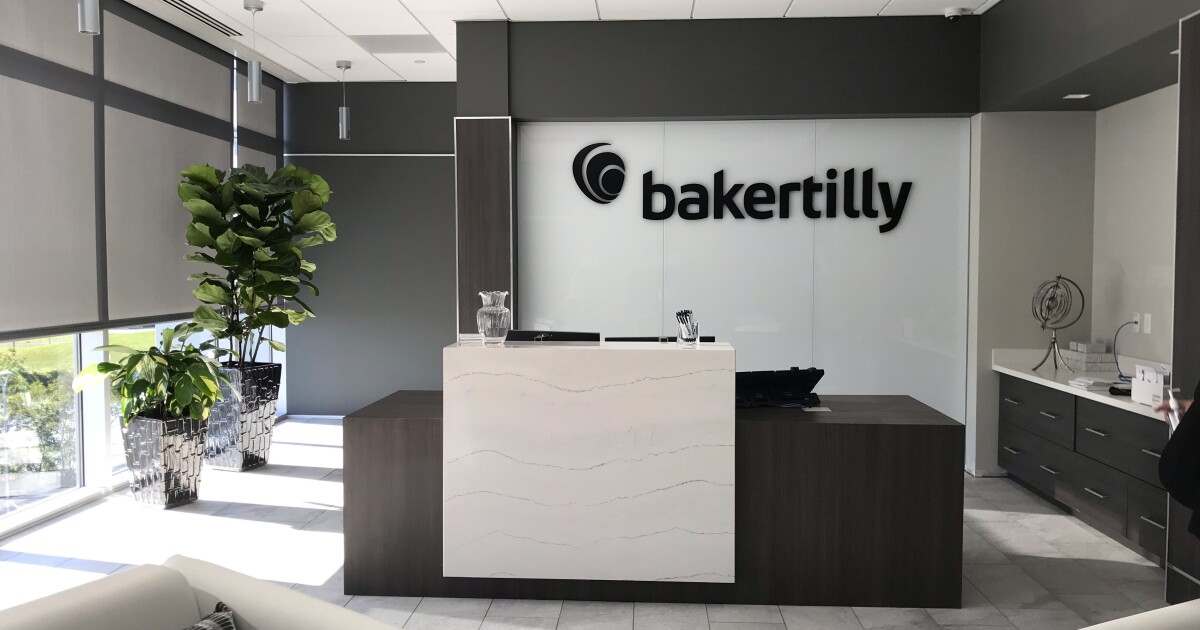
Baker Tilly, a Top 25 Firm based in Chicago, reportedly is close to a megamerger with Moss Adams, another Top 25 Firm based in Seattle, creating a firm with $3 billion in annual revenue.

The deal, reported Wednesday by The Wall Street Journal and the Financial Times, would create potentially the sixth largest accounting firm in the U.S. Baker Tilly ranked No. 11 on Accounting Today‘s 2025 list of the Top 100 Firms with $1.8 billion in annual revenue, over 600 partners and nearly 6,900 employees. Moss Adams ranked right below it at No. 12 with $1.3 billion in annual revenue, over 400 partners and more than 4,800 employees.

Baker TIlly declined to confirm the deal, but acknowledged it’s always searching for merger candidates. 

“We can’t comment on speculation or confidential discussions,” said Baker Tilly spokesperson Nicole Berkeland in an email to Accounting Today. “What we can say is that we’ve been transparent about our strategy to grow through strategic mergers. We are continually exploring opportunities with respected firms that align with our vision and will strengthen our ability to serve the middle market.” 

Moss Adams also declined to comment. “It’s our policy not to comment on market speculation,” said Moss Adams spokesperson Greg Kunkel.

Koltin Consulting Group CEO Allan D. Koltin, who has previously advised Baker Tilly and Moss Adams on strategy and M&A, sees major ramifications from the deal. “Just when we thought nothing could get any bigger in CPA firm M&A than Forvis (formerly BKD and Dixon Hughes), and CBIZ (formerly CBIZ and Marcum), here comes Baker Tilly and Moss Adams (potentially) combining to create the sixth largest CPA firm in the country (only behind the Big Four and RSM),” Koltin said in an email. “After the combination, Baker Tilly will become the largest (non-Big Four) CPA firm in the Western region and Moss Adams will become part of a Top 10 Global Network. Additionally, both firms will bring over their unique areas of industry specialization and service line expertise which should provide robust organic growth opportunities to the combined firm. As a 44-year veteran and advisor to the accounting profession, I daresay there has been more change and transformation in the accounting profession in the past 4 years than the 40 prior years combined!”

Another merger expert also sees benefits in the combination. “The primary reason for this reported merger is to expand both firms’ scale and market position,” said Brad Haller, a senior partner in West Monroe’s mergers and acquisitions practice. This move would significantly boost Moss Adams’ scale and provide Baker Tilly with access to Moss Adams’ extensive client base. Together, they would become the sixth largest firm, leapfrogging over Grant Thornton and others. Additionally, this merger would allow Moss Adams to tap into Baker Tilly’s global networks, enabling them to expand their wallet share with clients. While there will be modest synergies in the long term as they combine redundant support services, the immediate benefits of this merger would be substantial.”

Baker Tilly is part  of the Baker Tilly International network, based in London, which reported $5.6 billion in worldwide revenue in 2024. Baker Tilly has done several acquisitions since receiving private equity funding last February led by Hellman & Friedman and Valeas Capital Partners, accelerating the firm’s growth strategy. Earlier this year, it acquired CironeFriedberg, a firm based in Bethel, Connecticut, and Hancock Askew, a Regional Leader based in Savannah, Georgia.

Last May, it merged in Seiler LLP, a Top 75 Firm based in Redwood City, California. Prior to the private equity funding, in 2022, Baker Tilly merged in Henry + Horne in Tempe, Arizona, True Partners Consulting in Chicago; Management Partners in Cincinnati and San Jose; Bader Martin in Seattle; Orchestra Healthcare in West Palm Beach, Florida; and Vanilla, based in the United Kingdom. Baker Tilly US is part of the London-based Baker Tilly International network and was formerly known as Baker Tilly Virchow Krause. In 2021, it added MFA Companies in Boston; The Compliance Group in Carlsbad, California; Arnett Carbis Toothman in West Virginia; AcctTwo in Houston; and Margolin, Winer & Evens in New York.

Moss Adams does not do M&A deals as often, but last December, it entered the Salesforce.com consulting market by acquiring Yurgosky Consulted Limited LLC in New York.

Continue Reading

Accounting

FASB Standardizes Carbon Offsets Accounting Rules

Published

on

FASB Standardizes Carbon Offsets Accounting Rules

In a decisive move toward standardized environmental financial reporting, accounting standards boards issued updated implementation guidance during the week ending July 25, 2026, regarding the formal recognition and valuation of corporate carbon offsets and environmental credits. The revised frameworks establish precise rules for how enterprises must measure, record, and disclose carbon credits on balance sheets, eliminating years of inconsistent reporting practices across public capital markets.

Under the finalized accounting standard, purchased carbon offsets can no longer be categorized under vague administrative expenses or unstandardized intangible asset accounts. Instead, organizations must classify environmental credits based on underlying operational intent—distinguishing between credits held for immediate compliance compliance obligations, long-term offset obligations, or active market trading. Furthermore, companies are required to evaluate carbon holdings for fair value impairment at the end of each reporting period, ensuring that depreciated or low-quality environmental credits do not distort corporate asset values.

The standardized rules carry significant implications for corporate audit committees and chief accounting officers. External audit firms are implementing rigorous verification protocols to validate the physical legitimacy, legal ownership, and scientific permanence of carbon credits claimed on balance sheets. Inaccurate or overstated carbon accounting claims now carry substantial financial litigation risk, alongside potential regulatory enforcement for misleading ESG disclosures.

To remain fully compliant, corporate accounting departments must establish centralized carbon tracking systems integrated into primary standard ERP ledgers. Accounting teams that proactively adopt standardized environmental reporting protocols will build investor credibility, streamline annual audit processes, and insulate their organizations against evolving regulatory scrutiny.

Continue Reading

Accounting

Automated Tax Compliance Tools Reduce Risk

Published

on

Automated Tax Compliance Tools Reduce Risk

Corporate tax departments reached a critical juncture in automated operational management. With nations worldwide rapidly enacting digital service taxes, localized value-added tax (VAT) mandates, and real-time electronic invoicing requirements, manual tax calculations have become obsolete. Modern corporate tax divisions are aggressively deploying AI-driven tax engine software to automate complex cross-border indirect tax calculations in real time.

The imperative for automated tax compliance stems from the sheer complexity of current trade policies and multi-jurisdictional commerce. E-commerce platforms, software vendors, and global manufacturers face constantly changing regional tax rates, statutory exemption rules, and cross-border tariff structures. Automated tax engines embed directly into enterprise enterprise resource planning (ERP) architectures, automatically applying correct tax codes at the point of sale, calculating real-time withholding amounts, and generating compliant e-invoices.

Automated audit trail generation represents another key advantage of modern tax tech integration. Advanced compliance platforms log every transactional tax determination on immutable digital ledgers, providing tax authorities with transparent, self-verifying audit trails. This capability drastically reduces the operational duration and administrative cost of corporate tax audits, protecting enterprises against severe penalties resulting from calculation errors or missed reporting deadlines.

For chief financial officers and tax directors, investing in automated tax compliance is a vital operational risk mitigation strategy. Automating routine tax calculations frees high-level accounting professionals to focus on strategic tax planning, transfer pricing optimization, and risk management in an increasingly complex global economic environment.

Continue Reading

Accounting

Continuous Auditing Transforms Corporate ERPs

Published

on

continuous auditing transforms corporate erps

As corporate accounting departments cross the threshold into late July 2026, the adoption of continuous, automated auditing systems has reached a definitive turning point. Driven by advances in artificial intelligence and deep integration with modern Enterprise Resource Planning (ERP) platforms, leading finance organizations are moving away from traditional, periodic post-hoc audits in favor of real-time, 100% transactional verification. This technological transition is redefining internal control environments, reducing compliance costs, and eliminating the structural delays inherent in legacy quarterly closing processes.

Unlike traditional auditing frameworks that rely on statistical sampling—a process that inevitably leaves operational blind spots—continuous auditing software monitors operational data feeds continuously. Every purchase order, electronic invoice, payroll disbursement, and cross-border wire transfer is automatically cross-referenced against established corporate governance parameters, regulatory tax schedules, and anti-fraud algorithms in real time. Anomalies or unauthorized ledger entries are flagged instantly, allowing internal audit teams to investigate and remediate compliance gaps immediately rather than months after the close of a financial period.

The implications for executive financial management are far-reaching. By embedding continuous verification directly into daily transaction workflows, chief financial officers gain uninterrupted visibility into the organization’s true financial standing. Real-time balance sheet auditing eliminates the severe operational bottlenecks associated with month-end and quarter-end financial reconciliations, freeing accounting professionals to focus on strategic financial modeling, tax planning, and capital allocation rather than manual data entry and spreadsheet consolidation.

However, implementing continuous auditing requires accounting leadership to invest heavily in data governance and technical upskilling. Internal audit teams must evolve from manual ledger reviewers into system architects capable of auditing complex algorithms and validating automated data pipelines. Accounting firms and corporate controllers that master continuous auditing will establish a resilient compliance framework capable of meeting stringent international regulatory standards with total transparency.

Continue Reading

Trending