
Finance
Banks are thriving so far in Trump’s economy. Here’s what that means

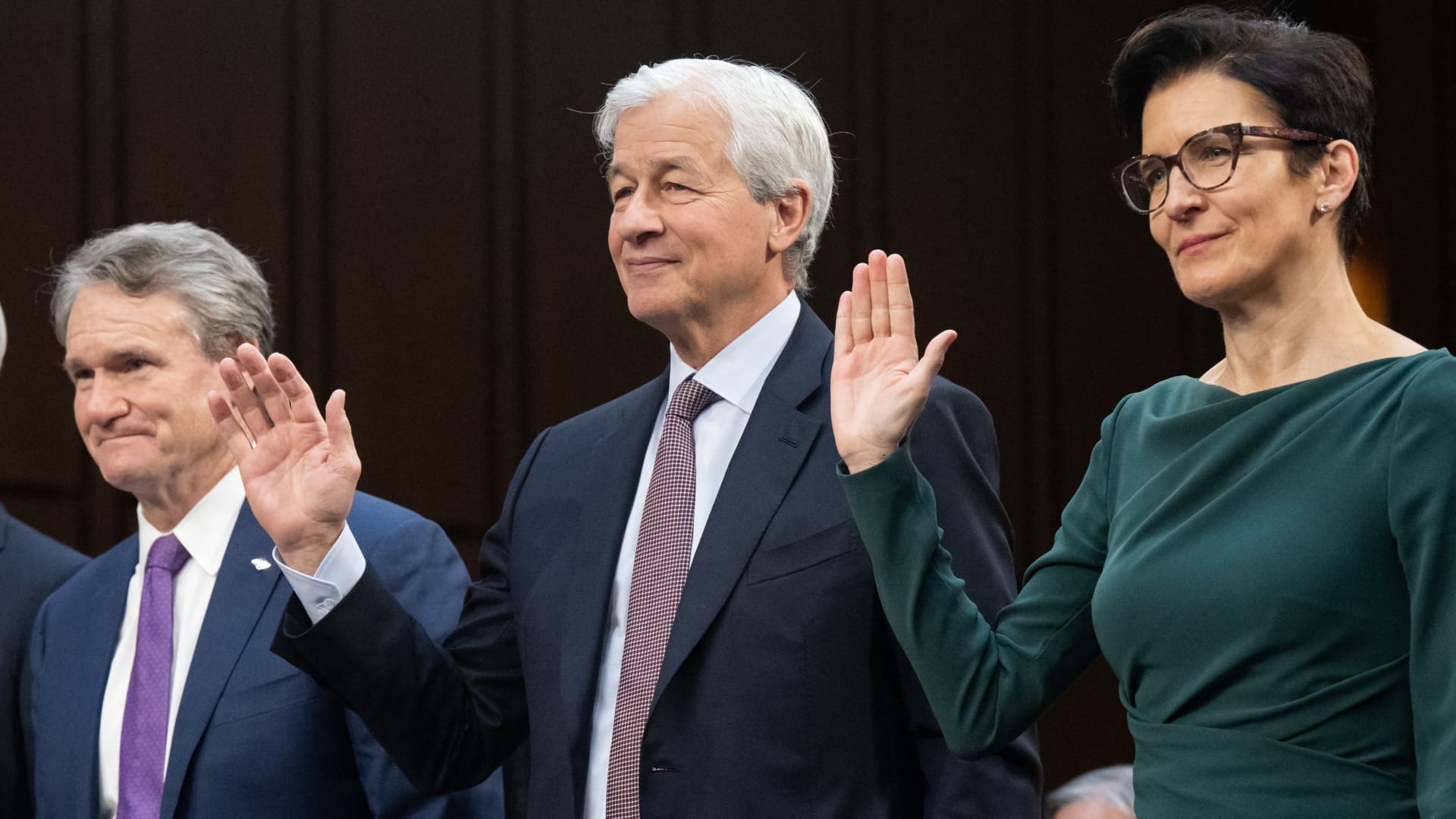
(L-R) Brian Moynihan, Chairman and CEO of Bank of America; Jamie Dimon, Chairman and CEO of JPMorgan Chase; and Jane Fraser, CEO of Citigroup; testify during a Senate Banking Committee hearing at the Hart Senate Office Building in Washington, D.C., on Dec. 6, 2023.
Saul Loeb | Afp | Getty Images
Nearly everywhere you look in the world of finance, things are going surprisingly well — at least for now.
Wall Street is humming thanks to a boom in stock and bond trading and a pickup in corporations acquiring competitors and taking out massive loans. At the same time, Main Street is holding up as the American consumer continues to spend, borrow and repay loans, according to reports this week from the largest U.S. banks.
It makes for an unusually profitable environment for financial firms. The six biggest U.S. banks generated about $39 billion in second-quarter profit, outstripping analysts’ expectations and collectively jumping more than 20% from core earnings a year ago.
It’s a remarkable result after a tumultuous start to the quarter. The period began with shock and plunging markets on April 2 over President Donald Trump’s sweeping “Liberation Day” tariffs. JPMorgan Chase economists said at the time that the policies would probably cause a recession this year.
But markets roared back after Trump responded to distress signals coming from U.S. bonds and delayed the most punishing tariffs on most trading partners. Investors have begun to tune out the administration’s barrage of tariff pronouncements as bluster or noise, and corporate leaders are stepping off the sidelines to pull off multibillion-dollar transactions, bank results show.
“Look how far the world’s come in three months,” Wells Fargo banking analyst Mike Mayo told CNBC. “Throughout the quarter, you had a pickup in investment banking, loan growth and optimism with economic scenarios. Here we are, with talk of a recession pretty much absent.”
That dynamic was clear at JPMorgan, the largest and most profitable U.S. bank. It produced about $15 billion in quarterly profit, which is nearly as much as the next three largest banks combined.
Trading benefited from turbulent conditions in the quarter as Trump roiled markets with rapidly evolving policy statements. But the real surprise came from investment banking, which involves mergers advice, IPOs and debt and equity issuance. Revenue at JPMorgan jumped 7%, producing $450 million more than analysts had expected, just weeks after managers had warned of an approximate 15% decline.
“The pickup in investment banking fees, to some extent, reflects people accepting uncertainty and deciding to move on with transactions,” JPMorgan CFO Jeremy Barnum told reporters on Tuesday. “The corporate community has sort of accepted that they just need to navigate through this.”
‘Soft landing’
But the good news didn’t end with corporate confidence. JPMorgan’s internal barometers for U.S. economic risks cooled down from the first quarter as some of the worst-case scenarios were taken off the table, Barnum said.
That means it’s less likely that a recession will cause a spike in U.S. unemployment this year, hurting consumers ability to repay their debts. That was clear in the bank’s provision for credit losses, which was 14% smaller than in the first quarter.
The economy is squarely in the “soft landing” scenario, Barnum told reporters this week.
At the same time, consumers and companies are borrowing more money from JPMorgan, where loan growth rose 5% compared with a year ago, fueled by rising credit card and wholesale loans, the bank said.
Those stats mean that, at least for now, banks are giving the all-clear signal on the U.S. economy in the early months of the second Trump presidency. Even in a time marked by turbulence and rising geopolitical risks, the economy has defied expectations for a downturn.
“Banks are economically sensitive businesses, and so how the economy performs under the administration is going to matter to their results,” said Matt Stucky, chief portfolio manager for equities at Northwestern Mutual wealth management. “So far, the economy continues to push forward.”
‘Firing on all cylinders’
The situation even made JPMorgan CEO Jamie Dimon, who frequently warns about risks he sees, sound relatively optimistic about the economy.
“It’s been resilient, and hopefully it’ll continue to be,” Dimon told reporters this week. “It’s always good to hope for the best, prepare for not the best, and we’ll see… One thing I would point out, the world is much bigger and much more diversified” now and that makes for a “slightly more stable global economy than you had 20 years ago,” he said.
Traders work on the floor at the New York Stock Exchange (NYSE) in New York City, U.S., July 17, 2025.
Brendan McDermid | Reuters
Trump’s sweeping spending bill, signed into law this month, preserves corporate tax rates and expands business deductions. On top of that, deregulatory efforts across industries will boost the economy, Dimon said.
Last month, the Federal Reserve released a proposal to amend the capital that banks need to hold for lower-risk assets, potentially freeing up billions of dollars for the banks that they could use to boost share repurchases, buy competitors or fuel more loan growth, executives said this week.
Taken together, it’s hard to conceive of a better setup for banks than right now, Barnum said.
“We’re essentially firing on all cylinders,” Barnum told analysts. “Rates are a good level for us. Deal activity is high. Capital markets are very strong. Consumer credit is excellent. Wholesale credit is excellent.”
To be sure, sentiment can shift on a dime, and risks including inflation, the mounting U.S. deficit and geopolitical turmoil are still out there, Barnum noted.
Good times ahead?
Even the banking industry’s former laggards are showing signs of a resurgence.
Wells Fargo CEO Charlie Scharf, fresh off finally removing the yoke of a Federal Reserve punishment that capped his bank’s balance sheet at 2017 levels, sounded ebullient during an earnings call this week. His company recently gave all its employees a $2,000 bonus to celebrate the milestone.
“This is an incredibly interesting and fun time,” Scharf told analysts Tuesday. “We’re starting to see deposit flows, as we’ve talked about. We’ve got new account growth. We’ve got expenses in check. Credit is performing well… We have less constraints.”

Citigroup shares have outpaced most financial stocks this year.
The shares of another former laggard, Citigroup, have climbed nearly 30% this year as CEO Jane Fraser convinces investors her turnaround plan is working.
Fraser this week sounded like a CEO on the attack, disclosing the bank’s new luxury credit card and plans to issue a Citi-branded stablecoin. She also marveled at the resiliency of the U.S. economy.
“The strength of the U.S. economy, driven by the American entrepreneur and a healthy consumer, has certainly been exceeding expectations,” Fraser told analysts. “As I’ve been speaking to CEOs, I have yet again been impressed by the adaptability of our private sector.”




Dario Amodei’s Call to Pace the AI Frontier and Its Market Ripple Effects

Rising Oil Prices And Persistent Inflation Complicate Fed Decision

Bridging the AI Skills Gap: How Gen Z Youth Demographics Are Transforming the Workforce

Armanino adds Strategic Accounting Outsourced Solutions

New 2023 K-1 instructions stir the CAMT pot for partnerships and corporations

Tax Strategy: Employee Retention Credit update
-
 Stock News1 week ago
S&P 500 September Outlook: Tech Rally Holds Index at 7,600
-

 Finance1 week ago
S&P 500 Outperforms Amid Strong Corporate Earnings as Treasury Yields Cap Equity Multiples
-
 Leaders1 week ago
India Unveils ‘Saptadhara’ Reform Agenda Targeting Technology, Youth Skilling, and Growth
-
 Economics1 week ago
U.S. Inflation Outlook for 2027
-

 Economics5 days ago
Economic Profile of the superpower of western Europe
-
 Economics5 days ago
Sovereign Bond Yield Volatility and Inflationary Shocks Challenge Global Central Banks
-

 Finance5 days ago
Big Tech Enterprise Borrowing Reaches $135 Billion as Hyperscalers Fund AI Infrastructure
-
 Economics2 days ago
Rising Oil Prices And Persistent Inflation Complicate Fed Decision