
Finance
China urges Beijing-backed development bank to focus more on Belt and Road Initiative

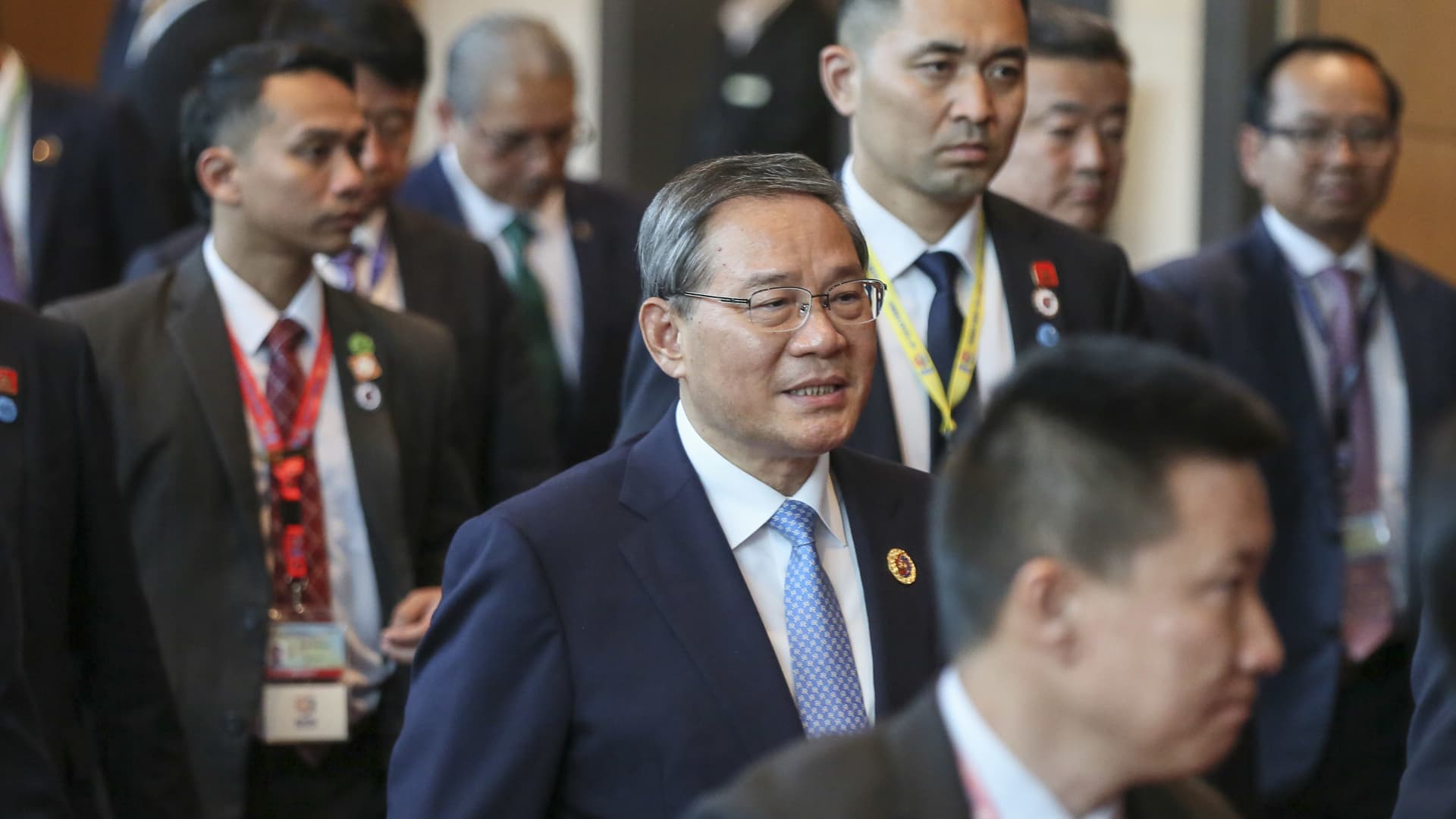
Chinese Premier Li Qiang spoke at the opening ceremony of the ASEAN-China-GCC Economic Forum in Kuala Lumpur, Malaysia, on May 27, 2025.
Sopa Images | Lightrocket | Getty Images
BEIJING — Chinese Premier Li Qiang on Thursday urged the Asian Infrastructure Investment Bank to increase its support for Beijing’s Belt and Road Initiative.
“I hope that the AIIB will stay committed to open regionalism and persevere in promoting connection and communication among Asian countries and countries across the world,” Li said in Mandarin through an official English translation.
“It is important to strengthen the synergy between the bank and the Belt and Road Initiative and Global Development Initiative,” Li said, referring to two Beijing-led programs.
His speech at the opening ceremony of the bank’s 10th annual meeting comes amid a pullback of U.S. support for Western-led institutions such as the World Bank and the International Monetary Fund, which U.S. President Donald Trump claims unfairly benefit other nations.
Premier Li’s “comments signal China’s ongoing attempts to capitalize on the chaos caused by Trump’s trade and economic policies,” said Stephen Olson, a visiting senior fellow at the Institute of Southeast Asian Studies and a former U.S. trade negotiator.
“China is also very aware that the U.S. is trying to pressure countries to tilt away from China (as we saw in the U.K. trade deal) and this is part of its strategy to counteract those efforts,” Olson said in an email.
Under Chinese President Xi Jinping, now in his third term, China launched a regional development program called the Belt and Road Initiative in 2013.
The program is widely viewed as Beijing’s effort to boost its global influence through the development of rail, sea and other transportation routes connecting Asia to Europe and Africa. Critics argue that China’s massive infrastructure project has forced developing nations to take on high debt while benefiting Chinese companies, often state-owned entities.
Xi subsequently announced a broader “Global Development Initiative” in 2021 to promote Beijing-led efforts around poverty alleviation, public health and food security, aligned with the UN’s 2030 Sustainable Development Goals.
The AIIB this week announced that Zou Jiayi, a former Chinese vice finance minister, will become its next president starting in January. Zou also previously represented China as an alternate governor at the World Bank. The former anti-corruption official is also a member of the ruling Chinese Communist Party’s Central Committee, the third-highest circle of power in the country.

AIIB’s current president, Jin Liqun, has served two five-year terms since the bank’s founding and is also a former Chinese vice finance minister.
Indonesia, a founding member of AIIB, has worked with the bank on 14 projects totaling over $5.1 billion, the country’s finance minister, Sri Mulyani Indrawati, said in a closing speech at the same event on Thursday.
“Indonesia is not only generating operating revenue for AIIB, but we [are] also providing enormous experience as well as strong participation,” Indrawati said.
“AIIB is no longer just an emerging bank. It is now a global force for development.”
While the U.S. isn’t a member of AIIB, the U.K., France, Germany are listed among the 110 members of the China-led bank, as are Russia, Israel, Singapore and Vietnam. China has the largest stake in AIIB, holding a 26.5% voting share.
The AIIB provides loans to developing countries, largely for infrastructure projects such as water supply and transportation. The Beijing-headquartered AIIB said it approved $8.4 billion in financing last year, bringing the total to over $60 billion since its launch in 2016.

Subscribe now
On Wednesday, Li urged global business leaders and senior government representatives to collaborate and avoid turning trade into a political or security issue. Engaging in the international economy is a way of “reshaping the rules and order,” he said, via an official English translation.
He was speaking at the World Economic Forum’s annual China conference, dubbed “Summer Davos,” held this year in Tianjin. Li subsequently met with business executives, including JD.com Founder and Chairman Richard Liu.
China’s Minister of Commerce Wang Wentao and Zheng Shanjie, head of the country’s economic planning agency, the National Development and Reform Commission, attended Li’s speech and meeting with businesses on Wednesday, according to state media.



Dario Amodei’s Call to Pace the AI Frontier and Its Market Ripple Effects

Rising Oil Prices And Persistent Inflation Complicate Fed Decision

Bridging the AI Skills Gap: How Gen Z Youth Demographics Are Transforming the Workforce

Armanino adds Strategic Accounting Outsourced Solutions

New 2023 K-1 instructions stir the CAMT pot for partnerships and corporations

Tax Strategy: Employee Retention Credit update
-
 Economics1 week ago
U.S. Inflation Outlook for 2027
-

 Economics5 days ago
Economic Profile of the superpower of western Europe
-

 Economics5 days ago
Sovereign Bond Yield Volatility and Inflationary Shocks Challenge Global Central Banks
-

 Finance5 days ago
Big Tech Enterprise Borrowing Reaches $135 Billion as Hyperscalers Fund AI Infrastructure
-
 Economics2 days ago
Rising Oil Prices And Persistent Inflation Complicate Fed Decision
-

 Accounting2 days ago
Embedded AI and Automated Anomaly Detection Reshape Modern Corporate Accounting Frameworks
-
 Insights2 days ago
Bridging the AI Skills Gap: How Gen Z Youth Demographics Are Transforming the Workforce
-
 Leaders22 hours ago
Dario Amodei’s Call to Pace the AI Frontier and Its Market Ripple Effects