
Finance
Fed holds key rate steady

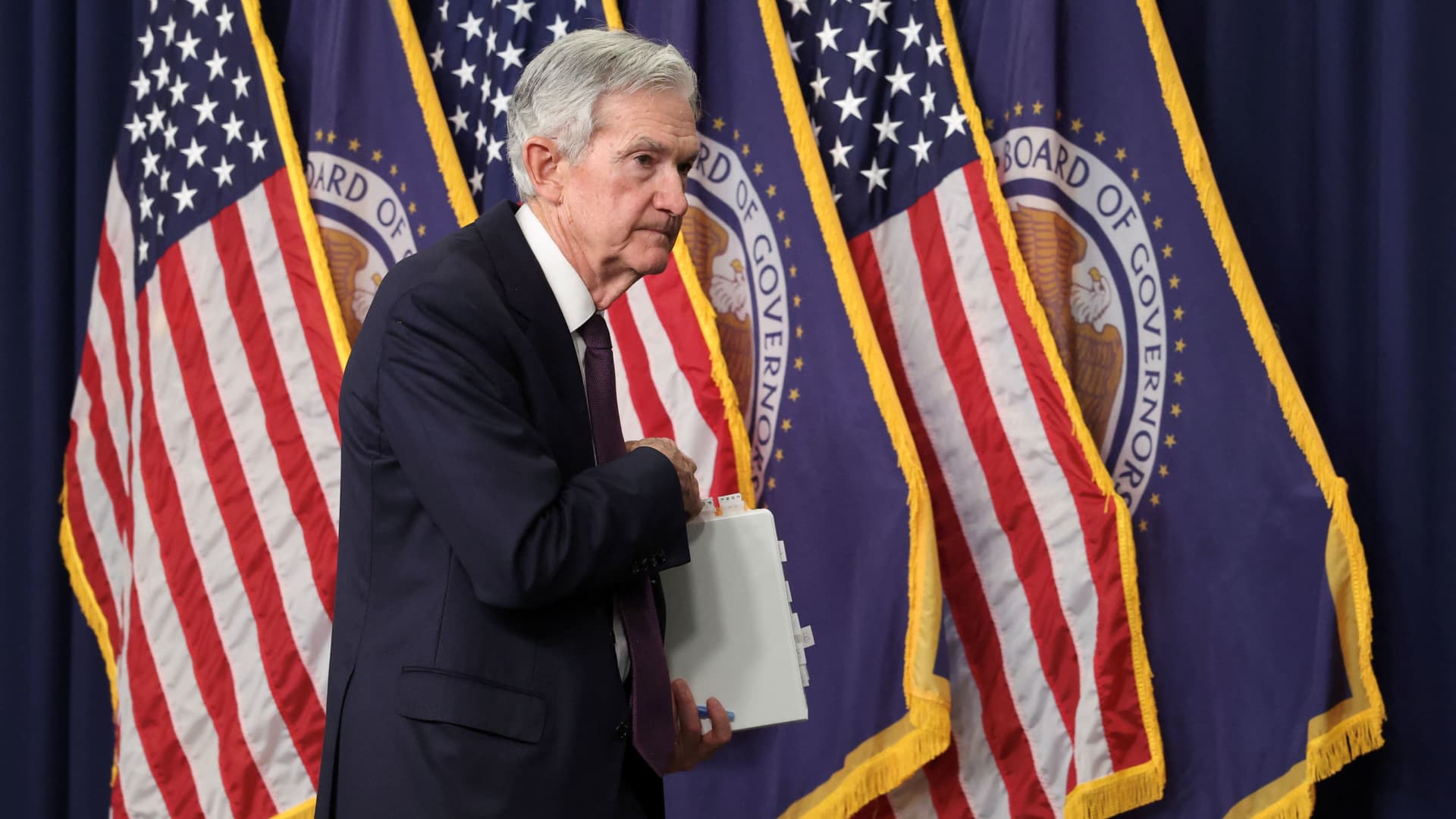

WASHINGTON – The Federal Reserve on Wednesday kept interest rates steady amid expectations of higher inflation and lower economic growth ahead, and still pointed to two reductions later this year.
With markets expecting no chance of a central bank move this week, the Federal Open Market Committee kept its key borrowing rate targeted in a range between 4.25%-4.5%, where it has been since December.
Along with the rate decision, the committee indicated, through its closely watched “dot plot,” that two cuts by the end of 2025 are still on the table. However, it lopped off one cut for both 2026 and 2027, putting the expected future rate cuts at four, or a full percentage point.
The plot indicated continued uncertainty from Fed officials about the future of rates. Each dot represents one official’s expectations for rates. There was wide dispersion on the matrix, with an outlook pointing to a fed funds rate around 3.4% in 2027.
Seven of the 19 participants indicated they wanted no cuts this year, up from four in March. However, the committee approved the policy statement unanimously.
Economic projections from meeting participants pointed to further stagflationary pressures, with participants seeing gross domestic project advancing at just a 1.4% pace in 2025 and inflation hitting 3%.
The revised forecasts from the last update in March represented a decrease of 0.3 percentage point for GDP and an increase of the same amount for the personal consumption expenditures price index. Core PCE, which eliminates food and energy prices, was projected at 3.1%, also 0.3 percentage point higher. The unemployment outlook saw a small revision, up to 4.5%, or 0.1 percentage point higher than March and 0.3 percentage point higher than the current level.
The FOMC statement changed little from the May meeting. Broadly speaking, the economy grew at a “solid pace,” with “low” unemployment and “somewhat elevated” inflation, the committee said.
Moreover, the committee indicated less concern about the gyrations of the economy and the clouds over White House trade policy.
“Uncertainty about the economic outlook has diminished but remains elevated. The Committee is attentive to the risks to both sides of its dual mandate,” the committee said.
Investors will be eager to hear more from Federal Reserve Chairman Jerome Powell at his 2:30 p.m. ET press conference.
While the statement did not elaborate on why uncertainty has ebbed, President Donald Trump has eased some of his fiery trade rhetoric and the White House is in the midst of a 90-day negotiating period over tariffs.
Trump’s rhetoric toward the Fed, however, has not softened.
Earlier in the day, the president again slammed Fed Chair Jerome Powell and his colleagues for not easing. Trump said the fed funds rate should be at least two percentage points lower and derided Powell as “stupid” for not pushing the committee to cut.
Fed officials have been reluctant to move, fearful that tariffs Trump implemented this year could cause inflation in the coming months. Price gauges so far have not indicated that the duties are having much of an impact. A delay in feed-through of the tariffs along with softening consumer demand and a build-up of inventories ahead of the April 2 “liberation day” announcement have helped deflect their impact.
The conflict between Israel and Iran adds another wild card to the policy mix, with prospects of higher energy prices a potential additional factor in keeping the Fed from cutting. The statement did not mention influence from the Middle East fighting.
A gradually softening economy could provide incentive to cut later this year.
Recent labor market data shows layoffs creeping higher, long-term unemployment also rising and consumers spending less. Retail sales tumbled nearly 1% in May and recent data has reflected a cooling housing market, with starts hitting their lowest level in five years.
For Trump, though, the importance of lower rates stems from the high cost the government is paying to finance its $36 trillion debt.
Interest on the debt is on track to total $1.2 trillion this year and exceeds all other budget items except Social Security and Medicare. The Fed last cut in December, and Treasury yields have held higher throughout the year, putting additional pressure on a budget deficit likely to approach $2 trillion, or more than 6% of gross domestic product.




Dario Amodei’s Call to Pace the AI Frontier and Its Market Ripple Effects

Rising Oil Prices And Persistent Inflation Complicate Fed Decision

Bridging the AI Skills Gap: How Gen Z Youth Demographics Are Transforming the Workforce

Armanino adds Strategic Accounting Outsourced Solutions

New 2023 K-1 instructions stir the CAMT pot for partnerships and corporations

Tax Strategy: Employee Retention Credit update
-
 Economics1 week ago
U.S. Inflation Outlook for 2027
-

 Economics5 days ago
Economic Profile of the superpower of western Europe
-

 Economics5 days ago
Sovereign Bond Yield Volatility and Inflationary Shocks Challenge Global Central Banks
-

 Finance5 days ago
Big Tech Enterprise Borrowing Reaches $135 Billion as Hyperscalers Fund AI Infrastructure
-
 Economics2 days ago
Rising Oil Prices And Persistent Inflation Complicate Fed Decision
-

 Accounting2 days ago
Embedded AI and Automated Anomaly Detection Reshape Modern Corporate Accounting Frameworks
-
 Insights2 days ago
Bridging the AI Skills Gap: How Gen Z Youth Demographics Are Transforming the Workforce
-
 Leaders23 hours ago
Dario Amodei’s Call to Pace the AI Frontier and Its Market Ripple Effects