
Finance
Jensen Huang lauds China’s AI models as Nvidia set to resume chip exports

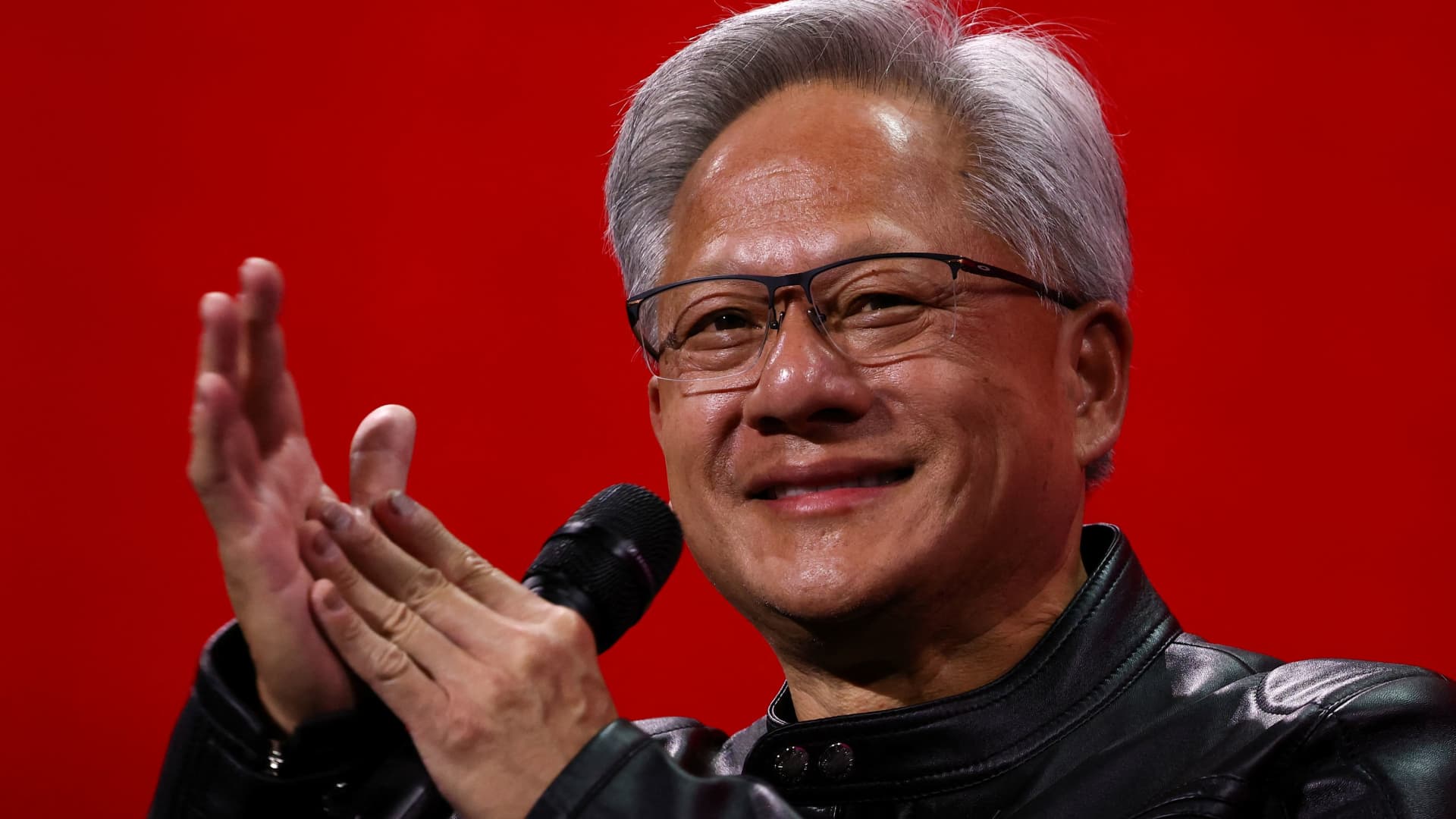
Nvidia CEO Jensen Huang attends a roundtable discussion at the Viva Technology conference dedicated to innovation and startups at Porte de Versailles exhibition center in Paris on June 11, 2025.
Sarah Meyssonnier | Reuters
BEIJING — Nvidia CEO Jensen Huang praised China’s generative artificial intelligence models, a day after the U.S. chipmaker said it expected to resume sales of a key AI chip to the country soon.
“Models like DeepSeek, Alibaba, Tencent, MiniMax, and Baidu Ernie bot are world class, developed here and shared openly [and] have spurred AI developments worldwide,” Huang said. He was speaking Wednesday at the opening ceremony of a supply chain expo in Beijing. He is scheduled to hold a press conference later in the day.
“More than 1.5 million developers in China build on Nvidia today to bring their innovations to life,” he said.
China-developed DeepSeek shocked global investors in January with an AI model that undercut OpenAI on development and operating costs. It’s not clear how DeepSeek managed to develop the model under broad U.S. chip restrictions on China, but the startup’s parent, High-Flyer, reportedly stockpiled Nvidia chips.
Nvidia on Tuesday said it expected to resume its H20 chip shipments to China soon following assurances from the U.S. government. The company was forced to halt the sales in April due to new U.S. requirements at the time.

U.S. chip restrictions nearly halved Nvidia’s share in China, Huang said in May. Due to the U.S. export controls on China, the company said it missed out on $2.5 billion in sales during the April quarter, and will likely take another $8 billion hit in the July quarter, pegging its quarterly sales at $45 billion.
Huang has warned that Chinese telecoms giant Huawei stands to benefit from U.S. AI chip curbs on exports to the Asian country.
Jensen is on his third trip to China this year, according to reports going back to January.
In the global race for AI, Chinese companies Alibaba, Tencent and Baidu have all rushed to release their own AI models despite limited access to training chips. OpenAI’s ChatGPT chatbot is also not officially available in China.
Praise for open-source approach
Huang on Wednesday also praised Chinese companies for taking an open-source approach to AI, meaning developers can access the underlying code for free. Notably OpenAI in the U.S. has not yet taken this approach. Alibaba-backed startup Moonshot last week released a new open source model called Kimi K2 that claims to beat OpenAI’s ChatGPT and Anthropic’s Claude on certain coding metrics.
“China’s open-source AI is a catalyst for global progress, giving every country and industry a chance to join the AI revolution,” Huang said. He added that open-source technology is also “key” for AI safety and enables international cooperation on standards.
Huang also described how AI “powers” Chinese consumer tech such as Tencent’s WeChat social media app, Alibaba’s Taobao shopping app, ByteDance’s Douyin short-video app and Meituan’s “super convenient” delivery.
The latest U.S. government restrictions on Nvidia had followed tighter export controls over the last three years that prevent American companies from selling advanced semiconductors to China over concerns that the tech will support the development of Beijing’s defense sectors.
Huang has pushed back against concerns that China’s military would use U.S. technology, and emphasized global access was needed for the country to remain a world leader in AI, according to an interview with CNN that aired Sunday.
Following U.S.-China trade talks in London last month, the U.S. has started to ease some restrictions on high tech exports to China, while Beijing has resumed some issuance of licenses that allow its companies to export critically needed rare earths to the U.S.
– CNBC’s Dylan Butts contributed to this report.





Dario Amodei’s Call to Pace the AI Frontier and Its Market Ripple Effects

Rising Oil Prices And Persistent Inflation Complicate Fed Decision

Bridging the AI Skills Gap: How Gen Z Youth Demographics Are Transforming the Workforce

Armanino adds Strategic Accounting Outsourced Solutions

New 2023 K-1 instructions stir the CAMT pot for partnerships and corporations

Tax Strategy: Employee Retention Credit update
-
 Economics1 week ago
U.S. Inflation Outlook for 2027
-

 Economics5 days ago
Economic Profile of the superpower of western Europe
-

 Economics5 days ago
Sovereign Bond Yield Volatility and Inflationary Shocks Challenge Global Central Banks
-

 Finance5 days ago
Big Tech Enterprise Borrowing Reaches $135 Billion as Hyperscalers Fund AI Infrastructure
-
 Economics2 days ago
Rising Oil Prices And Persistent Inflation Complicate Fed Decision
-

 Accounting2 days ago
Embedded AI and Automated Anomaly Detection Reshape Modern Corporate Accounting Frameworks
-
 Insights2 days ago
Bridging the AI Skills Gap: How Gen Z Youth Demographics Are Transforming the Workforce
-
 Leaders22 hours ago
Dario Amodei’s Call to Pace the AI Frontier and Its Market Ripple Effects