Connect with us

Accounting

Local firm slashes staff starting salaries

Published

on

To improve firm profitability, local firm Watts, Taber and Fiske has made an innovative move to reduce full-time starting salaries for new college recruits to $38,000. 

WTF managing partner Bill Billings noted, “With all the newly available IRS agents and easing of CPA licensure requirements, finding and doing the job of an entry-level professional is now super easy, so it only seems fair to align their compensation with our firm’s profitability goals.” 

Market research

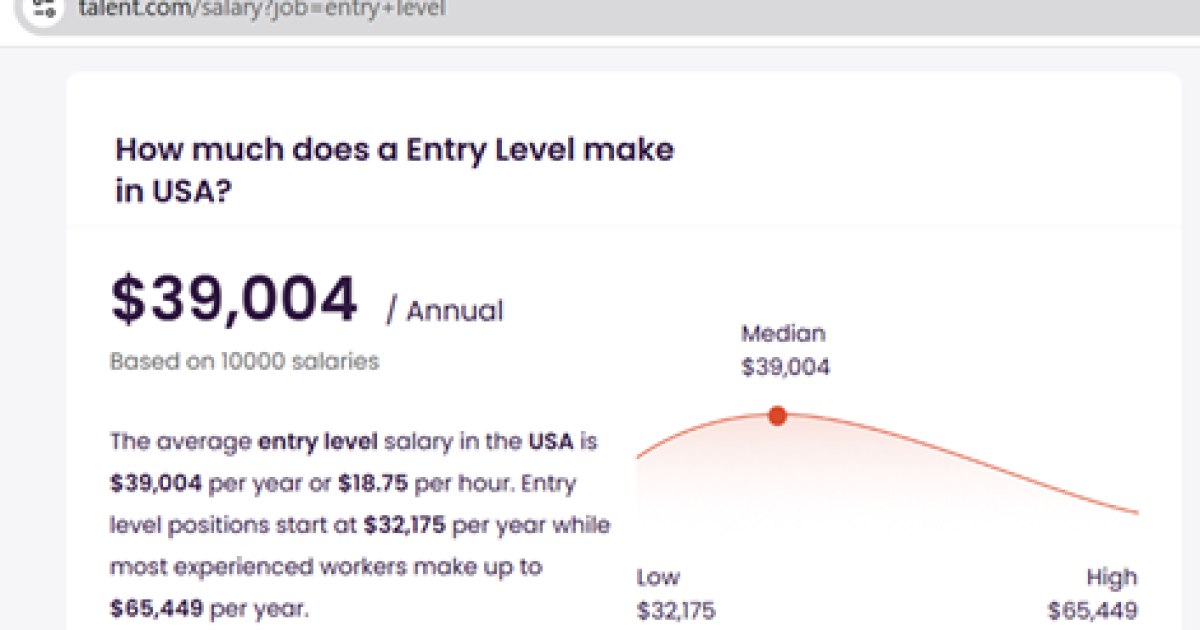
Mr. Billings performed online research and confirmed via talent.com that the average starting salary for “entry level” in the United States was $39,000. Pretty close to $38,000, and that extra $1,000 should keep those new staffers hungry to work hard to earn their next slightly-below-cost-of-living increase. 

Entry level salary graphic

Knowing that college students have a choice of major, Billings felt that paying half the starting rate of other professionals was more aligned with the work product he was getting from new graduates. In the past, accounting was one of the more lucrative career choices, making it attractive to freshmen and sophomores choosing their career destinations. But the productivity decline of “this generation” certainly didn’t warrant that. 

To determine how far to reduce entry-level salaries, WTF looked to other average professional starting salaries, then applied an approximate 50% multiple:

Software engineer: $78,000
Information science and systems: $74,000
Computer science: $75,000

Source: National Association of Colleges and Employers Winter 2024 Salary Survey 

New hire sentiments

Regarding the change to a $38,000 starting salary at Watts, Taber and Fiske, we interviewed several new hires to hear their thoughts. 

Audit associate Audrey felt positive, saying, “This salary easily covers both my clothes and gas for my 90-minute commute to the office. Luckily, I don’t have to pay rent because I still live with my parents. I might have to save for a few years to be able to pay for my wedding, but that’s OK.”

Tax associate Tanner felt less excited about the proposition. “I mean, this is the only offer I got, so I guess I’m glad to have it. Anyway, mostly I play the Clash of Clans video game during the day, except when someone is walking by my desk. Hopefully, no one wants me to learn the tax regulations, ʼcause that sounds difficult, and I’m not really into difficult.” 

When we asked Simon, an associate at competing firm Yates, Abrams + Yang, who also had received an offer from WTF, he noted, “Making $75,000 my first year gets me excited about my future here, knowing I can save to buy an affordable starter home, if I can find one, and progress with promotions and raises to a middle-class lifestyle.” 

Partner responses

Founding partner Fiske noted that his grandkids’ private school tuition and yacht club membership dues have grown significantly, and total partner comp of $850,000 wasn’t sufficient to reach his personal financial goals. If he could get another $10K from each new kid, that would ease the burden a bit. This move seemed like a no-brainer.

Retired partner Taber, who still attends partner meetings, suggested that perhaps keeping steady, or slightly increasing, staff pay might benefit the firm’s succession planning overall, as more partners are looking to retire. The current owners agreed but decided to leave that challenge to the next generation. 

At press time, the firm was engaging in talks with private equity to discuss the optimal exit strategy. 

Continue Reading

Accounting

FASB Standardizes Carbon Offsets Accounting Rules

Published

on

FASB Standardizes Carbon Offsets Accounting Rules

In a decisive move toward standardized environmental financial reporting, accounting standards boards issued updated implementation guidance during the week ending July 25, 2026, regarding the formal recognition and valuation of corporate carbon offsets and environmental credits. The revised frameworks establish precise rules for how enterprises must measure, record, and disclose carbon credits on balance sheets, eliminating years of inconsistent reporting practices across public capital markets.

Under the finalized accounting standard, purchased carbon offsets can no longer be categorized under vague administrative expenses or unstandardized intangible asset accounts. Instead, organizations must classify environmental credits based on underlying operational intent—distinguishing between credits held for immediate compliance compliance obligations, long-term offset obligations, or active market trading. Furthermore, companies are required to evaluate carbon holdings for fair value impairment at the end of each reporting period, ensuring that depreciated or low-quality environmental credits do not distort corporate asset values.

The standardized rules carry significant implications for corporate audit committees and chief accounting officers. External audit firms are implementing rigorous verification protocols to validate the physical legitimacy, legal ownership, and scientific permanence of carbon credits claimed on balance sheets. Inaccurate or overstated carbon accounting claims now carry substantial financial litigation risk, alongside potential regulatory enforcement for misleading ESG disclosures.

To remain fully compliant, corporate accounting departments must establish centralized carbon tracking systems integrated into primary standard ERP ledgers. Accounting teams that proactively adopt standardized environmental reporting protocols will build investor credibility, streamline annual audit processes, and insulate their organizations against evolving regulatory scrutiny.

Continue Reading

Accounting

Automated Tax Compliance Tools Reduce Risk

Published

on

Automated Tax Compliance Tools Reduce Risk

Corporate tax departments reached a critical juncture in automated operational management. With nations worldwide rapidly enacting digital service taxes, localized value-added tax (VAT) mandates, and real-time electronic invoicing requirements, manual tax calculations have become obsolete. Modern corporate tax divisions are aggressively deploying AI-driven tax engine software to automate complex cross-border indirect tax calculations in real time.

The imperative for automated tax compliance stems from the sheer complexity of current trade policies and multi-jurisdictional commerce. E-commerce platforms, software vendors, and global manufacturers face constantly changing regional tax rates, statutory exemption rules, and cross-border tariff structures. Automated tax engines embed directly into enterprise enterprise resource planning (ERP) architectures, automatically applying correct tax codes at the point of sale, calculating real-time withholding amounts, and generating compliant e-invoices.

Automated audit trail generation represents another key advantage of modern tax tech integration. Advanced compliance platforms log every transactional tax determination on immutable digital ledgers, providing tax authorities with transparent, self-verifying audit trails. This capability drastically reduces the operational duration and administrative cost of corporate tax audits, protecting enterprises against severe penalties resulting from calculation errors or missed reporting deadlines.

For chief financial officers and tax directors, investing in automated tax compliance is a vital operational risk mitigation strategy. Automating routine tax calculations frees high-level accounting professionals to focus on strategic tax planning, transfer pricing optimization, and risk management in an increasingly complex global economic environment.

Continue Reading

Accounting

Continuous Auditing Transforms Corporate ERPs

Published

on

continuous auditing transforms corporate erps

As corporate accounting departments cross the threshold into late July 2026, the adoption of continuous, automated auditing systems has reached a definitive turning point. Driven by advances in artificial intelligence and deep integration with modern Enterprise Resource Planning (ERP) platforms, leading finance organizations are moving away from traditional, periodic post-hoc audits in favor of real-time, 100% transactional verification. This technological transition is redefining internal control environments, reducing compliance costs, and eliminating the structural delays inherent in legacy quarterly closing processes.

Unlike traditional auditing frameworks that rely on statistical sampling—a process that inevitably leaves operational blind spots—continuous auditing software monitors operational data feeds continuously. Every purchase order, electronic invoice, payroll disbursement, and cross-border wire transfer is automatically cross-referenced against established corporate governance parameters, regulatory tax schedules, and anti-fraud algorithms in real time. Anomalies or unauthorized ledger entries are flagged instantly, allowing internal audit teams to investigate and remediate compliance gaps immediately rather than months after the close of a financial period.

The implications for executive financial management are far-reaching. By embedding continuous verification directly into daily transaction workflows, chief financial officers gain uninterrupted visibility into the organization’s true financial standing. Real-time balance sheet auditing eliminates the severe operational bottlenecks associated with month-end and quarter-end financial reconciliations, freeing accounting professionals to focus on strategic financial modeling, tax planning, and capital allocation rather than manual data entry and spreadsheet consolidation.

However, implementing continuous auditing requires accounting leadership to invest heavily in data governance and technical upskilling. Internal audit teams must evolve from manual ledger reviewers into system architects capable of auditing complex algorithms and validating automated data pipelines. Accounting firms and corporate controllers that master continuous auditing will establish a resilient compliance framework capable of meeting stringent international regulatory standards with total transparency.

Continue Reading

Trending