
Finance
Nasdaq wants Chinese companies to pay $25 million per U.S. IPO

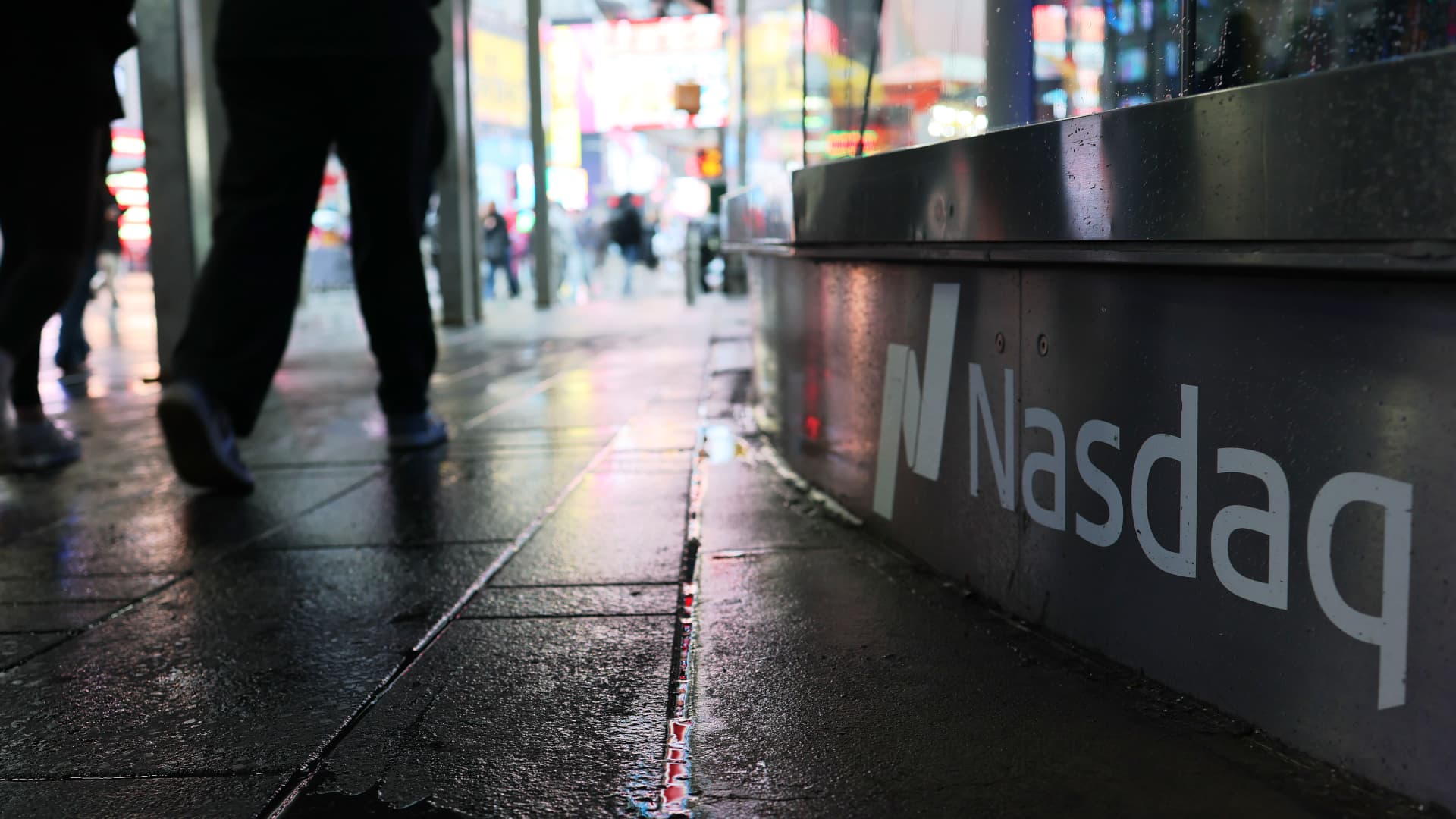
The Nasdaq Marketsite is seen during morning trading on April 7, 2025 in New York City.
Michael M. Santiago | Getty Images
BEIJING — The Nasdaq stock exchange in the U.S. is planning to make it harder for small Chinese companies to list in New York, after a flood of tiny initial public offerings.
As part of proposed changes, companies operating primarily in China will need to pay at least $25 million from their public offering, Nasdaq said late Wednesday local time.
The move comes as tensions between the U.S. and China simmer, and as the Nasdaq faces broader financial market issues.
“It will be more difficult for small Chinese companies to go IPO [on the] Nasdaq under the new rule,” said Winston Ma, adjunct professor at NYU School of Law. “The new rule reacts to some IPO cases of ‘pump and dump’ due to small float size.”
There have been been few large Chinese IPOs in the U.S. since the fallout around ride-hailing company Didi’s New York listing in 2021. But in 2024, 35 small China-based companies listed in New York, roughly twice the 17 U.S.-based microcap listings, Renaissance Capital said in December.
Microcaps typically refer to stocks with market capitalizations of between $50 million and $300 million, meaning the companies raised only a few million in the initial public offering. A $25 million fee would wipe out much of the money raised in a small IPO.
The rule change is “a positive,” said Gary Dvorchak, managing director at Blueshirt Group, whose business includes advising Chinese companies on IPOs. “I think it’s going to instill more confidence that the companies are listing are doing it for legitimate reasons and there’s less likely to be games being played with the stock and it really protects the companies as well.”

Nasdaq noted the Chinese listings pose greater risk to U.S. investors due to U.S. inability to take legal action “against entities and individuals involved in potentially manipulative trading activities in these securities.”
“Further, the Exchange has observed that Chinese companies listing on Nasdaq in connection with an IPO with an offering size below $25 million have a higher rate of compliance concerns,” Nasdaq said.
The U.S. Securities and Exchange Commission needs to formally approve Nasdaq’s proposal. Companies already in the IPO process would then have 30 days to complete the process under prior rules, Nasdaq said, while all subsequent listings would have to comply with the changes.
The New York Stock Exchange, which typically only handles far larger IPOs, did not immediately respond to a request for comment outside of U.S. business hours. The SEC and China’s Securities Regulatory Commission did not immediately respond either.
Tensions on the boil?
The Nasdaq’s listing payment requirement is “another example of the multitude of ways in which conducting business, trade and investment relations between the two countries is growing more complex and difficult,” said Stephen Olson, a visiting senior fellow at the ISEAS-Yusof Ishak Institute.
In fact, the New York exchange’s rule change came on the heels of Beijing’s announcement late Wednesday that it would slap new punitive tariffs on some U.S. optical fiber producers, effective Thursday.
“China is saying: we are prepared to fight fire with fire,” Olson said. “The trade truce is just a temporary band-aid. It could collapse at any time.”
China’s Ministry of Commerce cited a six-month investigation that found that some U.S. exporters had skirted China’s anti-dumping levies by selling a modified version of the optical fiber.
New York-headquartered optical fiber producer Corning now faces a 37.9% duty on the product’s exports to China, OFS Fitel 33.3% and Draka Communications Americas 78.2%.
For its overall business, Corning counted China as its largest source of revenue outside the U.S., contributing 32% of its total sales revenue in 2024, according to the company earnings report.
The company and the U.S. Commerce Department did not immediately respond to a request for comment.
China has a deficit of $57 million in optical fiber trade with the U.S. in the first seven months this year, according to the official customs figures.
That imbalance may have given Beijing the “technical pretext to act,” said Tianchen Xu, senior economist at Economist Intelligence Unit, noting that the items that China imports from the U.S. are largely more advanced and thus more expensive per item.
“The exchange of fire [between the U.S. and China] will continue in many ways,” Xu predicts, which might derail plans for a meeting between the two countries’ presidents.
The decision came a day after Washington revoked Taiwan Semiconductor Manufacturing Co’s authorization to ship key chipmaking equipment and technology to its manufacturing plant in China, the latest move to curb Beijing’s semiconductor advances.
China’s optical fiber tariff “signals displeasure” on recent U.S. moves to restrict Beijing’s access to advanced chips and participation in the undersea cable supply chain, said Alfredo Montufar-Helu, managing director at advisory firm GreenPoint.
But the tariff is “also targeted and restrained enough to avoid shattering months of trade negotiations. And it also serves as a reminder that China’s leverage extends beyond rare earths,” Montufar-Helu said.
Years of growing of scrutiny
While China has sought to encourage domestic financial development, it has also been keen to control capital outflows, including stock offerings overseas. New policies in the last three years have required Chinese companies to get the securities regulator’s approval for overseas listings, especially if their business has a large domestic user base.
Stateside, Nasdaq’s move marks a big step in what’s been growing regulatory scrutiny on tiny Chinese IPOs over the last several years.
Underwriters for IPOs with market capitalizations below $600 million saw their average commission triple over four years to 12% in 2020, the Hong Kong stock exchange and local securities regulator said in a joint statement back in May 2021.
Then in November 2022, the Financial Industry Regulatory Authority in the U.S. warned investors about “significant unusual price increases on the day of or shortly after the IPOs of certain small-cap issuers, most of which involve issuers with operations in other countries.” The notice mentioned China in particular.
FINRA added it “has concerns” about how foreign nationals have opened accounts at U.S. broker-dealers to invest in IPOs and then placed “manipulative orders and trades to inflate aftermarket prices.”
In a FINRA podcast dated Nov. 12, 2024, Peter Gonzalez of the special investigations unit said the “ramp and dump” schemes have evolved — now occurring weeks or months after the IPO, instead of only a few days.

Subscribe now




Dario Amodei’s Call to Pace the AI Frontier and Its Market Ripple Effects

Rising Oil Prices And Persistent Inflation Complicate Fed Decision

Bridging the AI Skills Gap: How Gen Z Youth Demographics Are Transforming the Workforce

Armanino adds Strategic Accounting Outsourced Solutions

New 2023 K-1 instructions stir the CAMT pot for partnerships and corporations

Tax Strategy: Employee Retention Credit update
-
 Stock News1 week ago
S&P 500 September Outlook: Tech Rally Holds Index at 7,600
-
 Finance1 week ago
S&P 500 Outperforms Amid Strong Corporate Earnings as Treasury Yields Cap Equity Multiples
-
 Accounting1 week ago
Mandatory ESG Reporting Standards Demand Standardized Non-Financial Audit Trails
-

 Insights1 week ago
Climate Resilience and Offshore Wind and Land Restoration Milestones
-

 Leaders1 week ago
India Unveils ‘Saptadhara’ Reform Agenda Targeting Technology, Youth Skilling, and Growth
-
 Economics1 week ago
U.S. Inflation Outlook for 2027
-

 Economics5 days ago
Economic Profile of the superpower of western Europe
-

 Economics5 days ago
Sovereign Bond Yield Volatility and Inflationary Shocks Challenge Global Central Banks