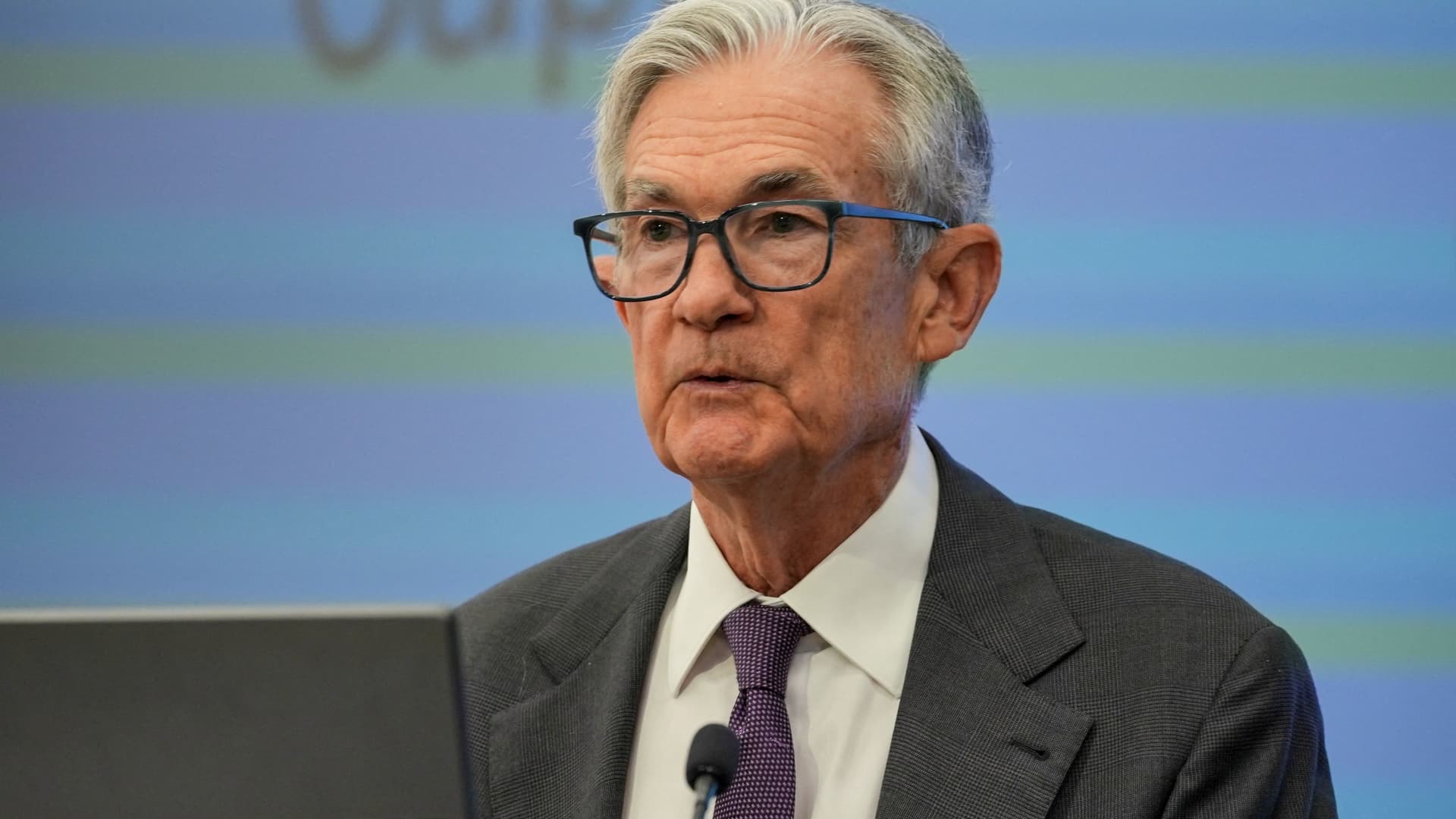
Federal Reserve Chair Jerome Powell is set to deliver what almost certainly will be his last keynote address at the central bank’s annual conclave during one of the most tumultuous times in its history.
What’s at stake is the near-term sentiment for financial markets, the longer-term path of the Fed’s policy trajectory, and a not insignificant dose of trying to preserve vestiges of independence at a time when the normally sacrosanct institution is facing enormous political pressure.
If Friday’s speech at Jackson Hole, Wyoming, goes at all like Powell’s first seven-plus years in office, it will feature a calm and collected veneer even if masking the weight that he and his colleagues have been under all year.
“He’s done a good job in terms of keeping the Fed’s independence, ignoring the noise and some of the questions he gets, and keeping it focused on the data dependency and the Fed’s dual mandate,” said Michael Arone, chief investment strategist at State Street Global Advisors. “He’s taken the high road as it relates to the Fed’s independence and some of the pressure he’s clearly getting from the Trump administration. So I think that he’ll continue to kind of walk that line.”
Indeed, President Donald Trump has kept up a near constant drumbeat against Powell and his colleagues. As he did during much of his first term, Trump has badgered Powell to lower interest rate cuts. But in recent days the president’s attacks on the Fed have gone past mere monetary policy.
Earlier this summer, the White House lashed out at the Fed for a major reconstruction project at its Washington, D.C. headquarters. That coincided with a period when Trump toyed with removing Powell, though he later backed off the idea.
Then this week the administration trained its focus on Fed Governor Lisa Cook, accusing her of mortgage fraud regarding two federally backed loans she took.
Amid the controversies, Powell could use the speech to at least take a swipe at the political distractions, even if he holds to past practice of not taking direct aim.
Politics and policy
“He’s going to take a jab and talk about fed independence, because what does he have to lose really at this point?” said Dan North, senior economist at Allianz Trade North America. “It seems pretty clear that Trump can’t legally fire him. He can certainly put all kinds of tremendous pressure on him. And I think it’s an opportunity for Powell to say the central bank’s got to stay independent, and that’s what we’re going to do.”
Beyond the politics there’s policy, and that also will be challenge.
The speech is billed as an “Economic Outlook and Framework Review,” indicating Powell will take time to provide his views on broad conditions as well as discuss the Fed’s long-term policy goals, a review that occurs every five years.
Markets are expecting Powell to tee up a September rate cut. At each of his previous Jackson Hole speeches, starting in 2018, he indicated significant policy shifts. From pushing for quarterly cuts in that first speech to a pivotal switch in how it would view inflation in 2020 to last year’s nod towards an aggressive September move, markets have taken their cues from the chair’s keynote.
Wall Street commentary reflects similar expectations this time around, if in somewhat subtler terms.
“We do not expect Powell to decisively signal a September cut, but the speech should make it clear to markets that he is likely to support one,” Goldman Sachs economist David Mericle said in a note.
Kansas City Fed President Jeffrey Schmid, whose district hosts the Jackson Hole event, told CNBC on Wednesday that he isn’t sold yet on a September cut and will need to see more data. In fact, only Governors Christopher Waller and Michelle Bowman have overtly signaled they favor a move next month.
“We suspect that most FOMC participants who have expressed mixed feelings about cutting in September will be willing to support a cut if Powell pushes for one, but that he will think it more reasonable to make that case to them closer to the meeting with more data in hand,” Mericle said.
Inflation vs. unemployment
Key points to watch will be how Powell characterizes the labor market and his view on the inflation pass-through from Trump’s tariffs.
Shortly after the July Fed meeting, the Bureau of Labor Statistics announced meager job growth for July and even weaker gains for May and June. However, multiple policymakers have used the word “solid” to describe the labor market, indicating they see less urgency for rate cuts.
Minutes from the July meeting indicated most FOMC members see a greater worry over inflation. Regional presidents Beth Hammack from Cleveland, Atlanta’s Raphael Bostic and Schmid in Kansas City have expressed skepticism about the need for a September cut, a position that could rile Trump and upset the market.
Powell “is likely to remain careful and not pre-commit in advance to a September cut, which could disappoint some investors,” wrote Krishna Guha, head of global policy and central bank strategy at Evercore ISI. “Much of his speech may try to provide a steady medium- to longer-term framing for policy strategy and inflation control.”
That framing could be critical as well, and is getting little attention from Wall Street so far.
Five years ago, against a backdrop of the Covid pandemic and protests over police brutality, the Fed adopted what it called “flexible average inflation targeting.” Essentially, the framework change would allow the Fed to let inflation run hot if unemployment was higher, particularly for underrepresented groups.
Over the next couple years, the Fed stood pat while inflation hit its highest level in more than 40 years. While most officials say the inflation targeting change did not play a role in the widely-held view that inflation was “transitory,” the policy is likely to get a retooling, with the Fed returning to its previous inflation stance that included preemptive action if inflation appeared to be rising.
“While the adoption of the new framework in 2020 was not the primary factor behind the Fed’s delay and the substantial inflation overshoot, it contributed to this outcome,” Matthew Luzzetti, Deutsche Bank chief U.S. economist, said in a note. “For this reason, we expect Powell’s speech in Jackson Hole to highlight changes to the Fed’s statement on longer-run goals that will reflect this reality. Specifically, we expect the speech to call for rolling back the 2020 modifications and restoring a primary role for preemption.”
Luzzetti added that the Friday speech “could arguably not come at a more important time” and he expects Powell to change his tone on the labor market.
Powell’s speech will be presented at 10 a.m. ET. The conference wraps up Saturday.







 Stock News1 week ago
 Finance1 week ago
 Accounting1 week ago
 Insights1 week ago
 Leaders1 week ago
 Economics1 week ago
 Economics5 days ago
 Economics5 days ago