
Finance
Trump faces a variety of choices as he seeks to fill Fed vacancies

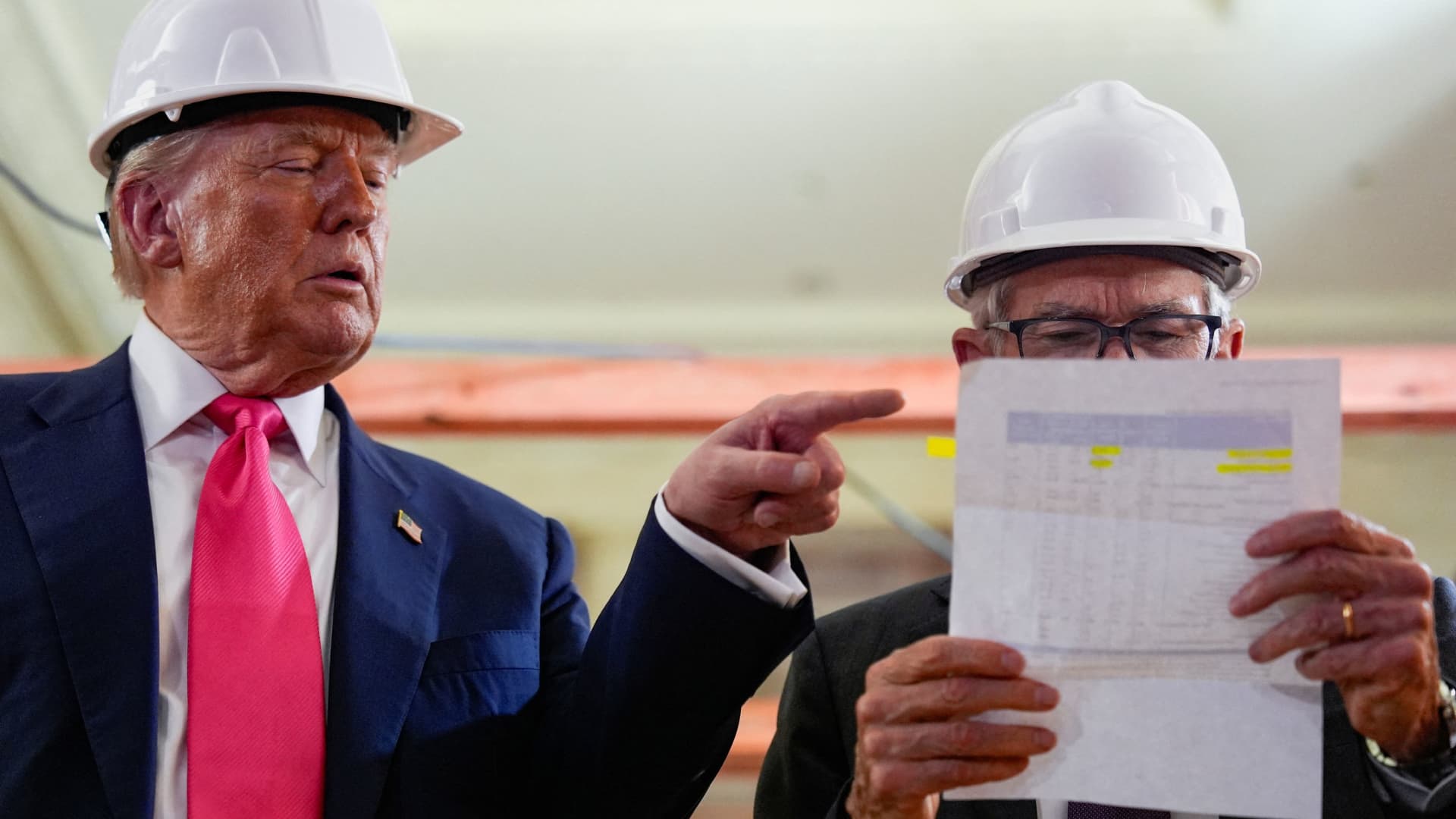
U.S. President Donald Trump points towards Federal Reserve Chair Jerome Powell holding a document during a tour of the Federal Reserve Board building, which is currently undergoing renovations, in Washington, D.C., U.S., July 24, 2025.
Kent Nishimura | Reuters
Federal Reserve Governor Adriana Kugler’s surprise resignation last week brought back a scenario that seemed to be fading but could have important ramifications for how the central bank conducts policy.
With the open seat on the influential central bank board, President Donald Trump now has a number of strategic options, including one where he could appoint a so-called shadow chair whose job would be largely to serve as an instigator until a successor to current Chair Jerome Powell could be named.
This in turn raises the tantalizing possibility that an institution historically known for collegiality and an ivory-toweresque approach to policy now will have to deal with a sudden dose of political intrigue.
Will Trump use the position to nominate a gadfly to torment Powell, a frequent target of blistering criticism from the president, or pursue a different strategy focused more on the long-term direction of the Fed?
“The president has two options. One is he can put a stop-gap appointment to fill the Kugler seat for the remaining four months of the unexpired term,” Krishna Guha, head of global policy and central bank strategy at Evercore ISI, said Wednesday on CNBC. “Or he could just decide to compress the entire process and pick the person he wants to be the Fed chair now.”

Kugler’s decision to leave the Fed with little notice would be important under normal circumstances, but the nature of her situation on the board raises the ante.
Former President Joe Biden in 2023 named Kugler to the position, succeeding Lael Brainard, who moved over to the White House to serve as a senior economic advisor. Kugler served less than two years of Brainard’s unexpired term and left with only about six months remaining, accounting for the couple of months it will take for her replacement to be confirmed.
Taking into account the Senate calendar, the new governor would serve at best three or four months, then have to undergo yet another confirmation hearing should Trump decide to reappoint the person.
While Trump could be tempted to go the shadow-chair route — Treasury Secretary Scott Bessent in the past has advocated for that course — it might be an unappetizing choice for the nominee.
The shadow chair “is still just going to be one person among many, not enjoying the powers of the office of chairman,” Guha said.
‘Apprentice’ Fed-style
For Trump, though, selecting a shadow chair would be in keeping with his affinity for conflict and making people prove themselves, Guha added.
“He likes to run things like ‘Celebrity Apprentice,'” Trump’s former reality show on NBC, Guha said. “He likes to have people trialing, dueling it out with each other. So he might be tempted with the idea of putting somebody in the seat for a few months, see how they do, if they pass the audition, then be given the nod for the next Fed chair. So I suspect he’s probably pulled in both directions here.”
The time span that came with Kugler’s announcement carries added risk. If she had stayed in the seat, the appointment wouldn’t have come at least until her term expired in January and would have been for a full 14-year term on the board. The window between now and then created by the resignation carries both opportunity and peril.
Accepting such an appointment also is a dicey proposition.
Trump has made it clear he will only appoint governors who are in favor of cutting rates. The president has stated that he not only wants reductions, but is looking for dramatic moves, along the lines of 3 percentage points. Former Fed Chair and past Treasury Secretary Janet Yellen said on CNBC that Trump’s rate demands “should be frightening to markets.”
“A shadow chairman with only four months to go has some risk,” said Brian Gardner, chief Washington policy strategist at Stifel. “Someone can say something that annoys Trump. Maybe there they have to take a position that Trump doesn’t like. Just the time that we’re talking about increases the chances of that happening so it becomes a more difficult option. That being said, I think the administration thinks it’s an attractive idea, and does give them some flexibility.”
The next chair
The alternative to a shadow chair, at least regarding the Kugler vacancy, is to appoint the actual person who Trump wants to serve as chair, with the understanding that they would be nominated when Powell exits.
In that case, it would present a more conventional approach and not push the new governor into a potentially adversarial relationship with colleagues with whom he or she will serve for potentially the next 14 years.
“Maybe they do this as kind of a backup plan to make sure that they have the person they want in place when the Powell chairmanship ends in in May,” Gardner says.
White House officials did not respond to a request for comment.
Trump told CNBC on Tuesday that he has the choice for Kugler’s seat down to four finalists — former Governor Kevin Warsh, National Economic Council director Kevin Hassett and two unnamed candidates. One of those in contention is thought to be current Governor Christopher Waller. Other names mentioned included economist and former World Bank President David Malpass as well as economist Judy Shelton, whom Trump tried to appoint during his first term but failed to clear Senate approval.
Betting markets are split between Warsh and Hassett as the favorite, with Shelton also drawing some interest. Treasury Secretary Scott Bessent has taken himself out of contention, Trump told CNBC.
Assuming Powell leaves the board after his tenure as chair ends, Trump has the chance to hold a majority of his appointees on the seven-member group. However, he would not have a majority on the rate-setting Federal Open Market Committee, which entails the seven governors plus a rotating cast of five regional presidents. His current appointees are Christopher Waller and Michelle Bowman, who also is the vice chair in charge of bank supervision.
Trump has promised a decision in the next few days. However, he also said he would name a Powell successor weeks ago and has not done so yet.
Yellen and others have criticized Trump for leaning so hard against the Fed for lower rates, something that previous presidents have done but in a much less public manner.
The concern is that Trump is treading on the Fed’s independence, something officials feel is vital for proper monetary policy free of political influence.
“There is going to be a bit of an institutional pushback from the Fed,” Gardner said, noting that Powell was at the Treasury Department in the early 1990s when President George H.W. Bush was pressuring then-Fed Chair Alan Greenspan for lower rates. “I think it’s in a secure enough place for now, but things can change. So I don’t think it’s existential now, but of course, it’s a fluid situation.”



Dario Amodei’s Call to Pace the AI Frontier and Its Market Ripple Effects

Rising Oil Prices And Persistent Inflation Complicate Fed Decision

Bridging the AI Skills Gap: How Gen Z Youth Demographics Are Transforming the Workforce

Armanino adds Strategic Accounting Outsourced Solutions

New 2023 K-1 instructions stir the CAMT pot for partnerships and corporations

Tax Strategy: Employee Retention Credit update
-

 Stock News1 week ago
S&P 500 September Outlook: Tech Rally Holds Index at 7,600
-
 Finance1 week ago
S&P 500 Outperforms Amid Strong Corporate Earnings as Treasury Yields Cap Equity Multiples
-

 Accounting1 week ago
Mandatory ESG Reporting Standards Demand Standardized Non-Financial Audit Trails
-

 Insights1 week ago
Climate Resilience and Offshore Wind and Land Restoration Milestones
-
 Leaders1 week ago
India Unveils ‘Saptadhara’ Reform Agenda Targeting Technology, Youth Skilling, and Growth
-
 Economics1 week ago
U.S. Inflation Outlook for 2027
-

 Economics5 days ago
Economic Profile of the superpower of western Europe
-
 Economics5 days ago
Sovereign Bond Yield Volatility and Inflationary Shocks Challenge Global Central Banks