
Finance
Where is Nvidia? Chinese rivals take the limelight at major AI event

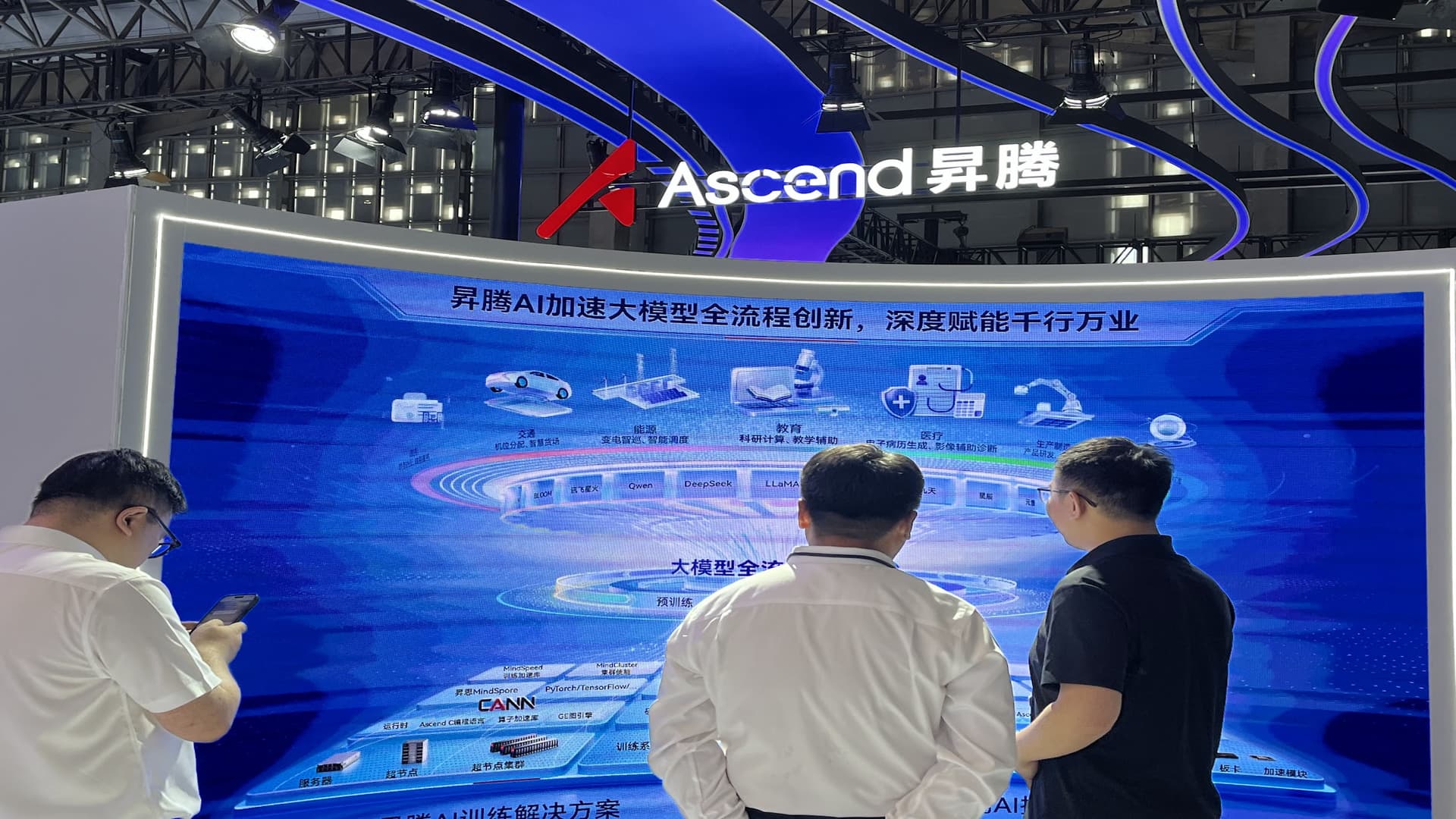
Chinese telecoms giant Huawei showed off its Ascend chips and system for powering artificial intelligence models at the World AI Conference in Shanghai on July 26, 2025.
CNBC | Evelyn Cheng
BEIJING — Less than two weeks after Nvidia CEO Jensen Huang’s high-profile visit to Beijing, the U.S. chipmaker was conspicuous by its absence at China’s biggest AI event of the year.
Despite renewed hopes this month of selling its less advanced H20 chips to China again, Nvidia didn’t have a booth at the World AI Conference that opened Saturday in Shanghai. The company declined CNBC’s request for comment.
In contrast, Nvidia’s China rival, Huawei, had a large display — focused on its Ascend AI chips — near the venue entrance. Huang has called Huawei “one of the most formidable technology companies in the world,” while warning that it could replace Nvidia in China if U.S. sticks with its export curbs on Beijing.
The telecoms giant showed off for the first time the hardware for its computing system that links 384 Ascend chips together to power AI model training and use. Huawei is marketing the product as “Atlas 900 A3 SuperPoD.”
Earlier this year, research firm SemiAnalysis pointed out that even though one Ascend chip may be less powerful than Nvidia’s most advanced Blackwell chip, an early look at a Huawei system similar to the one unveiled in Shanghai more than offsets the disparity by piling in five times more chips than Nvidia does in its GB200 computing system. But there’s an efficiency cost as Huawei’s systems require far more power than Nvidia’s to operate, the report said.
Huawei is far from being the only Chinese player in the complex supply chain for advanced chips. For example, semiconductor designer Moore Threads and startup Yunsilicon both had booths at the AI expo center in Shanghai.

Many of the exhibitors from startups to giants such as Tencent and Alibaba showed off AI applications in robotics, smart glasses and translation apps. Overall, there was less talk at the expo about needing Nvidia to power their products.
Internet tech company NetEase‘s Youdao business displayed a handheld bar device that uses AI to help students study material including that for college entrance exams.
The device currently uses both AI based in the cloud and “edge” AI that runs on the device, said Gao Huituan, product manager of educational learning hardware at Youdao.
Looking ahead, he said that new AI chips are becoming more power efficient and are able to support different types of products.
While Nvidia’s chips focus more on cloud computing power, “many domestically made, very excellent chip manufacturers are working on some edge devices,” he said in Mandarin, translated by CNBC. “Now everyone has relatively good computing power.”
Straddling tech tensions
Nvidia has become the world’s most valuable company, riding on the demand for its chips that have been heled drive the latest generative AI breakthroughs.
The company had to stop sales to China in April due to new U.S. restrictions, following tougher export controls over the last three years aimed at reducing China’s AI capabilities and which have prevented Nvidia from selling its most advanced chips to the country. The company tailored the H20 for China, which Huang has said is a $50 billion market.
Tesla, Google, Amazon Web Services and Siemens were among the U.S. and European companies with booths at the AI conference in Shanghai.
Nvidia had a booth in Beijing earlier this month at an annual supply chain conference, which coincided with Huang’s third visit to China this year and news that the U.S. will allow the chipmaker to resume sales of the H20 chips to China.
But the company has not shared when shipments would begin or how many orders it had received from Chinese customers.
“Nvidia is the model in (AI) GPU development for the short to medium term not just because of H20, but also because of flagship products like the GB300,” Phelix Lee, senior equity analyst at Morningstar, said in an emailed statement. “The return of H20 could help Nvidia to remain as the de facto standard in AI datacenter systems, especially when domestic alternatives are lurking.”

Subscribe now
Beijing has been striving to boost tech self-sufficiency as it has faced U.S. restrictions accessing high-end tech. The country over the weekend also took another step toward promoting its AI standards globally.
Chinese Premier Li Qiang announced plans for a global AI cooperation organization during a speech at Saturday’s opening ceremony. The initial headquarters will likely be in Shanghai, state media said.
The plans come just days after U.S. President Donald Trump announced an American action plan for AI that included calls to reduce alleged “woke” bias in AI models and support the deployment of U.S. tech overseas.



Dario Amodei’s Call to Pace the AI Frontier and Its Market Ripple Effects

Rising Oil Prices And Persistent Inflation Complicate Fed Decision

Bridging the AI Skills Gap: How Gen Z Youth Demographics Are Transforming the Workforce

Armanino adds Strategic Accounting Outsourced Solutions

New 2023 K-1 instructions stir the CAMT pot for partnerships and corporations

Tax Strategy: Employee Retention Credit update
-

 Stock News1 week ago
S&P 500 September Outlook: Tech Rally Holds Index at 7,600
-
 Finance1 week ago
S&P 500 Outperforms Amid Strong Corporate Earnings as Treasury Yields Cap Equity Multiples
-
 Leaders1 week ago
India Unveils ‘Saptadhara’ Reform Agenda Targeting Technology, Youth Skilling, and Growth
-
 Economics1 week ago
U.S. Inflation Outlook for 2027
-

 Economics5 days ago
Economic Profile of the superpower of western Europe
-

 Economics5 days ago
Sovereign Bond Yield Volatility and Inflationary Shocks Challenge Global Central Banks
-

 Finance5 days ago
Big Tech Enterprise Borrowing Reaches $135 Billion as Hyperscalers Fund AI Infrastructure
-
 Economics2 days ago
Rising Oil Prices And Persistent Inflation Complicate Fed Decision