Connect with us

Personal Finance

20 items and goods most exposed to price shocks

Published

on

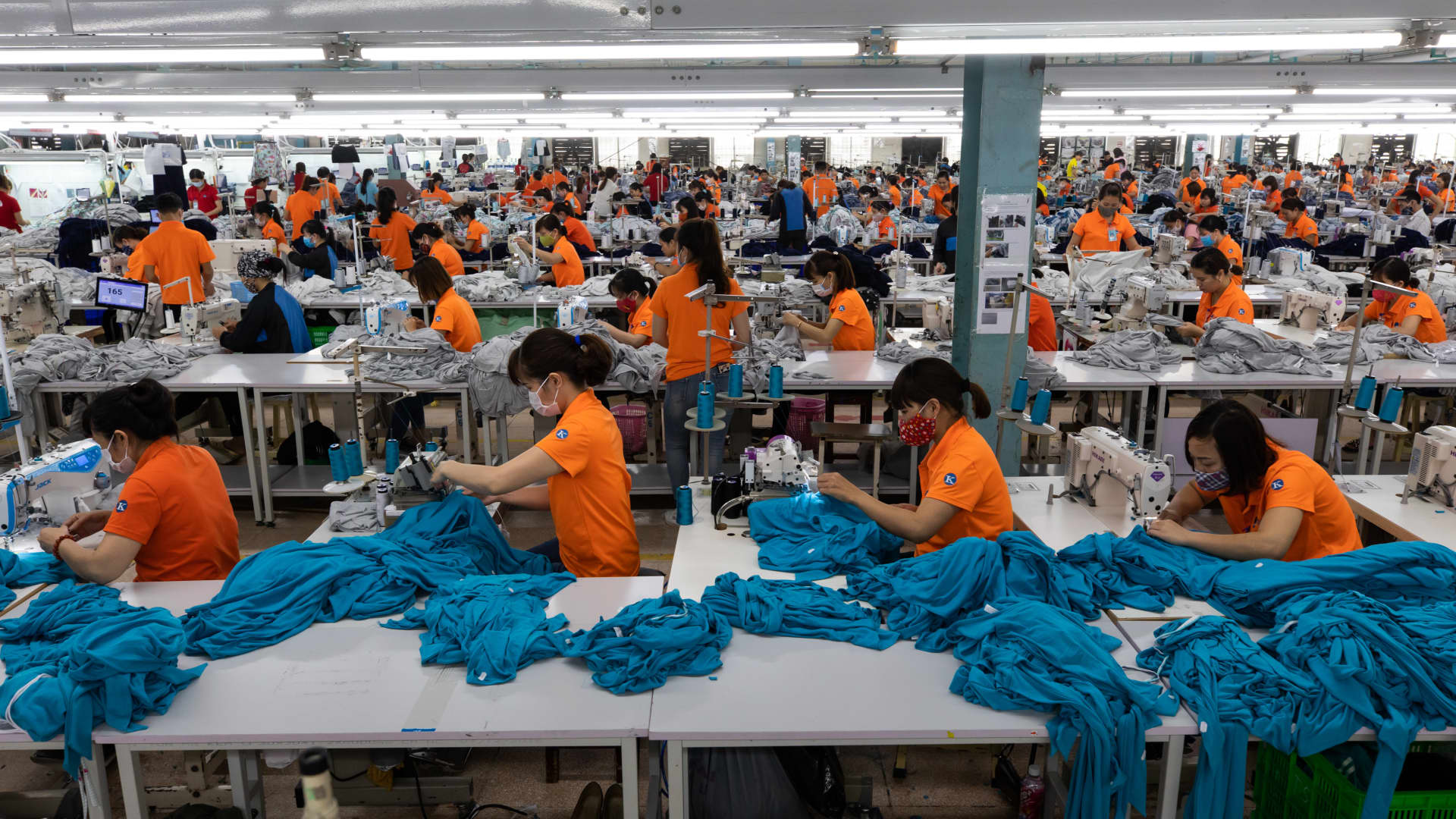
Employees at a clothing factory in Vo Cuong, Bac Ninh province, in Vietnam.

SeongJoon Cho/Bloomberg via Getty Images

The Trump administration’s plan to slap steep tariffs on goods from dozens of countries is expected to spike prices for consumers. Some items, like leather goods, will see a bigger jump than others.

The overall impact on households will vary based on their purchasing habits. But most families — especially lower earners — are likely to feel the pain to some degree, economists said.

According to an analysis by the Budget Lab at Yale University, the average household will lose $3,800 of purchasing power per year as a result of all President Donald Trump‘s tariff policies — and retaliatory trade actions by other nations — announced as of Wednesday.

That’s a “meaningful amount,” said Ernie Tedeschi, the lab’s director of economics and former chief economist at the White House Council of Economic Advisers during the Biden administration.

The analysis doesn’t include the 34% retaliatory tariff China announced Friday on all U.S. exports, set to take effect April 10. The U.S. exported nearly $144 billion worth of goods to China in 2024, the third-largest market for U.S. goods behind Canada and Mexico, according to the Census Bureau.

Clothing prices poised to spike

The garment industry is among the most susceptible to tariff-related price shocks.

Prices for clothing and shoes, gloves and handbags, and wool and silk products will all increase by between 10% and 20% due to the tariffs Trump has so far imposed, according to the Yale Budget Lab analysis. Tedeschi noted that some of these price increases could take 5 years or more to unfold.

Srdjanpav | E+ | Getty Images

The bulk of apparel and shoes sold in the U.S. is manufactured in China, Vietnam, Sri Lanka and Bangladesh, said Denise Green, an associate professor at Cornell University and director of the Cornell Fashion + Textile Collection.

Under the “reciprocal tariffs” Trump announced Wednesday, Chinese imports will face a 34% duty. Goods from Vietnam, Sri Lanka and Bangladesh face tariffs of 46%, 44% and 37%, respectively.

Taking into account the pre-existing tariffs on China totaling 20%, Beijing now faces an effective tariff rate of at least 54%.

“The tariffs are disastrous for the apparel industry worldwide, but especially for smaller countries with highly specialized garment manufacturing,” Green said.

A lot of clothing production has moved overseas over the last 50 years, Tedeschi said, but it’s “very unlikely” clothing and textile manufacturing will return to the U.S. from Asia in the wake of the new tariffs.

“People will still import clothing to a large extent, and they’ll have to eat the price increase,” he said.

Car prices are another pain point

Various Mercedes-Benz vehicles assembled in the “Factory 56” production hall.

Picture Alliance | Picture Alliance | Getty Images

The duties announced Wednesday are on top of other tariffs Trump has imposed since his second inauguration, including duties on automobiles and car parts; copper, steel and aluminum; and certain imports from Canada and Mexico.

The cost of motor vehicles and car parts could swell by over 8% according to the Yale Budget Lab analysis.

Bank of America estimated that new vehicle prices could increase as much as $10,000 if automakers pass the full impact of tariffs on to consumers.

More from Personal Finance:
Economists say ‘value-added taxes’ aren’t a trade barrier
Tariffs are ‘lose-lose’ for U.S. jobs and industry
Why uncertainty makes the stock market go haywire

“Rising car prices are already a major pain point for the vast majority of Americans who live in an area where they need a car to get to work, school, their kids’ activities, and medical appointments,” said Erin Witte, director of consumer protection for the Consumer Federation of America.

“These tariffs will make it much worse, and will significantly reduce Americans’ choices about what car they want to buy,” she said.

Tariffs on specific commodities like aluminum and steel affect consumers indirectly, since the materials are used to manufacture a swath of consumer goods.

White House spokesman Kush Desai pushed back on analyses that prices will spike because of Trump’s tariff policy.

“Chicken Little ‘expert’ predictions didn’t quite pan out during President Trump’s first term, and they’re not going to pan out during his second term when President Trump again restores American Greatness from Main Street to Wall Street,” Desai said in an e-mailed statement.

Trump’s second-term tariffs are orders of magnitude larger than his first term, however.

The first Trump administration put tariffs on about $380 billion worth of goods in 2018 and 2019, according to the Tax Foundation. The tariffs so far imposed in Trump’s second term affect more than $2.5 trillion of U.S. imports, it said.

There’s also evidence that the first-term tariffs raised prices for some consumers.

Retail prices for the typical washing machine and clothing dryer rose by about 12% each — about $86 and $92 per unit, respectively — due to 2018 tariffs on imports of washing machines, according to a study by economists at the Federal Reserve Board and University of Chicago. The increased cost to consumers totaled $1.5 billion a year, the study found.

Tariffs are expected to raise the U.S. inflation rate

Economists also expect the overall U.S. inflation rate to jump due to tariffs.

American businesses that import goods from abroad will be the ones on the hook for paying the cost of tariffs, and economists anticipate that companies will pass at least some of those costs on to consumers.

The tariffs are disastrous for the apparel industry worldwide, but especially for smaller countries with highly specialized garment manufacturing.

Denise Green

director of the Cornell Fashion + Textile Collection

An environment of rising prices for foreign goods may give U.S. businesses cover to somewhat raise their prices, too.

As a result, the consumer price index could jump to 4.5% later in 2025, Capital Economics estimated Thursday. That’s up from 2.8% in February, and roughly double the Federal Reserve’s long-term inflation target.

Continue Reading

Personal Finance

Maximizing Returns in High Rate Climate and market uncertainty

Published

on

Maximizing Returns in High-Rate Climate

In the macroeconomic environment of late July 2026, personal cash management requires an active, structured approach to wealth preservation. With central bank benchmark rates remaining elevated to ensure long-term disinflation, conservative yield-bearing vehicles—such as short-term U.S. Treasury bills, money market funds, and high-yield savings accounts (HYSAs)—continue to offer reliable nominal returns between 4% and 5%. For individual investors, maximizing net returns requires moving beyond passive checking accounts and executing a disciplined cash laddering strategy.

Leaving substantial liquid capital in traditional bank deposits creates an invisible drag on personal net worth due to ongoing inflation. By implementing a tiered liquidity framework, individuals can split emergency cash reserves and short-term capital allocations across rolling maturities. Allocating cash into 4-week, 8-week, and 13-week Treasury bills creates a continuous cycle of maturing liquidity, allowing investors to continuously reinvest capital at prevailing market yields while maintaining immediate access to emergency funds.

Tax efficiency represents a critical dimension of high-yield cash optimization. For high-earning individuals residing in states with substantial local income taxes, direct holdings in short-term U.S. Treasury instruments often deliver superior net post-tax yields compared to standard commercial bank HYSAs. Because interest earned on federal Treasury bills is strictly exempt from state and local taxation, investors can retain a larger portion of their compounding interest gains without taking on additional credit or market risk.

Ultimately, personal wealth accumulation in mid-2026 relies on intentional capital deployment. Cash should be managed as a productive asset class that generates consistent, risk-free returns. Regularly auditing account yield terms, automating recurring transfers, and leveraging tax-advantaged fixed-income instruments ensures that personal liquidity remains fully optimized against macroeconomic fluctuations.

Continue Reading

Personal Finance

Algorithmic Wealth Management: Balancing Automated Financial Planning with Human Oversight

Published

on

Balancing Automated Financial Planning with Human Oversight

The personal finance industry in July 2026 is experiencing a technological evolution, driven by the wide deployment of next-generation algorithmic wealth management tools. Modern digital financial platforms have expanded far beyond basic automated index investing; today’s robo-advisors utilize real-time tax-loss harvesting, dynamic portfolio rebalancing, and hyper-personalized spending analysis to optimize retail investor outcomes. However, as these digital solutions become ubiquitous, investors face the crucial challenge of balancing automated execution with human strategic judgment.

The core advantage of automated financial planning platforms lies in their ability to remove emotional bias from investment execution. During periods of market volatility or localized sector realignments, automated algorithms systematically rebalance portfolios back to target asset allocations without falling victim to panic selling or speculative enthusiasm. Furthermore, integrated cash-flow monitoring algorithms analyze individual spending patterns in real time, automatically sweeping surplus income into designated retirement or debt-liquidation accounts to accelerate net worth accumulation.

Despite these operational advantages, algorithmic tools have inherent structural limitations when addressing complex, highly personalized financial life events. Decisions involving multi-generational estate planning, highly complex tax strategies, small business exits, or nuanced real estate transactions require contextual human judgment that software models cannot replicate. Relying solely on automated models without periodic human professional review can result in misaligned risk profiles or overlooked tax liabilities during major life transitions.

The optimal approach for personal financial planning in late 2026 is a hybrid advisory model. Individuals should utilize automated platforms for routine asset allocation, continuous tax optimization, and low-cost passive index tracking, while engaging qualified human financial advisors for periodic strategic planning, estate structuring, and qualitative risk evaluations. This dual approach ensures maximum cost efficiency and disciplined execution while retaining essential strategic guidance.

Continue Reading

Personal Finance

High-Yield Optimization: Structuring Personal Cash Reserves in a Sustained Rate Environment

Published

on

Structuring Personal Cash Reserves in a Sustained Rate Environment

In the financial environment of mid-2026, personal cash management has re-emerged as a vital component of holistic wealth building. With central bank policy rates holding firm to maintain long-term price stability, yield-bearing instruments such as money market funds, high-yield savings accounts (HYSAs), and short-term Treasury bills continue to offer compounding returns around 4% to 5%. For individual investors, effectively structuring cash reserves requires shifting away from passive bank deposits toward active yield optimization.

A frequent pitfall in personal asset management is leaving substantial liquid capital in traditional checking or low-yield savings accounts, where real returns are continuously eroded by baseline inflation. By implementing a disciplined ‘cash ladder’ strategy—allocating liquid funds across tiered maturities using ultra-short Treasury instruments and FDIC-insured high-yield accounts—individuals can secure maximal yields while retaining immediate liquidity for emergency expenses or tactical investment opportunities.

Simultaneously, investors must evaluate the tax efficiency of their cash holdings based on their tax bracket and geographic location. For high earners situated in states with high local income taxes, direct holdings in short-term U.S. Treasury bills often yield a higher net post-tax return than standard high-yield savings accounts, as Treasury interest is strictly exempt from state and local taxation. Understanding these nuanced tax distinctions allows individuals to capture significant incremental gains without taking on additional market risk.

Ultimately, personal financial health in late 2026 hinges on intentional liquidity management. Cash reserves should not be viewed merely as static emergency funds, but as a dynamic asset class that contributes positively to net worth growth. Regularly auditing yield terms, automating cash transfers, and optimizing for post-tax efficiency ensures that personal capital remains fully productive across all economic conditions.

Continue Reading

Trending