
Accounting
2025 Fastest-Growing Firms: The secrets of turbo-charged growth

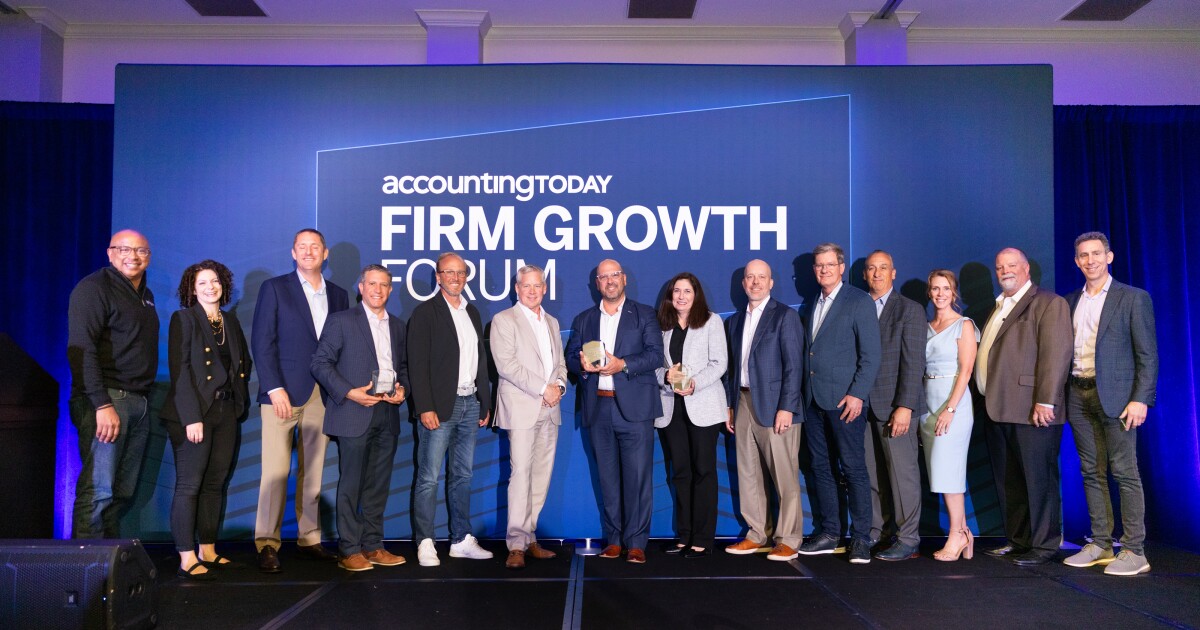
This year’s
Aaron Dawson, CEO of Vancouver, Washington-based Opsahl Dawson, named it as the “biggest thing that we attribute growth to,” and his fast-growing peers would agree. Most of this year’s honorees mention being deliberate in their strategies for achieving exceptional revenue numbers over the last year. Where they differ, of course, is in their specific strategies.
To thine own niche be true
RS&F employed a direct approach, according to managing partner Jeffrey Rosen, but for the Towson, Maryland-based firm, it was niche-based.
“We’ve made a very intentional decision about a decade ago to focus on certain key areas, particularly our family-office practice,” Rosen explained. “We also concentrate on ultra-high-net-worth families and upper-middle-market businesses. But the fact that we have had this focus has allowed us to then build a platform around those clients and not try to be everything to everybody.”

Jesse Sutton
KNAV has a similar laser focus, but on the Atlanta-based firm’s global clientele. “We are actually an international firm,” shared CEO Nishta Sharma. “We are not just internationally focused, but we have operations in the U.K., Canada, Netherlands, Singapore, and, of course, India. So our growth strategy actually stems from having a clear jurisdictional corridor strategy, and focusing on the needs of multinational clients. That’s how we have grown this niche … We are a globally integrated firm, which means that we deliver services seamlessly across borders to our clients, which are mainly multinational companies.”
AbitOs also recognized its international client base as one of “several factors” contributing to the Coral Gables, Florida-based firm’s recent growth.
“Most of our work is international-related or cross-border-transaction-related,” explained partner Alberto Guzman. “So we were lucky to get all that additional clientele coming over. Additionally … we were able to acquire a lot of clients that typically were with the Big Four or the regional [firms]… that we’re able to compete with them on the international side. And these last couple of years have been amazing in that department.”

Jesse Sutton
Top 100 Firm Your Part-Time Controller, meanwhile, caters to nonprofits, which have been instrumental to the Philadelphia-based firm’s success. “We have always specialized in nonprofits and we’ve also always provided highly customized services to nonprofits,” shared chief growth officer Jerilyn Dressler. “I think that, combined with the pipeline shortage, makes us uniquely positioned to really service the nonprofit sector. Nonprofits have a hard time hiring really highly qualified and talented accounting and finance professionals, so we really make a lot of sense because not all nonprofits need somebody full time. They can leverage us however much they need us. So from a business-model perspective, it makes a lot of sense.”
Citrin Cooperman has also stuck to what’s long worked for the New York City-based Top 100 Firm. “We’ve had inorganic and organic growth,” explained Jason Kruger, a partner in the firm’s business process outsourcing practice. “It all revolves around our focus on technology innovation, collaboration within the firm, and the culture of our firm, and really our core focus on midmarket private companies and high-net-worth individuals. So staying true to ourselves has been very important to us, and [those] are really the key contributors to the growth that we’ve had.”
Always be planning
The key to exceptional growth for Atlanta-based Top 100 Firm Smith + Howard is goal-setting, shared CEO Sean Taylor.
“Our growth has been very intentional,” he said. “We created a vision back in 2020, we call it Vision 2030, and it was based in what we termed ‘exponential growth.’ That was growth of the firm in terms of service lines, revenue geographies, career paths, and that sort of thing. So we’re very intentional about it with that vision statement and we put a growth plan behind it that accompanied that. And then it’s just been an intentional part of the goal-setting of all of our leaders across the firm.”
Top 100 Firm Pinion not only constructed a roadmap for growth, but entirely new positions to support it, reported chief client officer Jeanne Bernick — including her own.
“Over the last I’d say three to five years, we’ve gotten really intentional about growth,” she shared. “I’m the growth leader for the firm; that’s kind of a new role out in the industry, and so trying to figure out what that entails, but for me it really is about four areas of the firm: sales, business development, and then marketing, and then our newest areas are client experience and pricing and it’s kind of like a four-legged stool, really.”

Jesse Sutton
For firms looking to hire for more growth-focused roles, Bernick advised patience. “The pricing strategist we hired two years ago, the client experience, that’s been about three years, and for the business developers, it’s taken a good three to four years to get them up to speed,” she explained. “So, I’d say if I was going to recommend this kind of plan to anybody else, give it a good two to three years, but this year it’s really starting to prove out.”
Opsahl Dawson’s growth plans also chart out at least a few years ahead. “We have done a strategic plan to figure out where we want to go, and what clients do we want to be working on,” Dawson explained. “And it’s a balance between: What do our staff want to work on? What does the community need? And then: What is our capacity?”
“We can’t work on every client, so we actually went through a pretty thorough client-based management exercise this last year and we figured out, which we evaluated clients against a number of factors,” he continued. “And we had to figure out which clients we were going to work on and which ones were taking up our resources and not allowing us to serve our best clients. And so we found by going through that client-base management exercise, we had to part ways with some clients that were not aligned with the future and the growth of our firm. We want to move to more being an advisory firm than just a pure compliance firm.”
Taking action on transactions
Opsahl Dawson is one of 12 of the Fastest-Growing Firms backed by or partnered with private equity, and one of four that are member firms of PE-backed platform Ascend.
Ascend, like fellow Fastest-Growing Firms Springline Advisory and Crete Professionals Alliance, acquires firms that then operate with a degree of autonomy under their PE-funded guidance.
Unsurprisingly, this year’s PE-backed firms credit these investments as foundational to their success. But the fastest-growing independent firms have also benefitted from transactional activity, with many mentioning M&A as a large part of their revenue acceleration — including REDW, which has made acquisitions a fundamental part of its blueprint.
“The biggest thing we’ve done is really stick with our strategic plan for six or seven years,” explained Steven Cogan, managing principal of the Albuquerque, New Mexico-based Top 100 Firm. “And one piece of that strategic plan has been sustained, profitable growth. And so what we’ve done with that is we’ve said we want to grow 5% organically, we want to grow 5% through talent acquisition, and we want to grow 5% through M&A. And we’ve exceeded that.”
Mahoney Sabol also credits its growth to M&A, though the Glastonbury, Connecticut-based firm also has the edge in market differentiation, according to co-founder and managing partner James Mahoney.
“Some of it was organic, some of it was acquisition-related,” he explained of the firm’s higher revenues. “But really the key thing for us is in this market — we’re in central Connecticut — there’s so much consolidation in the industry. Our firm’s 35 years old. So, we’re now at the point we’ve got enough maturity, market awareness — I guess we’ve got almost some institutional value built up so that we’re well recognized. So, we’re attracting talent from the bigger firms, people that have been with nice, good-sized regional firms that are merging up into the national firms and just don’t like that environment. So, we’re getting people, we’re getting clients. And there honestly aren’t that many firms left in this market around our size.”

Jesse Sutton
Both Top 100 Firm Springline Advisory and Cleveland-based Top 10 Firm CBIZ / CBIZ CPAs have also been busy on the M&A front.
“This year the biggest piece of our growth was inorganic,” said Springline Advisory CEO Tim Brackney. “We did a number of acquisitions, but I will say that we still did scratch out some decent organic growth as well.”
Last November, CBIZ — which has been operating under its own alternative practice structure with Mayer Hoffman McCann since 1998 —
“We have been fueled by acquisitions, and I think CBIZ has a broad array of services that they can provide outside of accounting and tax,” shared Andrew Gragnani, president of CBIZ CPAs, and formerly MHM before its renaming last year. “Our relationship with CBIZ is quite important. The only public company professional services provider, its access to capital has allowed us to close a lot of transactions. And with an established platform that we have, we can onboard firms pretty effectively and efficiently, and we’re continuing to refine that.”
While Top 100 Firm Dean Dorton has had its own recent spate of acquisitions, many of them technology firms, president and CEO David Bundy also stressed the importance of organic growth.
“We’ve been very strategically focused for the last 10 years,” he explained. “So we’ve not said, ‘Hey, we’re going to grow just by mergers,’ we wanted to grow organically. That’s important to us … That’s how we evaluate everything we’re doing is, are we able to grow organically, and as you grow, you get the opportunity, you get bigger and better opportunities, and so that leads to more organic growth, and then we’ve supplemented that with specific strategically focused mergers and acquisitions over the years. And so it’s been a combination, but over the course of time, our organic growth is more than half of our overall growth.”
Keeping up the culture
Whether independent, the product of M&A, or backed by PE, a fast-growing firm’s culture must be strong.
For Arlington, Virginia-based Top 100 Firm Ascend, which has nearly 20 regional firms on its private equity-backed platform, its strength is not only in these numbers but their communal goal, said vice president of partnerships Maureen Dillmore.
(Watch:
“We’re creating a really exciting community of firms that are coming together, not because they necessarily have problems that need solving right away, but because they want to be on the leading edge of what is changing in the industry right now,” she said.
As one of the firms in that community, Opsahl Dawson balances access to Ascend’s capital and resources with maintaining a strong internal culture, said Dawson.
“We have private equity firepower behind us, but we still have the entrepreneurial spirit,” he explained. “You know, we’re running our own firm … . I tell people, it’s kind of like going to the CrossFit gym and having a coach — they’re helping look at your form. They’re helping energize you. They’re helping give you the right tools, and they’re helping to give you some coaching and motivation on how you grow your business, and so it’s been a lot of fun to have that resource.”
Tampa, Florida-based Top 100 Firm Crete Professionals Alliance — the 2025 No. 1 Fastest-Growing Firm — aims to offer the same balance to the many firms it has acquired in its short existence.
“Our growth has been relatively remarkable,” shared CEO Steve Stagner. “We started in 2023 and have acquired roughly 20 firms very quickly. I think there’s a couple of key drivers of that. One is our model is kind of unique in the sense that it’s a true partnership model, where our partners are co-investing in their brand, so they get to keep their local identity, they get to keep their local culture, and their incentives are geared around their own specific brand versus a traditional PE rollup model where you roll up into the total platform so your incentives get marginalized to some degree. So I think that’s been pretty attractive to people.”
“We just really believe in decentralized command,” Stagner continued. “So we’re there to be your partner. We’re not there to control, and I think that people who’ve built their firms and their legacy really are attracted to those dynamics.”

Jesse Sutton
Firm culture cannot be broached without referencing the people that are its bedrock — and the Fastest-Growing Firms did indeed praise the talent whose hard work makes them so successful.
Jeremy Vokt, managing partner at Omaha, Nebraska-based Bland & Associates said the firm’s success starts there.
“When I think about our culture and our people, we have about nine partners and I think for all nine, Bland was their first job or they were an intern at Bland, so that’s part of our culture in terms of, they’ve been here this entire time and their career,” he said. “I would say that with our directors too, probably at least three four of their first jobs were at Bland. So I think that just speaks a lot to our culture, which probably leads into the other piece for our growth too. We [use] EOS — an ‘entrepreneurial operating system.’ So within that goal-setting philosophy, it’s alignment, it’s working together, it’s trying to achieve that strategy together.”
Like many Fastest-Growing Firms, Bland & Associates is also boosted by its structure, Vokt added, “I think that also aligns with us being a 100% employee-owned ESOP too. So all … of those aligned with each other that then good things happen, growth happens, and we’re all kind of sailing in the same ship the same way.”





Sovereign Bond Yield Volatility and Inflationary Shocks Challenge Global Central Banks

Big Tech Enterprise Borrowing Reaches $135 Billion as Hyperscalers Fund AI Infrastructure

Economic Profile of the superpower of western Europe

Armanino adds Strategic Accounting Outsourced Solutions

New 2023 K-1 instructions stir the CAMT pot for partnerships and corporations

Tax Strategy: Employee Retention Credit update
-

 Stock News7 days ago
S&P 500 September Outlook: Tech Rally Holds Index at 7,600
-

 Finance7 days ago
S&P 500 Outperforms Amid Strong Corporate Earnings as Treasury Yields Cap Equity Multiples
-

 Insights7 days ago
Climate Resilience and Offshore Wind and Land Restoration Milestones
-

 Accounting7 days ago
Mandatory ESG Reporting Standards Demand Standardized Non-Financial Audit Trails
-

 Leaders7 days ago
India Unveils ‘Saptadhara’ Reform Agenda Targeting Technology, Youth Skilling, and Growth
-
 Economics5 days ago
U.S. Inflation Outlook for 2027
-
 Economics2 days ago
Sovereign Bond Yield Volatility and Inflationary Shocks Challenge Global Central Banks
-
 Economics2 days ago
Economic Profile of the superpower of western Europe