
Personal Finance
2026 will be the ‘year of the used EV,’ analyst says. Here’s why

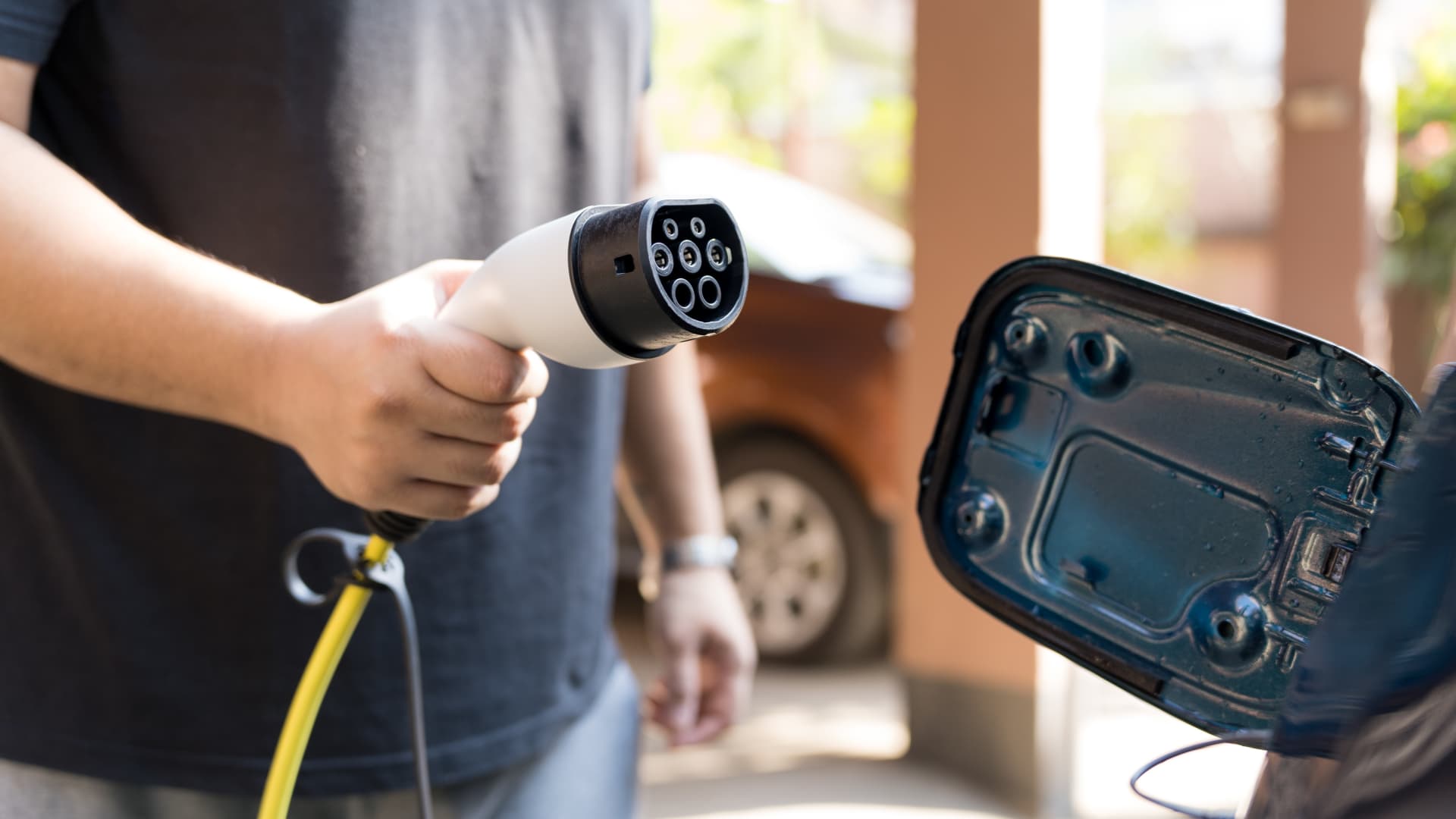
Charging an electric vehicle.
Tashdique Mehtaj Ahmed | Moment | Getty Images
The price of used electric vehicles has come down to levels comparable with gasoline cars, a dynamic poised to boost their popularity despite the loss of a federal tax incentive for EVs, according to auto analysts.
In August, the price premium for used EVs relative to used vehicles with a gasoline engine narrowed to just $897, on average, the smallest price gap on record, according to Cox Automotive.
The average list price for used EVs was $34,704 in August, down 1.1% from July and 2.6% from a year earlier, it found.
This price tag excludes a federal tax credit that ended after Sept. 30, after Republicans scrapped it as part of a multitrillion-dollar legislative package in July. That tax break was worth up to $4,000 for used EVs (and $7,500 for new EVs) — meaning the average used EV cost less than its gasoline counterpart after incentives.

Consumers bought nearly 41,000 used EVs in August, up 59% from a year earlier, Cox data shows.
Analysts expect that momentum to continue, driven in large part by affordability even absent the federal tax break.
2026 will be “the year of the used EV,” said Scott Case, the CEO of Recurrent, an EV market research firm.
Why leased EVs help drive down prices for used ones
Automakers leaned heavily on leasing in recent years to move electric vehicles, analysts said.
Since 2023, more than 1.1 million EVs have been leased, Stephanie Valdez Streaty, director of industry insights at Cox, wrote in an analysis last month.
This was partly due to the so-called leasing “loophole.” Consumers could more easily claim a $7,500 tax credit when leasing a new EV than buying one, the latter of which came with more restrictions.
More from Personal Finance:
How EVs and gasoline cars compare on total cost
Climate change is gentrifying neighborhoods
Here’s how to buy renewable energy from your electric utility
Now, a large volume of electric vehicles are reaching the end of their lease term. Lease returns and trade-ins are boosting the supply of used EVs, driving down prices, Valdez Streaty wrote.
In fact, 14 used EV models had a lower average price than their gasoline counterparts in August, according to Valdez Streaty.
“For mainstream buyers, EV affordability in the used-vehicle space is finally within reach,” Valdez Streaty wrote.
The top-selling models — Tesla Model 3, Tesla Model Y, the General Motors-owned Chevrolet Bolt EV, Tesla Model S and Ford Mustang Mach-E — all had prices below the market average in August, which shows their appeal to budget-conscious buyers consumers, Valdez Streaty wrote.
For example, two high-volume models — the Renault-owned Nissan Leaf and the Tesla Model 3 — carried an average price tag of $12,890 and $23,278, respectively, according to Valdez Streaty. The Chevrolet Bolt EV was $14,705.
Not the ‘end of affordable EVs’
Valentinrussanov | E+ | Getty Images
By contrast, the market for new electric vehicles is likely to struggle for the rest of 2025 and into next year, analysts said.
Average new EV prices in August were $57,245, representing a nearly $9,100 premium over the average gasoline car, according to Cox Automotive.
That doesn’t include the now-expired $7,500 federal tax credit, which brought new EVs closer to price parity with their gasoline counterparts.
“The tax credit helped get a lot of butts in seats,” Aaron Bragman, Detroit bureau chief for Cars.com, told CNBC. “It helped a lot of people get into EVs.”

However, there are still some relatively affordable new electric vehicles even without the federal tax break, he said.
For example, the 2025 Nissan Leaf has a starting price under $30,000, Bragman said.
A few others — the Fiat 500e, Hyundai Kona Electric and Chevrolet Equinox EV — have a starting price under $35,000, according to Cars.com.
“The end of the [tax] credit doesn’t mean the end of affordable EVs,” Bragman wrote in an e-mail. “Brands like Nissan, Chevrolet, and Hyundai are rolling out lower-priced options, and used EVs are getting more attractive too, with plenty available under $25,000. Battery costs are also coming down, which will help keep prices competitive in the long run.”
For mainstream buyers, EV affordability in the used-vehicle space is finally within reach.
Stephanie Valdez Streaty
director of industry insights at Cox Automotive
In fact, the tax break’s expiration doesn’t seem to negatively influence interest among prospective new-car buyers, according to J.D. Power.
More than half of new-vehicle shoppers are either “very likely” (24%) or “somewhat likely” (35%) to consider buying an EV in the next 12 months, rates that have remained fairly consistent for the past year, according to a September study by J.D. Power.
Total cost of ownership
Consumers should focus on total cost of ownership rather than upfront purchase price when choosing a car, analysts said.
This means a car owner should account not only for upfront purchase price, but for the full suite of financial costs, like repairs, maintenance and fuel.
Such costs are generally cheaper for electric vehicles, and can therefore make the lifetime cost of EV ownership less expensive than that of a gasoline-powered car, according to studies and industry experts.
“I think this is the bigger argument” in favor of EVs, said Case of Recurrent.
Factors like geography and charging accessibility are important here, analysts said. For example, relying heavily on public charging networks may flip the economic calculus, since public charging is often more expensive than charging at home, they said.
State incentives are still available
While the federal electric vehicle tax incentive has disappeared, there are additional incentives available from utilities, automakers, and state and local governments that can, in some instances, shave thousands of dollars off an EV’s upfront cost, experts said.
California, Colorado, Connecticut, Maine, Massachusetts, New Jersey, New York and Rhode Island are among the states that offer relatively generous incentives, analysts said.
“There are a lot of state supports still for these EVs,” said Al Salas, CEO of Eco Auto, an EV dealer with operations in Massachusetts and Washington state.


Personal Finance
Next-Generation Retirement Planning: Managing Longevity Risk and Variable Income Streams


U.S.- Canada Trade Talks Collapse; Carney Says Retaliatory Tariffs Begin September 8

Flock Cameras and the Future of Public Security

AI Infrastructure Boom Hits Physical Limits: Power, Financing, and Supply Chain Strain

Armanino adds Strategic Accounting Outsourced Solutions

New 2023 K-1 instructions stir the CAMT pot for partnerships and corporations

Tax Strategy: Employee Retention Credit update
-

 Stock News1 week ago
Nvidia Earnings Preview: What Wall Street Expects From the AI Bellwether’s Q2 Report
-

 Accounting1 week ago
SEC’s Semiannual Reporting Proposal Faces Investor Pushback: What CFOs Need to Know
-

 Stock News1 week ago
Nvidia Q2 FY2027 Earnings beats Wall Street Expectation with Record $96.2 Billion Revenue
-

 Finance1 week ago
Treasury Bond Volatility Forces Bessent to Double Debt Buyback Size as Yields Swing
-
 Technology5 days ago
AI Infrastructure Boom Hits Physical Limits: Power, Financing, and Supply Chain Strain
-
 Technology3 days ago
Flock Cameras and the Future of Public Security
-
 Economics3 days ago
U.S.- Canada Trade Talks Collapse; Carney Says Retaliatory Tariffs Begin September 8