
Economics
3 Facts That Help Explain a Confusing Economic Moment

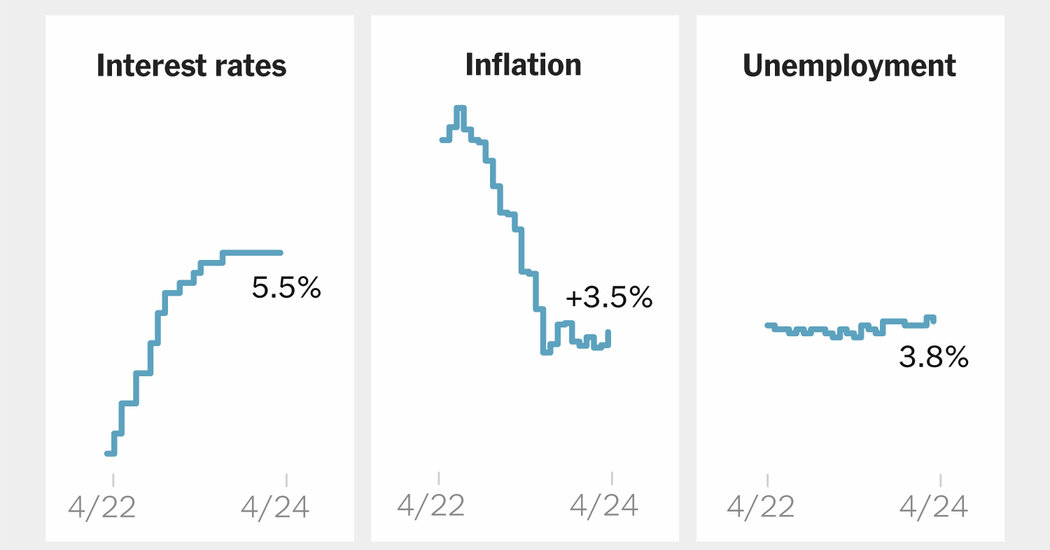
The path to a “soft landing” doesn’t seem as smooth as it did four months ago. But the expectations of a year ago have been surpassed.

The economic news of the past two weeks has been enough to leave even seasoned observers feeling whipsawed. The unemployment rate fell. Inflation rose. The stock market plunged, then rebounded, then dropped again.
Take a step back, however, and the picture comes into sharper focus.
Compared with the outlook in December, when the economy seemed to be on a glide path to a surprisingly smooth “soft landing,” the recent news has been disappointing. Inflation has proved more stubborn than hoped. Interest rates are likely to stay at their current level, the highest in decades, at least into the summer, if not into next year.
Shift the comparison point back just a bit, however, to the beginning of last year, and the story changes. Back then, forecasters were widely predicting a recession, convinced that the Federal Reserve’s efforts to control inflation would inevitably result in job losses, bankruptcies and foreclosures. And yet inflation, even accounting for its recent hiccups, has cooled significantly, while the rest of the economy has so far escaped significant damage.
“It seems churlish to complain about where we are right now,” said Wendy Edelberg, director of the Hamilton Project, an economic policy arm of the Brookings Institution. “This has been a really remarkably painless slowdown given what we all worried about.”
The monthly gyrations in consumer prices, job growth and other indicators matter intensely to investors, for whom every hundredth of a percentage point in Treasury yields can affect billions of dollars in trades.
But for pretty much everyone else, what matters is the somewhat longer run. And from that perspective, the economic outlook has shifted in some subtle but important ways.
Inflation is stubborn, not surging.
Inflation, as measured by the 12-month change in the Consumer Price Index, peaked at just over 9 percent in the summer of 2022. The rate then fell sharply for a year, before stalling out at about 3.5 percent in recent months. An alternative measure that is preferred by the Fed shows lower inflation — 2.5 percent in the latest data, from February — but a similar overall trend.
In other words: Progress has slowed, but it hasn’t reversed.
On a monthly basis, inflation has picked up a bit since the end of last year. And prices continue to rise quickly in specific categories and for specific consumers. Car owners, for example, are being hit by a triple whammy of higher gas prices, higher repair costs and, most notably, higher insurance rates, which are up 22 percent over the past year.
But in many other areas, inflation continues to recede. Grocery prices have been flat for two months, and are up just 1.2 percent over the past year. Prices for furniture, household appliances and many other durable goods have been falling. Rent increases have moderated or even reversed in many markets, although that has been slow to show up in official inflation data.
“Inflation is still too high, but inflation is much less broad than it was in 2022,” said Ernie Tedeschi, a research scholar at Yale Law School who recently left a post in the Biden administration.
The rest of the economy is doing well.
The recent leveling-off in inflation would be a big concern if it were accompanied by rising unemployment or other signs of economic trouble. That would put policymakers in a bind: Try to prop up the recovery and they could risk adding more fuel to the inflationary fire; keep trying to tamp down inflation and they could tip the economy into a recession.
But that isn’t what is happening. Outside of inflation, most of the recent economic news has been reassuring, if not outright rosy.
The labor market continues to smash expectations. Employers added more than 300,000 jobs in March, and have added nearly three million in the past year. The unemployment rate has been below 4 percent for more than two years, the longest such stretch since the 1960s, and layoffs, despite cuts at a few high-profile companies, remain historically low.
Wages are still rising — no longer at the breakneck pace of earlier in the recovery, but at a rate that is closer to what economists consider sustainable and, crucially, that is faster than inflation.
Rising earnings have allowed Americans to keep spending even as the savings they built up during the pandemic have dwindled. Restaurants and hotels are still full. Retailers are coming off a record-setting holiday season, and many are forecasting growth this year as well. Consumer spending helped fuel an acceleration in overall economic growth in the second half of last year and appears to have continued to grow in the first quarter of 2024, albeit more slowly.
At the same time, sectors of the economy that struggled last year are showing signs of a rebound. Single-family home construction has picked up in recent months. Manufacturers are reporting more new orders, and factory construction has soared, partly because of federal investments in the semiconductor industry.
Interest rates are going to stay high for a while.
So inflation is too high, unemployment is low and growth is solid. With that set of ingredients, the standard policymaking cookbook offers up a simple recipe: high interest rates.
Sure enough, Fed officials have signaled that interest rate cuts, which investors once expected early this year, are now likely to wait at least until the summer. Michelle Bowman, a Fed governor, has even suggested that the central bank’s next move could be to raise rates, not cut them.
Investors’ expectation of lower rates was a big factor in the run-up in stock prices in late 2023 and early 2024. That rally has lost steam as the outlook for rate cuts has grown murkier, and further delays could spell trouble for stock investors. Major stock indexes fell sharply on Wednesday after the unexpectedly hot Consumer Price Index report; the S&P 500 ended the week down 1.6 percent, its worst week of the year.
Borrowers, meanwhile, will have to wait for any relief from high rates. Mortgage rates fell late last year in anticipation of rate cuts but have since crept back up, exacerbating the existing crisis in housing affordability. Interest rates on credit card and auto loans are at the highest levels in decades, which is particularly hard on lower-income Americans, who are more likely to rely on such loans.
There are signs that higher borrowing costs are beginning to take a toll: Delinquency rates have risen, particularly for younger borrowers.
“There are reasons to be worried,” said Karen Dynan, a Harvard economist who was a Treasury official under President Barack Obama. “We can see that there are parts of the population that are for one reason or another coming under strain.”
In the aggregate, however, the economy has withstood the harsh medicine of higher rates. Consumer bankruptcies and foreclosures haven’t soared. Nor have business failures. The financial system hasn’t buckled as some people feared.
“What should keep us up at night is if we see the economy slowing but the inflation numbers not slowing,” Ms. Edelberg of the Hamilton Project said. So far, though, that isn’t what has happened. “We still just have really strong demand, and we just need monetary policy to stay tighter for longer.”
Economics
U.S. National Debt Surpasses $40 Trillion for the First Time: What It Means for the Economy



Executive Summary & Core Macro Outlook
The United States enters the 2026–2030 macroeconomic window as the unquestioned heavyweight of nominal economic output, retaining its status as the primary engine of global financial liquidity, private enterprise innovation, and high-margin technological deployment. According to multi-year projections from the International Monetary Fund (IMF) World Economic Outlook and complementary datasets from the World Bank, the US nominal Gross Domestic Product (GDP) is projected to reach $32.38 trillion by 2026, accounting for approximately 25% of global nominal output and roughly 14.5% of world GDP measured at Purchasing Power Parity (PPP).
Unlike many of its advanced-economy peers across Western Europe and East Asia—which are grappling with acute demographic contraction and structural energy shocks—the United States demonstrates remarkable macroeconomic resilience. The IMF projects a real GDP Compound Annual Growth Rate (CAGR) of 2.1% to 2.3% through 2030. This expansion is sustained by three structural anchors: unmatched capital depth driving massive private-sector investment in Artificial Intelligence (AI) infrastructure, complete energy independence as a net exporter of hydrocarbons and liquefied natural gas (LNG), and high labor productivity gains that cushion the economy against rising debt-servicing costs.
Macroeconomic Data Matrix (2026–2030 Projections)
| Economic Metric | IMF / World Bank Baseline (2026–2030) | Global Benchmark & Context |
| Nominal GDP (2026 Projection) | ~$32.38 Trillion | Rank #1 Globally |
| GDP at Purchasing Power Parity (PPP) | ~$32.40 Trillion | Rank #2 Globally (Behind China’s ~$38.5T PPP) |
| Projected Real GDP CAGR (2026–2030) | 2.1% – 2.3% | Top decile among G7 advanced economies |
| Gross Public Debt (% of GDP) | ~122.5% – 128.0% | Structural fiscal deficit trajectory |
| Core Inflation Rate (PCE Target) | Stabilizing at 2.0% – 2.2% | Federal Reserve inflation target alignment |
| Current Account Balance (% of GDP) | -2.8% to -3.2% | Persistent capital import & reserve currency demand |
Deep Structural Growth Drivers
1. The AI Infrastructure Hyper-Cycle & TFP Expansion
The defining growth catalyst for the US economy over the 2026–2030 horizon is the unprecedented scale of private capital expenditure (Capex) poured into artificial intelligence infrastructure, enterprise software integration, and advanced computing hardware.
Major technology mega-caps and private equity funds are directing hundreds of billions of dollars annually into hyper-scale data centers, domestic semiconductor fabrication, high-voltage electrical grid upgrades, and AI-driven workflow platforms. According to World Bank economic research, technological adoption across American service and manufacturing sectors is driving a notable uptick in Total Factor Productivity (TFP). This productivity surge allows US companies to expand profit margins and output even in an environment characterized by higher structural real interest rates and tight skilled-labor markets.
2. Deep Capital Markets and Private Sector Liquidity
The structural backbone of US economic outperformance remains its financial system. US capital markets represent over 40% of global equity market capitalization and a vast majority of global venture capital and private credit assets.
This liquidity creates an efficient mechanism for capital allocation: high-potential emerging industries (such as quantum computing, synthetic biology, and advanced defense technology) receive early-stage funding at a scale that no other national market can match. When global monetary conditions tighten, global capital flees toward safety and yield, reinforcing US capital depth and lowering the relative cost of equity capital for American corporations.
3. Net Energy Independence & Industrial Cost Advantages
Unlike industrial hubs in Germany, Japan, or South Korea—which remain highly vulnerable to volatile sea-lane logistics and imported fuel price spikes—the United States operates as a major net exporter of petroleum, natural gas, and refined chemical products.
Access to abundant, cheap domestic natural gas provides US heavy industry, advanced manufacturing, and electricity-hungry data centers with a persistent structural cost advantage. Furthermore, federal policy frameworks (including the CHIPS and Science Act and clean energy tax provisions) continue to catalyze domestic private manufacturing investment, re-shoring high-value supply chains from East Asia back to the American Sunbelt and Midwest.
Macroeconomic Vulnerabilities & Downside Risks
1. Structural Sovereign Debt Trajectory
The most significant medium-term threat to US macroeconomic stability is the path of federal public debt. With gross national debt exceeding 120% of GDP and annual federal deficits running between 5% and 7% of GDP, the US fiscal baseline faces increasing structural pressure.
As older legacy low-yield Treasury bonds mature, they are refinanced at higher prevailing interest rates. According to IMF fiscal monitor assessments, federal net interest payments are absorbing an expanding share of total fiscal revenue, crowding out discretionary spending and narrowing the government’s capacity to deploy counter-cyclical fiscal stimulus during future downturns.
2. Commercial Real Estate (CRE) & Banking Sector Realignment
The structural transformation toward hybrid work models has permanently altered office space utilization across major US metropolitan areas. Regional and community banks, which hold a disproportionate share of commercial real estate debt, face ongoing balance-sheet pressure as legacy office loans mature and require refinancing at lower property valuations and higher interest rates. While systemic money-center banks remain well-capitalized, localized credit tightening from regional lenders presents a headwind for small-and-medium enterprise (SME) borrowing.
High-Outperformance Sector Matrix (2026–2030)
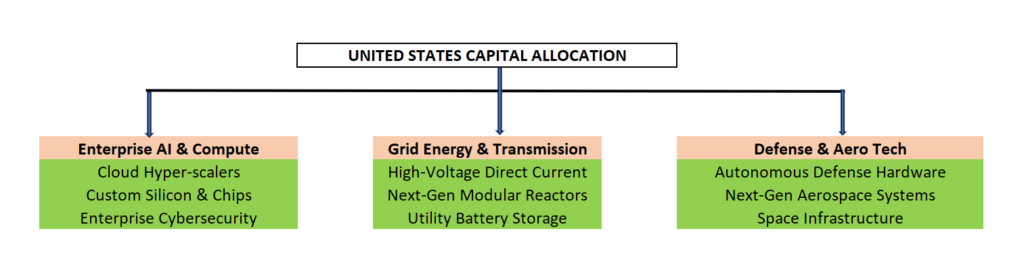
- Enterprise AI, Cloud Compute, & Cybersecurity: Companies building enterprise-grade software, AI agents, cloud architectures, and specialized hardware protection layers.
- Next-Generation Energy & Grid Modernization: Power generation utilities, high-voltage electrical equipment makers, small modular nuclear reactor (SMR) developers, and energy storage systems catering to exponential data center energy demands.
- Advanced Defense Technology & Aerospace: Autonomous systems, satellite networks, hypersonic defense, and advanced materials supplying both domestic security needs and global allied demand.
Strategic Summary for Global Investors & Executives
The United States through 2030 remains the ultimate high-volume, high-yield destination for institutional capital. While fiscal debt risks require long-term monitoring, the immediate 5-year outlook is defined by strong technology-driven productivity, resilient private consumption, and unmatched market liquidity. For global corporations and institutional allocators, exposure to the US economy remains an indispensable pillar of long-term growth strategy.
Top 65 Largest Economies in the World for 2027
Top 10 Largest Economies by 2030: IMF & World Bank GDP Projections for Global Powerhouses

U.S.- Canada Trade Talks Collapse; Carney Says Retaliatory Tariffs Begin September 8

Flock Cameras and the Future of Public Security

AI Infrastructure Boom Hits Physical Limits: Power, Financing, and Supply Chain Strain

Armanino adds Strategic Accounting Outsourced Solutions

New 2023 K-1 instructions stir the CAMT pot for partnerships and corporations

Tax Strategy: Employee Retention Credit update
-

 Stock News1 week ago
Nvidia Earnings Preview: What Wall Street Expects From the AI Bellwether’s Q2 Report
-

 Accounting1 week ago
SEC’s Semiannual Reporting Proposal Faces Investor Pushback: What CFOs Need to Know
-

 Stock News1 week ago
Nvidia Q2 FY2027 Earnings beats Wall Street Expectation with Record $96.2 Billion Revenue
-

 Finance1 week ago
Treasury Bond Volatility Forces Bessent to Double Debt Buyback Size as Yields Swing
-
 Technology5 days ago
AI Infrastructure Boom Hits Physical Limits: Power, Financing, and Supply Chain Strain
-
 Technology2 days ago
Flock Cameras and the Future of Public Security
-
 Economics2 days ago
U.S.- Canada Trade Talks Collapse; Carney Says Retaliatory Tariffs Begin September 8