
Personal Finance
3 student loan changes in Republicans’ ‘big, beautiful’ bill

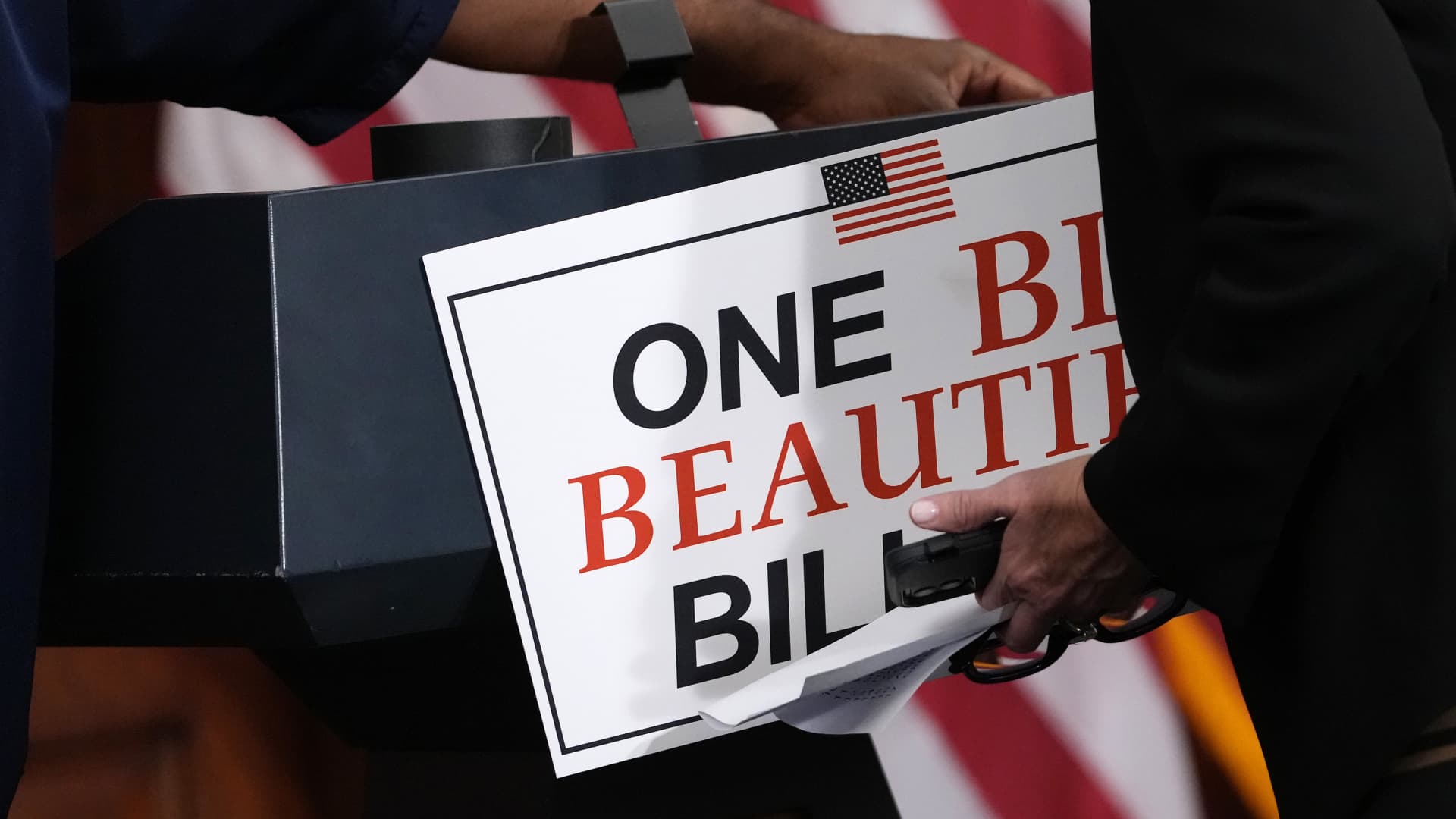
Staff members remove a sign following a press conference after the House passage of the tax and spending bill, at the U.S. Capitol on May 22, 2025 in Washington, DC.
Kevin Dietsch | Getty Images
Republicans’ “big beautiful” bill, if enacted as drafted, would make some of the biggest changes to the federal student loan system in decades.
GOP House and Senate lawmakers’ proposals would eliminate several repayment plans, keep borrowers in debt for longer and roll back relief options for those who become unemployed or run into another financial challenge.
The House advanced its version of the One Big Beautiful Bill Act in May. The Senate Committee on Health, Education, Labor and Pensions released its budget bill recommendations related to student loans on June 10. Senate lawmakers are preparing to debate the massive tax and spending package.
Sen. Bill Cassidy, R-La., chair of the Senate Health, Education, Labor, and Pensions Committee, said his party’s plans would lift the burden on taxpayers of subsidizing college graduate’s loan payments.
“Biden and Democrats unfairly attempted to shift student debt onto taxpayers that chose not to go to college,” Cassidy said in a statement on June 10. He said his committee’s bill would save an estimated $300 billion from the federal budget.
More from Personal Finance:
‘SALT’ deduction in limbo as Senate Republicans unveil tax plan
How Senate GOP ‘no tax on tips’ proposal differs from House plan
Senate tax bill includes $1,000 baby bonus in ‘Trump accounts’
However, consumer advocates say that the legislation will deepen a lending crisis in which millions of borrowers are already struggling to pay off the debt from their education.
“It’s not about fiscal responsibility, it’s about doing some funny math that justifies tax cuts,” said Astra Taylor, co-founder of the Debt Collective, a union for debtors.
“It’s going to be extremely hard for people to get out of debt with these changes,” Taylor said.
Here are three big proposals in the GOP bills to overhaul federal student lending.
1. Fewer repayment plans, larger bills
Under the Republican proposals, there would be just two repayment plan choices for new borrowers, compared with roughly a dozen options now.
Student loan borrowers could either enroll in a standard repayment plan with fixed payments, or an income-based repayment plan known as the “Repayment Assistance Plan,” or RAP.
Under RAP, monthly payments would typically range from 1% to 10% of a borrower’s income; the more they earn, the bigger their required payment. There would be a minimum monthly payment of $10 for all borrowers.
It’s going to be extremely hard for people to get out of debt with these changes.
A typical student loan borrower with a college degree could pay an extra $2,929 per year if the Senate GOP proposal of RAP is enacted, compared to the Biden administration’s now-blocked SAVE plan, according to a recent analysis by the Student Borrower Protection Center.
The new plan would fail to provide many borrowers’ with an affordable monthly bill — the goal of Congress when it established income-driven repayment plans in the 90s, said Michele Zampini, senior director of college affordability at The Institute for College Access & Success.
“If Republicans’ proposed ‘Repayment Assistance Plan’ is the only thing standing between borrowers and default, we can expect many to suffer the nightmarish experience of default,” Zampini said.
2. Longer timelines to loan forgiveness
As of now, borrowers who enroll in the standard repayment plan typically get their debt divided into 120 fixed payments, over 10 years. But the Republicans’ new standard plan would provide borrowers fixed payments over a period between 10 years and 25 years, depending on how much they owe.
For example, those with a balance exceeding $50,000 would be in repayment for 15 years; if you owe over $100,000, your fixed payments will last for 25 years.
Meanwhile, current income-driven repayment plans now conclude in loan forgiveness after 20 years or 25 years. But RAP wouldn’t lead to debt erasure until 30 years.
“Thirty years is your adult life,” Taylor said.
If RAP becomes law, she said, “We anticipate an explosion of senior debtors.”
3. Fewer ways to pause bills
House and Senate Republicans are also calling for the elimination of the economic hardship and unemployment deferments.
Those deferments allow federal student loan borrowers to pause their monthly bills during periods of joblessness or other financial setbacks, often without interest accruing on their debt. Under both options, which have existed for decades, borrowers can avoid payments for up to three years.
Under the Senate Republicans’ proposal, student loans received on or after July 1, 2026, would no longer qualify for the unemployment deferment or economic hardship deferment. The House plan does away with both deferments a year earlier, on July 1, 2025.

“These protections enable borrowers to stay in good standing on their loans while they get back on their feet,” Zampini said.
“Without them, borrowers who suddenly can’t afford their payments will have little recourse, and many will likely enter delinquency and eventually default,” she said.


Personal Finance
Next-Generation Retirement Planning: Managing Longevity Risk and Variable Income Streams


U.S.- Canada Trade Talks Collapse; Carney Says Retaliatory Tariffs Begin September 8

Flock Cameras and the Future of Public Security

AI Infrastructure Boom Hits Physical Limits: Power, Financing, and Supply Chain Strain

Armanino adds Strategic Accounting Outsourced Solutions

New 2023 K-1 instructions stir the CAMT pot for partnerships and corporations

Tax Strategy: Employee Retention Credit update
-

 Stock News1 week ago
Nvidia Earnings Preview: What Wall Street Expects From the AI Bellwether’s Q2 Report
-

 Accounting1 week ago
SEC’s Semiannual Reporting Proposal Faces Investor Pushback: What CFOs Need to Know
-

 Stock News1 week ago
Nvidia Q2 FY2027 Earnings beats Wall Street Expectation with Record $96.2 Billion Revenue
-

 Finance1 week ago
Treasury Bond Volatility Forces Bessent to Double Debt Buyback Size as Yields Swing
-
 Technology5 days ago
AI Infrastructure Boom Hits Physical Limits: Power, Financing, and Supply Chain Strain
-
 Technology3 days ago
Flock Cameras and the Future of Public Security
-
 Economics3 days ago
U.S.- Canada Trade Talks Collapse; Carney Says Retaliatory Tariffs Begin September 8