
Personal Finance
$400 to change a lightbulb? Appliance repair costs are no joke

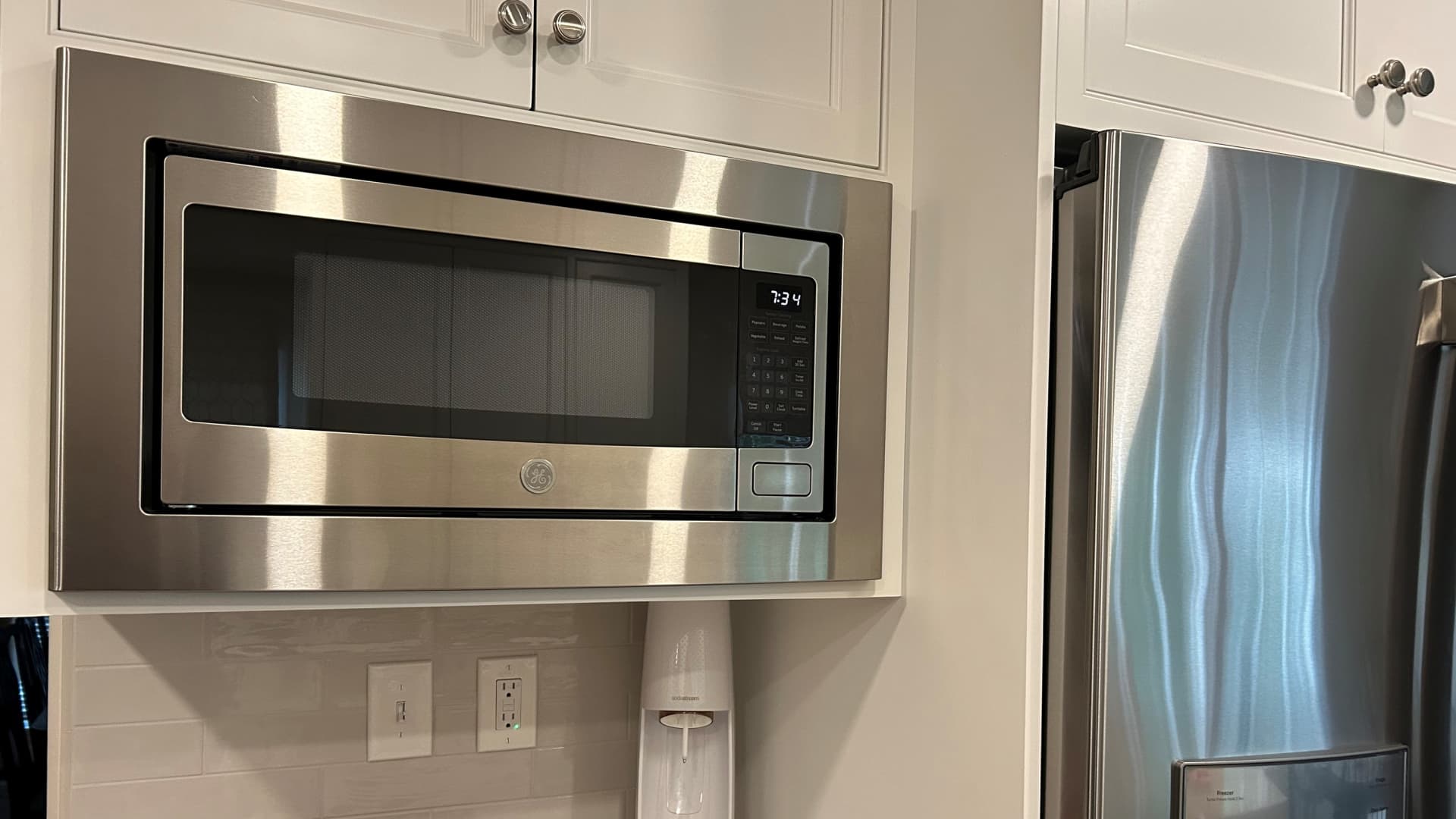
Author Stephanie Dhue’s difficult-to-repair microwave.
Courtesy Stephanie Dhue
I bought a General Electric microwave oven in 2020 for $355. Recently, I noticed the interior light was out.
I told my husband, since he’s the one who takes care of repairs in our house. He took a look, only to learn that this wasn’t going to be an easy fix. The lightbulb is built into the unit so that it requires taking the microwave apart to change, and a technician is recommended.
It sounds like the setup to a lightbulb joke: How much does it cost to change a microwave bulb?
The answer, however, wasn’t funny. When my husband and I started gathering estimates, we learned that the labor costs involved could be up to $400, maybe more — and that didn’t include the cost of the lightbulb.
While my lightbulb situation may be somewhat unique, experts say it is not uncommon to learn the cost of repairs is more than the cost to replace an appliance.
Gay Gordon-Byrne had a similar experience with a microwave she purchased to match a stove. The microwave touchpad stopped working.
She figured out how to do the repair herself, but said the manufacturer tried to charge her $600 for the replacement part. Instead, she bought a new microwave for $175.
“I tell the story all the time because it’s so emblematic of what’s wrong with appliances these days,” said Gordon-Byrne, who is the executive director of Repair.org, which advocates for the legal right of owners to repair their own devices.
Figuring out the cost for a repair
My first call to repair our microwave was to the appliance store where I made the purchase. The service center told me there would be $140 charge to come out, and they couldn’t guarantee that the technician would have a lightbulb on the truck. The service representative suggested I simply purchase a new microwave or shop around for other repair options.
Next, I went to the GE site and filled out a form for service. I learned that the charge for a technician to come would be $125.
One of the the main reasons why it’s so difficult to fix things is because they’re designed with kind of a hostility to repair, or an ambivalence to repair.
Nathan Proctor
senior director of U.S. PIRG’s Right to Repair campaign
When the technician called, I explained the situation and that I needed to know how much it would cost before he came out. He told me he would charge for labor and parts.
How much? Since the microwave sits in a cabinet above the counter, to remove it would be a “two man job,” he said, and could cost upwards of $400 for the labor. What if my husband and I took the microwave out and placed it on the counter? In that case the labor charge would be closer to $200, but that wasn’t an exact estimate. It also didn’t include the cost of the lightbulb.
I canceled the visit and the technician said there would be no charge.
When I asked GE Appliances why the microwave was designed this way, a spokesperson responded via e-mail that microwave lights are designed to last the lifetime of the product and failures are very uncommon in their products. The light fixture is more than a standard bulb that has to be encased behind a metal enclosure.
“It’s not a simple screw-in and requires electrical training and background,” the spokesperson said. “Given the high voltage nature of microwaves, it not safe for consumers without a deep electrical understanding to operate on the interior of a microwave.” She also noted that service techs are required to test for emissions to comply with strict standards set by the U.S. government.
How ‘right to repair’ laws may affect options, costs
Studio4 | E+ | Getty Images
State lawmakers and consumer advocates have been trying to make it easier and cheaper for consumers to get their devices repaired.
Several states — including California, Maine, Massachusetts, Minnesota and New York — have implemented so-called “right to repair” laws. Typically, the laws require manufacturers of certain devices — such as consumer electronics or appliances — to make parts, physical and software tools and repair information, like schematics, available at a fair and reasonable price. These laws can make it more straightforward for consumers to do repairs themselves, and widen professional repair options, too.
Colorado and Oregon have passed right to repair legislation that will go into effect in the next year, and more than a dozen others have introduced bills, according to Repair.org.
“We are just now starting to see the impact of legislation that we’ve been working on for 10 years,” said Gordon-Byrne. The earliest right to repair bills were filed in 2014, she said — including the first, in South Dakota, which failed — and “we really only got the first three laws in place to start July first of this year.”
There are limits to what these laws can do. Typically they only cover purchases made in recent years, and can be product-specific. New York’s law, for example, doesn’t include appliances. Some states have separate laws to cover specific products like autos, farm equipment and electronic wheelchairs.
At the federal level, the Federal Trade Commission said in a 2021 report to Congress that “restricting consumers and businesses from choosing how they repair products can substantially increase the total cost of repairs, generate harmful electronic waste, and unnecessarily increase wait times for repairs.” The Commission has also brought warranty-related enforcement actions and this summer sent warning letters to several manufacturers about their warranty practices.
Critics of right to repair legislation say the patchwork of state laws are too broad and may do more harm than good.
“These state proposals and state laws could lead to a lose-lose situation in which manufacturers are harmed because it undercuts their profits, and consumers are harmed because they either see a decreased kind of quality of these products or an increase in price,” said Alex Reinauer, a research fellow at the Competitive Enterprise Institute.
Some products designed ‘with a hostility to repair’
Consumer advocates say state laws and the FTC actions help, but haven’t solved the problem.
“One of the main reasons why it’s so difficult to fix things is because they’re designed with kind of a hostility to repair, or an ambivalence to repair,” said Nathan Proctor, the senior director of U.S. PIRG’s Right to Repair campaign.
To give consumers more information, US PIRG is also launching a new effort to bring repair-score labeling to the U.S. Right now, “there’s no way to tell what products are designed to be serviceable, and therefore last, and be resilient and durable,” Proctor said.
France already has this kind of system, he said, and the EU is rolling out a “repairability index,” with a rating system that scores a product based on factors including a repair-friendly design and the price and availability of parts. Scores range from zero to 10, with higher numbers indicating a more repairable product and greater longevity expectations.
However, those scores are subjective and may not hold up over time. For example, if a manufacturer discontinues making a part, that reparability score may not longer be accurate.
Competitive Enterprise Institute’s Reinauer is keeping a score of his own, using a spreadsheet that compares the Ingress Protection (IP) rating, which grades how a product stands up to water and dust intrusion, with the reparability index. He says that comparison doesn’t favor repairs.
“When a when a product is more repairable, typically it’s less durable,” said Reinauer, “so there are trade-offs in this.”
Do-it-yourself help
Halfpoint Images | Moment | Getty Images
Depending on the nature of the problem and safety issues involved, a repair may be worth trying to tackle on your own. Appliance owners may find help from others online.
“Researching the broken item’s issue on the web often leads to information and guides posted by others who have encountered the same issue, or a similar issue and how they addressed it,” said Peter Mui, the founder of Fixit Clinics. Product owners can get help with a do-it-yourself project at a Fixit Clinic or online at Discord.
I’m weighing whether it’s worth trying to fix our microwave ourselves or to just live without an interior light. We could try to make it a fun community DIY event, but we risk a repair failure. The microwave model we have now typically costs between $420 and $480 new, if we want to replace it — but I promise I will not buy another appliance without checking if I can change the lightbulb.
Feels like there’s a bad joke in here somewhere.


Personal Finance
Next-Generation Retirement Planning: Managing Longevity Risk and Variable Income Streams


U.S.- Canada Trade Talks Collapse; Carney Says Retaliatory Tariffs Begin September 8

Flock Cameras and the Future of Public Security

AI Infrastructure Boom Hits Physical Limits: Power, Financing, and Supply Chain Strain

Armanino adds Strategic Accounting Outsourced Solutions

New 2023 K-1 instructions stir the CAMT pot for partnerships and corporations

Tax Strategy: Employee Retention Credit update
-

 Stock News1 week ago
Nvidia Q2 FY2027 Earnings beats Wall Street Expectation with Record $96.2 Billion Revenue
-
 Technology6 days ago
AI Infrastructure Boom Hits Physical Limits: Power, Financing, and Supply Chain Strain
-
 Economics4 days ago
U.S.- Canada Trade Talks Collapse; Carney Says Retaliatory Tariffs Begin September 8
-
 Technology4 days ago
Flock Cameras and the Future of Public Security