Connect with us

Finance

Fed rate decision September 2025

Published

on

Fed lowers rates by a quarter point

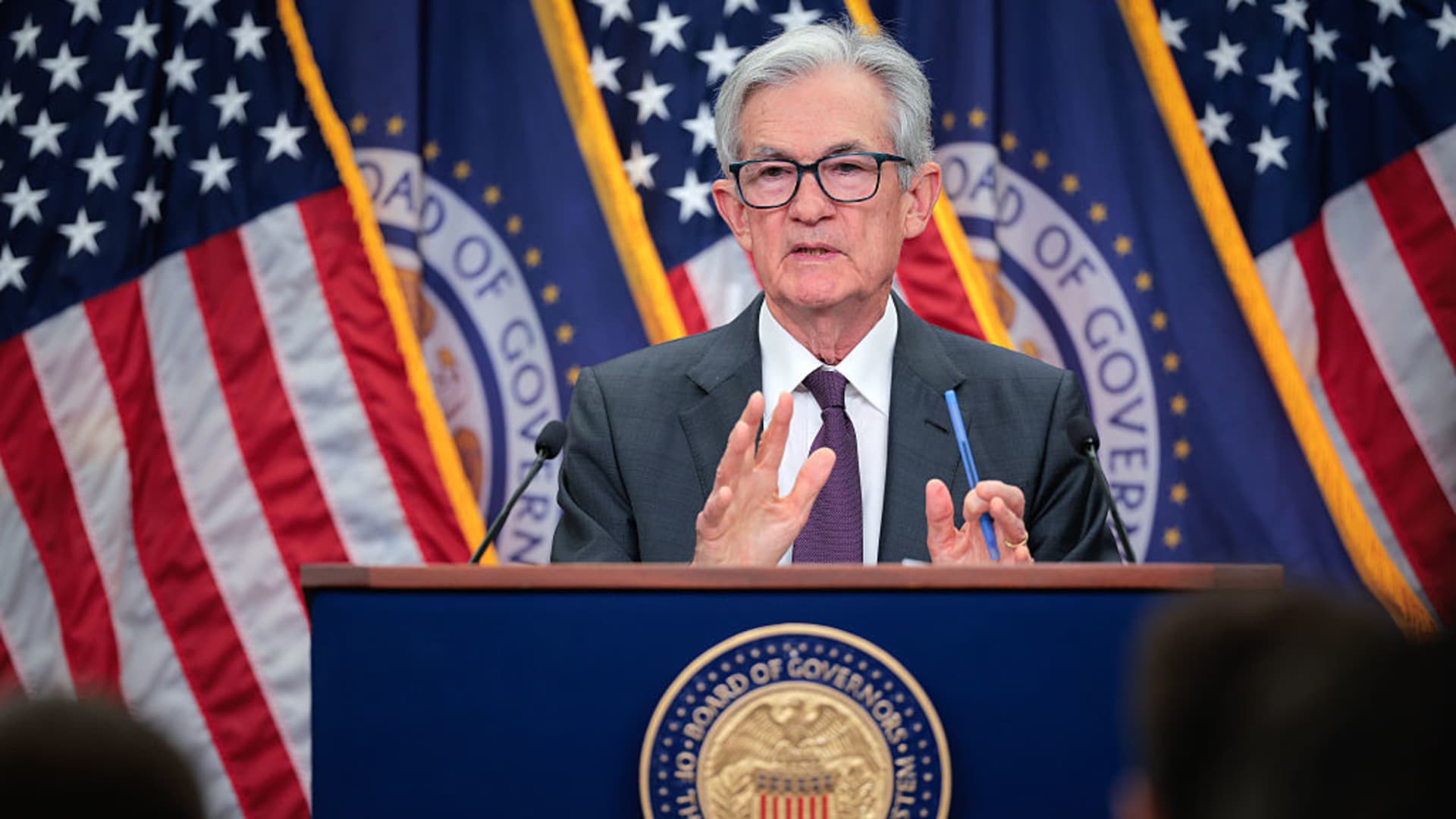
WASHINGTON – The Federal Reserve on Wednesday approved a widely anticipated rate cut and signaled that two more are on the way before the end of the year as concerns intensified over the U.S. labor market.

In an 11-to-1 vote signaling less dissent than Wall Street had anticipated, the Federal Open Market Committee lowered its benchmark overnight lending rate by a quarter percentage point. The decision puts the overnight funds rate in a range between 4.00%-4.25%.

Newly-installed Governor Stephen Miran was the only policymaker voting against the quarter-point move, instead advocating for a half-point cut.

Governors Michelle Bowman and Christopher Waller, looked at for possible additional dissents, both voted for the 25-basis point reduction. All were appointed by President Donald Trump, who has badgered the Fed all summer to cut not merely in its traditional quarter-point moves but to lower the fed funds rate quickly and aggressively.

In the post-meeting statement, the committee again characterized economic activity as having “moderated” but added language saying that “job gains have slowed” and noted that inflation “has moved up and remains somewhat elevated.” Lower job growth and higher inflation are in conflict with the Fed’s twin goals of stable prices and full employment.

 “Uncertainty about the economic outlook remains elevated” the Fed statement said. “The Committee is attentive to the risks to both sides of its dual mandate and judges that downside risks to employment have risen.”

Along with the rate decision, officials in their closely watched “dot plot” of individual expectations pointed to two more cuts before the end of the year. The grid, however, showed a wide level of disparity, with one dot, possibly Miran’s, pointing to a total of 1.25 percentage points in additional reductions this year.

The plot is done anonymously, with one dot for each meeting participant, but Miran has been an advocate for much lower rates. Nine of the 19 participants indicated just one more reduction this year, while 10 saw two, which would indicate moves at the October and December meetings. One official did not want any cuts, including Wednesday’s.

The plot indicated one cut in 2026, significantly slower than current market pricing of three. Traders had fully priced in this week’s move. Officials also indicated another reduction in 2027, as the Fed approaches a long-run neutral rate of 3%. A half-dozen officials saw the long-run rate below the median neutral level.

Projections released following the meeting on general economic conditions saw slightly faster economic growth than was projected in June, while the outlooks for unemployment and inflation were unchanged.

A stunning level of political drama preceded the meeting, especially for an institution that generally does its business quietly and with few dissenting voices.

A year ago, against similar worries that a gradual rise in the unemployment rate could be signaling broader weakness, the FOMC approved a jumbo half-point reduction that Trump has said was politically motivated to influence the presidential election in favor of his Democratic opponent, Kamala Harris.

Trump’s hectoring of the Fed and Miran’s appointment have raised questions over the traditional independence the central bank has had from political influence. Miran also has openly criticized Chair Jerome Powell and his colleagues and is generally seen as a loyalist vote for the president and his desire for significantly lower rates.

 The president has said lower rates are needed to bolster the moribund housing market and to lower financing costs for government debt.

There was an additional layer of political intrigue this week as a court blocked Trump from removing Governor Lisa Cook, an appointee under former President Joe Biden. The White House has accused Cook of mortgage fraud involving federally backed loans she received for homes she purchased, though no charges have been brought.

Cook was among those who joined the majority in voting for the quarter-point move.

 Recent signals have shown that economic growth remains solid and consumer spending topping forecasts, though the labor market has been a point of contention.

On the jobs front, the unemployment rate hit 4.3% in August, still relatively tame by historical standards but the highest since October 2021. Job creation has been stagnant this year, and a recent update from the Bureau of Labor Statistics showed that the economy created nearly a million fewer jobs than initially reported in the 12-month period prior to March 2025.

Governor Waller in particular has expressed concern that the Fed should ease policy now to head off future issues in the labor market. His name also has been in the mix as a potential replacement for Powell, whose term expires in May 2026. 

Continue Reading
Click to comment

Leave a Reply

Your email address will not be published. Required fields are marked *

Finance

S&P 500 Outperforms Amid Strong Corporate Earnings as Treasury Yields Cap Equity Multiples

Published

on

S&P 500 Outperforms Amid Strong Corporate Earnings as Treasury Yields Cap Equity Multiples

Financial markets opened September on a firm footing following a solid performance in August, where the S&P 500 gained 2.6% and the tech-heavy Nasdaq Composite rose 3.9%. Corporate earnings across major index constituents showed impressive momentum, with S&P 500 year-over-year earnings growth topping historic averages. However, despite robust corporate balance sheets, equity market valuations face headwinds as benchmark 10-year Treasury yields remain elevated near 4.75%.

The current financial environment is characterized by a strong divergence between corporate earnings resilience and bond market pressure. Enterprise technology leaders, financial institutions, and consumer sectors reported strong profit margins, benefiting from operational efficiency gains and disciplined cost management. Yet, institutional investors remain cautious about expanding price-to-earnings multiples when risk-free benchmark bond yields offer yields near 4.7%.

Fixed income markets continue to reflect restrictive monetary conditions. The broader aggregate bond market recorded flat total returns year-to-date, while fixed income yields—such as 30-day SEC yields on core bond funds—stayed above 4.6%. This yield profile provides institutional and retail investors with meaningful cash flow returns without taking on equity market downside risk, creating a competitive alternative for institutional capital allocation.

Portfolio managers and investment strategists recommend a disciplined, quality-oriented approach entering the final quarter of 2026. Rather than chasing speculative momentum, capital flows are favoring companies with strong cash flow generation, low debt-to-equity ratios, and robust pricing power capable of withstanding elevated input costs.

Why This Information Matters
The tension between strong corporate earnings and elevated bond yields directly impacts portfolio allocations and retirement wealth. Individual investors and wealth managers must balance equity market participation with fixed-income yield opportunities, ensuring portfolios are diversified against sudden valuation adjustments caused by fluctuating benchmark interest rates.

Continue Reading

Finance

Treasury Bond Volatility Forces Bessent to Double Debt Buyback Size as Yields Swing

Published

on

Bessent

A turbulent week in the U.S. Treasury market prompted the Treasury Department to sharply increase the size of its long-term debt buyback program, as bond prices fell even while equity markets pushed toward record highs. The divergence has drawn attention from fixed-income strategists who see it as a signal of underlying investor unease about federal borrowing levels.

What Happened This Week

U.S. Treasury Secretary Scott Bessent told CNBC on Thursday, August 20, 2026, that the Treasury had doubled the size of its long-term debt buyback operations, moving from roughly $2 billion to at least $4 billion per operation. Bessent indicated the figure could climb further, saying “we’re going to increase the size of the buyback,” and noted the accelerated pace could exceed the announced $4 billion threshold per issue.

Buybacks allow the Treasury to repurchase outstanding government bonds directly from the market, which can help support prices and dampen yield volatility during periods of stress. The expanded program came as stocks staged a late-week recovery: the S&P 500 and Russell 2000 both advanced on Friday, August 21, even as Treasuries logged mild losses, according to Bloomberg market data.

Why Bond and Equity Markets Are Diverging

Capital.com senior market analyst Daniela Hathorn described the week’s dynamic as markets “ending the week on a softer tone after the relative calm of early August was disrupted by renewed pressure in global bond markets, another rise in oil prices, and growing uncertainty around the Federal Reserve’s next move.” She noted that higher long-term borrowing costs are increasingly challenging elevated equity valuations, even as U.S. equities pull back modestly from record highs.

This divergence — equities near record levels while bonds sell off  is unusual and reflects two different sets of investor concerns. Equity investors have remained focused on corporate earnings strength, particularly from large technology companies ahead of Nvidia’s closely watched August 26 earnings report. Bond investors, by contrast, are more directly exposed to concerns about the scale of federal borrowing, highlighted this week by the national debt crossing the $40 trillion threshold for the first time.

The Fed and Treasury “Working in Opposite Directions”

Wilmington Trust senior bond portfolio manager Wil Stith told Yahoo Finance that current conditions reflect “the Fed and the Treasury basically working in sort of opposite directions,” adding that the imbalance will likely require the Federal Reserve  which he described as having “the larger sandbox”  to adjust the federal funds rate rather than relying on Treasury market interventions alone to manage yields.

Notably, the bond market’s reaction to the Treasury’s buyback expansion was relatively muted; strategists described the move as being largely absorbed without a major rally, suggesting the underlying pressure on yields stems from factors, such as inflation persistence and debt sustainability concerns, that a buyback program alone cannot resolve.

What Comes Next

Markets are now looking to two major events in the days ahead: Nvidia’s earnings report on Wednesday, August 26, and the Federal Reserve’s Jackson Hole Economic Symposium, running August 27-29. This will be the first Jackson Hole gathering under new Fed Chair Kevin Warsh, whose public communication style and policy signals remain less established than his predecessors’, according to market commentary from Regards of Wall Street.

For investors, the key metrics to watch are the size and frequency of future Treasury buyback operations, movements in the 10-year Treasury yield, and any policy signals from Warsh’s keynote address. Continued yield volatility alongside record equity valuations would suggest the market imbalance identified this week has not yet been resolved.


Continue Reading

Finance

Cross-Border Settlement Innovation and Real-Time Payment Architecture

Published

on

The global banking system is undergoing a comprehensive modernization of cross-border payment infrastructure. Driven by real-time settlement networks, open banking APIs, and interoperable messaging standards, financial institutions and multinational corporations are eliminating multi-day delays and reducing transaction costs associated with legacy international wire transfers.

Transition to Real-Time Gross Settlement Networks
Historically, international business-to-business (B2B) payments relied on complex correspondent banking relationships involving intermediary fees and processing delays. In 2026, the widespread adoption of ISO 20022 messaging protocols alongside interconnected Real-Time Gross Settlement (RTGS) systems allows direct, end-to-end processing of cross-border transfers.

Commercial banks are providing corporate clients with continuous, 24/7 payment clearing capabilities. Real-time transaction confirmation and automated FX rate locking allow international businesses to settle cross-border trade obligations within minutes, significantly reducing counterparty risk.

Central Bank Digital Currency (CBDC) Interoperability
Wholesale Central Bank Digital Currency (CBDC) pilot initiatives are reaching operational maturity across several key financial centers. Collaborative multi-CBDC platforms enable participating central banks and commercial institutions to settle foreign exchange and international trade transactions directly on shared distributed ledgers.

These wholesale digital currency networks eliminate traditional clearinghouse delays and minimize foreign exchange slippage. Enterprise treasury departments benefit from enhanced liquidity management, as cross-border cash balances can be deployed and repatriated instantaneously.

Corporate Treasury Transformation
For enterprise treasurers, instant cross-border settlement transforms cash management strategies:
– Working Capital Optimization: Reduced transaction float allows companies to lower precautionary cash reserves and optimize short-term liquidity investments.
– Automated Reconciliation: Enriched data formats embedded in ISO 20022 payment messages streamline automated general ledger posting and invoice matching.
– Reduced Processing Overhead: Account-to-account (A2A) real-time clearing bypasses costly intermediary correspondent banking fees.

Strategic Financial Priorities
1. Upgrade Treasury Systems: Ensure internal core enterprise software supports real-time ISO 20022 payment messaging standards.
2. Leverage Instant Clearing Rails: Utilize direct payment networks to lower cross-border transaction fees and eliminate settlement delays.
3. Evaluate Multi-Currency Liquidity: Modernize liquidity management frameworks to capitalize on 24/7 real-time settlement capabilities.

Continue Reading

Trending