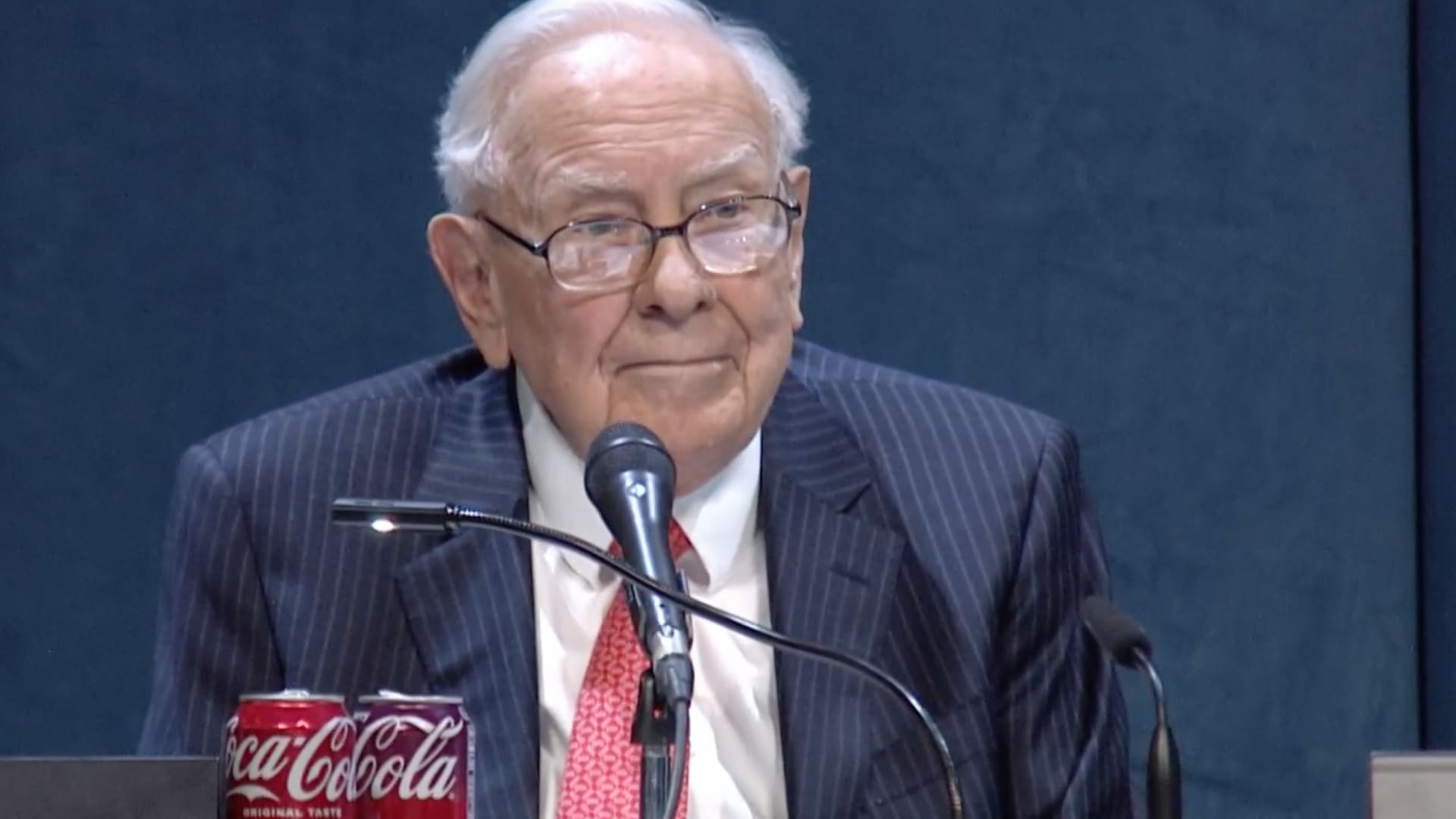
Warren Buffett laid out a plan to “step up” the pace of giving away his $149 billion estate to his children’s foundations, while still allowing for a short period that lets Berkshire Hathaway shareholders gain confidence in incoming CEO Greg Abel.
Buffett, in a Thanksgiving letter that will become an annual tradition, said he needs to accelerate the disbursement of his Berkshire stock to his three children’s foundations because of their own advanced ages and that by doing so it will “improve the probability that they will dispose of what will essentially be my entire estate before alternate trustees replace them.”
Abel, 63, is set to take over for Buffett, 95, as Berkshire CEO at the start of the new year with the “Oracle of Omaha” remaining chairman.
“I would like to keep a significant amount of ‘A’ shares until Berkshire shareholders develop the comfort with Greg that Charlie and I long enjoyed,” wrote Buffett, referring to long-time Berkshire Vice Chairman and his cherished business partner Charlie Munger, who died two years ago.
“That level of confidence shouldn’t take long. My children are already 100% behind Greg as are the Berkshire directors,” said Buffett.
Buffett owns about $149 billion worth of Berkshire based on shares held at the end of the second quarter, making him far and away the largest shareholder. Most of his wealth is in the original A shares which trade for around $751,480 a share.
He said 1,800 of those Berkshire A shares were converted into 2.7 million B shares and given Monday to four family foundations: The Susan Thompson Buffett Foundation, The Sherwood Foundation, The Howard G. Buffett Foundation and the NoVo Foundation.
“The acceleration of my lifetime gifts to my children’s foundations in no way reflects any change in my views about Berkshire’s prospects,” added Buffett.
The note marks Buffett’s first major communication since announcing plans to step down as CEO, signaling the close of a six-decade run that made him a household name and one of the most successful investors in history.
“As the British would say, I’m ‘going quiet.’… sort of,” Buffett wrote in the letter.
‘I Generally Feel Good’
Abel, currently vice chairman of non-insurance operations, will take over writing Berkshire’s annual shareholder letters — a tradition that Buffett began in 1965 and that has become essential reading across Wall Street — while Buffett said he will continue this Thanksgiving message.
In one of the most personal passages of the letter, Buffett gave a rare update on his health.
“To my surprise, I generally feel good. Though I move slowly and read with increasing difficulty, I am at the office five days a week where I work with wonderful people,” he wrote. “I was late in becoming old … but once it appears, it is not to be denied.”
The Berkshire Fortress
Since taking control of Berkshire in 1965, Buffett has transformed a struggling textile mill into a $1 trillion conglomerate spanning insurance, railroads, utilities and consumer brands.
He devoted part of his letter to reaffirming Berkshire’s durability, saying it is designed to withstand nearly any economic environment.
“Berkshire has less chance of a devastating disaster than any business I know,” he said.
Berkshire held a record $381.6 billion in cash at the end of September, underscoring its unmatched balance sheet and cautious investing approach. Berkshire has also been selling equities for 12 straight quarters, reflecting Buffett’s caution in a richly valued market.
The company’s underlying businesses remain strong with operating profit jumping 34% in the third quarter. Still, Buffett acknowledged that Berkshire’s sheer scale has become both its strength and its limitation.
“In aggregate, Berkshire’s businesses have moderately better-than-average prospects, led by a few non-correlated and sizable gems. However, a decade or two from now, there will be many companies that have done better than Berkshire; our size takes its toll,” he wrote.
Berkshire‘s stock has risen roughly 10% in 2025, outpacing many defensive names but lagging the S&P 500 amid a tech-driven rally.
“Our stock price will move capriciously, occasionally falling 50% or so as has happened three times in 60 years under present management,” Buffett said. “Don’t despair; America will come back and so will Berkshire shares.”
A turbulent week in the U.S. Treasury market prompted the Treasury Department to sharply increase the size of its long-term debt buyback program, as bond prices fell even while equity markets pushed toward record highs. The divergence has drawn attention from fixed-income strategists who see it as a signal of underlying investor unease about federal borrowing levels.
What Happened This Week
U.S. Treasury Secretary Scott Bessent told CNBC on Thursday, August 20, 2026, that the Treasury had doubled the size of its long-term debt buyback operations, moving from roughly $2 billion to at least $4 billion per operation. Bessent indicated the figure could climb further, saying “we’re going to increase the size of the buyback,” and noted the accelerated pace could exceed the announced $4 billion threshold per issue.
Buybacks allow the Treasury to repurchase outstanding government bonds directly from the market, which can help support prices and dampen yield volatility during periods of stress. The expanded program came as stocks staged a late-week recovery: the S&P 500 and Russell 2000 both advanced on Friday, August 21, even as Treasuries logged mild losses, according to Bloomberg market data.
Why Bond and Equity Markets Are Diverging
Capital.com senior market analyst Daniela Hathorn described the week’s dynamic as markets “ending the week on a softer tone after the relative calm of early August was disrupted by renewed pressure in global bond markets, another rise in oil prices, and growing uncertainty around the Federal Reserve’s next move.” She noted that higher long-term borrowing costs are increasingly challenging elevated equity valuations, even as U.S. equities pull back modestly from record highs.
This divergence — equities near record levels while bonds sell off is unusual and reflects two different sets of investor concerns. Equity investors have remained focused on corporate earnings strength, particularly from large technology companies ahead of Nvidia’s closely watched August 26 earnings report. Bond investors, by contrast, are more directly exposed to concerns about the scale of federal borrowing, highlighted this week by the national debt crossing the $40 trillion threshold for the first time.
The Fed and Treasury “Working in Opposite Directions”
Wilmington Trust senior bond portfolio manager Wil Stith told Yahoo Finance that current conditions reflect “the Fed and the Treasury basically working in sort of opposite directions,” adding that the imbalance will likely require the Federal Reserve which he described as having “the larger sandbox” to adjust the federal funds rate rather than relying on Treasury market interventions alone to manage yields.
Notably, the bond market’s reaction to the Treasury’s buyback expansion was relatively muted; strategists described the move as being largely absorbed without a major rally, suggesting the underlying pressure on yields stems from factors, such as inflation persistence and debt sustainability concerns, that a buyback program alone cannot resolve.
What Comes Next
Markets are now looking to two major events in the days ahead: Nvidia’s earnings report on Wednesday, August 26, and the Federal Reserve’s Jackson Hole Economic Symposium, running August 27-29. This will be the first Jackson Hole gathering under new Fed Chair Kevin Warsh, whose public communication style and policy signals remain less established than his predecessors’, according to market commentary from Regards of Wall Street.
For investors, the key metrics to watch are the size and frequency of future Treasury buyback operations, movements in the 10-year Treasury yield, and any policy signals from Warsh’s keynote address. Continued yield volatility alongside record equity valuations would suggest the market imbalance identified this week has not yet been resolved.
The global banking system is undergoing a comprehensive modernization of cross-border payment infrastructure. Driven by real-time settlement networks, open banking APIs, and interoperable messaging standards, financial institutions and multinational corporations are eliminating multi-day delays and reducing transaction costs associated with legacy international wire transfers.
Transition to Real-Time Gross Settlement Networks
Historically, international business-to-business (B2B) payments relied on complex correspondent banking relationships involving intermediary fees and processing delays. In 2026, the widespread adoption of ISO 20022 messaging protocols alongside interconnected Real-Time Gross Settlement (RTGS) systems allows direct, end-to-end processing of cross-border transfers.
Commercial banks are providing corporate clients with continuous, 24/7 payment clearing capabilities. Real-time transaction confirmation and automated FX rate locking allow international businesses to settle cross-border trade obligations within minutes, significantly reducing counterparty risk.
Central Bank Digital Currency (CBDC) Interoperability
Wholesale Central Bank Digital Currency (CBDC) pilot initiatives are reaching operational maturity across several key financial centers. Collaborative multi-CBDC platforms enable participating central banks and commercial institutions to settle foreign exchange and international trade transactions directly on shared distributed ledgers.
These wholesale digital currency networks eliminate traditional clearinghouse delays and minimize foreign exchange slippage. Enterprise treasury departments benefit from enhanced liquidity management, as cross-border cash balances can be deployed and repatriated instantaneously.
Corporate Treasury Transformation
For enterprise treasurers, instant cross-border settlement transforms cash management strategies:
– Working Capital Optimization: Reduced transaction float allows companies to lower precautionary cash reserves and optimize short-term liquidity investments.
– Automated Reconciliation: Enriched data formats embedded in ISO 20022 payment messages streamline automated general ledger posting and invoice matching.
– Reduced Processing Overhead: Account-to-account (A2A) real-time clearing bypasses costly intermediary correspondent banking fees.
Strategic Financial Priorities
1. Upgrade Treasury Systems: Ensure internal core enterprise software supports real-time ISO 20022 payment messaging standards.
2. Leverage Instant Clearing Rails: Utilize direct payment networks to lower cross-border transaction fees and eliminate settlement delays.
3. Evaluate Multi-Currency Liquidity: Modernize liquidity management frameworks to capitalize on 24/7 real-time settlement capabilities.
The global private credit market has solidified its role as a fundamental pillar of enterprise finance, expanding rapidly across middle-market lending, asset-backed finance, and infrastructure financing. As non-bank financial institutions capture a larger share of corporate debt origination, global regulatory bodies are increasing oversight to evaluate market transparency and systemic risk interconnections.
Growth Drivers in Direct Lending
Direct lending platforms have continued to attract substantial institutional allocations from pension funds, sovereign wealth entities, and insurance companies seeking attractive risk-adjusted yields. Private debt funds offer corporate borrowers customized financing structures, faster execution timelines, and confidentiality compared to syndicated loan markets.
In 2026, private credit managers are increasingly financing larger corporate transactions, providing multi-billion-dollar credit facilities for buyout deals and corporate restructurings. The flexibility of private debt contracts—featuring unitranche pricing and tailored covenant packages—has made direct lending the preferred capital source for middle-market enterprise sponsors.
Regulatory Scrutiny and Systemic Risk Assessment
The rapid growth of non-bank intermediation has drawn heightened scrutiny from financial regulators in North America and Europe. Because private debt agreements are negotiated privately without public exchange disclosures, central banks are evaluating potential vulnerabilities related to asset valuation consistency and fund liquidity profiles.
Regulatory agencies are introducing guidelines aimed at improving reporting standards for private investment vehicles managing institutional assets. Key focus areas include monitoring leverage ratios within private credit funds and evaluating indirect credit exposures between commercial banking institutions and private debt funds.
Navigating Elevated Refinancing Costs
With benchmark interest rates remaining elevated, private debt borrowers face higher debt service obligations on floating-rate credit facilities. Financial advisory firms report an increase in proactive liability management strategies, including payment-in-kind (PIK) interest options, equity infusions from sponsors, and covenant modifications.
Private credit managers with deep operational capabilities are actively working alongside portfolio companies to optimize working capital and maintain cash flow coverage ratios during periods of higher borrowing costs.
Key Financial Takeaways
1. Mainstream Asset Class: Private credit has expanded beyond niche alternative asset status into a core corporate finance solution.
2. Enhanced Transparency Standards: Regulatory frameworks are evolving toward greater disclosure requirements for private debt managers.
3. Proactive Risk Management: Lenders and sponsors must prioritize debt sustainability and active portfolio monitoring amid high benchmark rates.









 Stock News1 week ago
 Accounting1 week ago
 Stock News1 week ago
 Finance1 week ago

