Connect with us

Accounting

How OBBBA changes the educators tax deduction in 2026

Published

on

As teachers spend more of their own money on classroom supplies, the One Big Beautiful Bill Act is removing the limits on itemized tax deductions for K-12 educators.

But that new benefit in 2026 — on top of the existing “above-the-line” deduction of $300 toward their unreimbursed qualifying expenses — applies only to households that itemize. The number that do so will probably be higher than under the Tax Cuts and Jobs Act of 2017, but not by a lot.

The K-12 teacher set isn’t known for high salaries. Those most likely to be able to take advantage of the new no-ceiling deduction include teachers paying mortgages or high state taxes, or joint filers whose spouses have high incomes.

“Many incredible people who are taking care of our kids and our youth spend a lot of money out of their pocket,” certified public accountant Miklos Ringbauer of Los Angeles-based MiklosCPA said, pointing out that the new, uncapped deduction applies to more educational activities and unreimbursed expenses for sports administrators and coaches as well. “It’s a very welcome adjustment,” he added. But, “It’s not going to impact as many people as we’d hoped.”

Fewer households have been itemizing since the TCJA raised the standard deduction in 2017. And teachers are a small group among those that do still itemize. 

Most educators, since they still won’t likely benefit from itemizing over the standard deduction, will be stuck with the $300 cut to their adjusted gross income, noted Kevin Thompson, an enrolled agent and certified financial planner who is the CEO of Fort Worth, Texas-based 9I Capital Group, a registered investment advisory firm. 

“It’s something, but I would rather see teachers be able to deduct everything they spend above the line,” he said. “It’s ridiculous. It’s a slap in the face to be honest with you.”

READ MORE: Non-grantor trusts could ‘stack’ big tax breaks under OBBBA

chart visualization

What the new rules say

Millions of teachers, counselors, principals and aides who work 900 hours or more in a year at a K-12 school take the available $300 standard deduction. Books, supplies, equipment and professional development courses can count toward that deduction. 

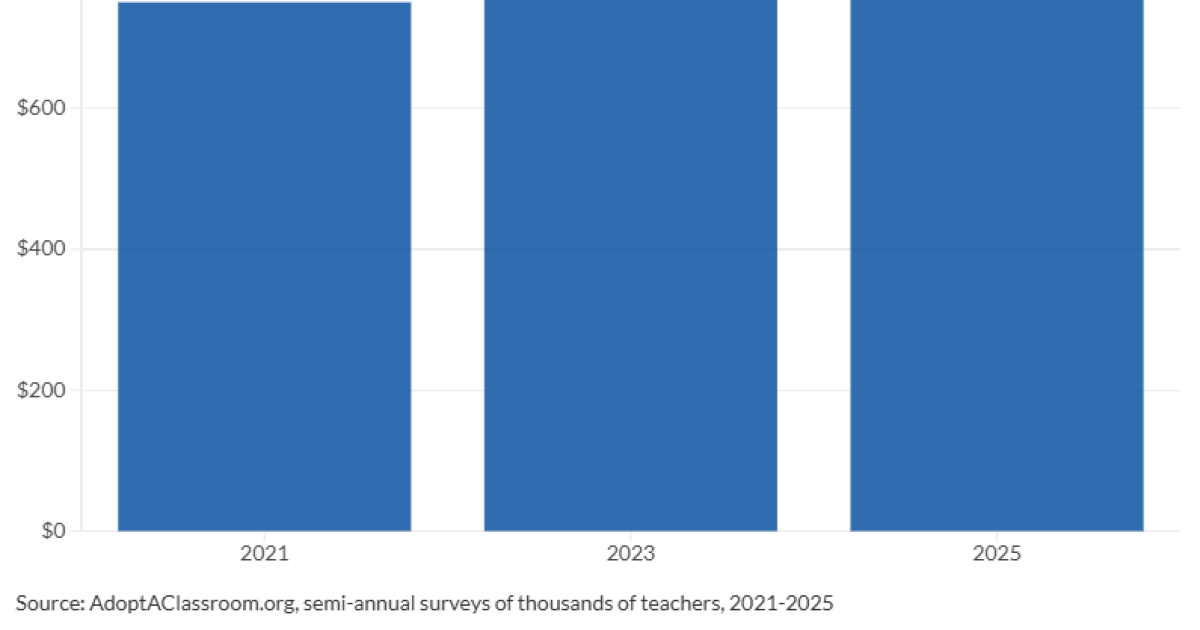
On the other hand, teachers spent an average of $895 of their own money in the last school year for basics like pencils and notebooks, food for students and books, according to a survey of more than 3,700 of them earlier this year by the nonprofit organization AdoptAClassroom.org. That number has jumped 49% in the past decade. At least 20% of the respondents said they have taken other jobs to supplement their income, and 97% said that their official budget didn’t provide enough money to meet their classrooms’ needs.

“The results paint a powerful picture of a profession stretched thin and what it takes for teachers to show up for their students every day,” the nonprofit organization’s report said. “This steady rise in out-of-pocket classroom costs underscores the growing crisis these teacher statistics show and reveals why many educators feel compelled to supplement classroom budgets with their own funds.”

While it’s unclear whether OBBBA could provide any meaningful relief to that problem, some teachers may benefit from its new miscellaneous itemized deduction for educator costs, according to a blog post about the provision by CPA firm Milliken, Perkins & Brunelle.

“Both who’s eligible and what expenses qualify are a little broader for the itemized deduction than for the above-the-line deduction,” the blog said. “For example, interscholastic sports administrators and coaches are also eligible. And, for courses in health and physical education, the supplies don’t have to be related to athletics. Keep in mind that you’ll have to itemize deductions to claim this new deduction next year. Taxpayers can choose to itemize this and certain other deductions or to take the standard deduction based on their filing status. Itemizing deductions saves tax only when the total is greater than the standard deduction. The OBBBA has made permanent the nearly doubled standard deductions under the TCJA, so fewer taxpayers are benefiting from itemizing.”

READ MORE: Caps, credits, contributions: Tax planning for parents under OBBBA

Take another look

Either way, tax experts point out that it’s important that educators hang on to the receipts for the unreimbursed expenses and document the purpose of them. OBBBA’s unlimited restoration of an itemized deduction that had been reduced to zero by TCJA provides a good reason for advisors and teachers to think through whether the new rules for state and local taxes and any other relevant provisions to their wealth could alter their itemization decisions, Ringbauer said. For some, it may be the first time they’ve considered that question since 2017.

“It’s very valuable for them now to evaluate and really go through their records to see whether they are going to itemize or not,” Ringbauer said. “This is where schools can also play a huge role with their foundations, their nonprofit arms, so educators don’t pay out of pocket.”


Continue Reading

Accounting

SEC’s Semiannual Reporting Proposal Faces Investor Pushback: What CFOs Need to Know

Published

on

U.S. Securities and Exchange Commission (SEC)

A proposal from the U.S. Securities and Exchange Commission to potentially shift some public companies away from quarterly financial reporting toward a semiannual model is drawing significant pushback from investors, even as it continues moving through the regulatory process. The debate has direct implications for corporate finance teams, auditors, and the broader transparency of U.S. capital markets.

What the SEC Proposed

According to a summary published by accounting advisory firm Cohen & Co., the SEC issued a proposed rule on May 19, 2026, aimed at simplifying financial reporting requirements for many U.S. public companies. The proposal would potentially reduce the frequency of certain mandatory disclosures from quarterly to semiannual, a structural change that has not been made to core U.S. reporting requirements in decades.

The proposal follows an extended debate within U.S. policy circles, with proponents arguing that reduced reporting frequency could lower compliance costs and free up management time for longer-term strategic planning rather than quarter-to-quarter results management.

Why Investors Are Pushing Back

Comment letters submitted in response to the proposal have been extensive, and according to Cohen & Co.’s review of the public record, investors “appear to be largely opposed” to the shift, viewing frequent interim reporting as a core benefit of U.S. capital markets relative to other jurisdictions.

Accounting and law firms have taken a more measured position, generally urging any changes to remain aligned with the Financial Accounting Standards Board (FASB), whose existing disclosure requirements and guidance are built around a quarterly reporting cadence. A shift to semiannual reporting without corresponding changes to FASB guidance could create friction between SEC filing requirements and GAAP-based disclosure expectations.

Lessons From the U.K. Experience

The debate is not without precedent. The United Kingdom moved away from mandatory quarterly reporting for listed companies in 2014, returning to a semiannual disclosure requirement. According to Cohen & Co.’s analysis, that experience offers a cautionary data point: there was no measurable increase in capital expenditure or R&D investment following the change, while analyst coverage of affected companies declined as reliable interim information became less available — a particular risk for smaller and newly public companies that rely on analyst coverage to maintain investor visibility.

Practical Implications for Finance Teams

Beyond the debate over disclosure philosophy, the proposal carries practical complications. Many companies have debt covenants and credit agreements structured around quarterly financial delivery; a shift to semiannual reporting could require renegotiating those terms. Reduced reporting frequency would also extend the “window of market silence” between disclosures, a factor that governance and investor-relations teams would need to manage carefully to avoid information asymmetry.

Separately, and unrelated to the reporting-frequency debate, the SEC and FASB have continued finalizing more routine updates this year. New Accounting Standards Updates are taking effect for December 31, 2026, fiscal year-ends covering income tax disclosures, credit loss measurement, induced debt conversions, and stock compensation, according to Eide Bailly’s review of 2026 ASU activity. Additional guidance on paid-in-kind dividends and environmental credits is also on the near-term horizon.

What to Watch Next

The semiannual reporting proposal remains in the comment and review phase, and no final rule has been adopted as of this writing. Finance leaders should monitor the SEC’s regulatory agenda for further movement, while treating the current quarterly reporting requirement as the operative standard until any final rule is issued and an effective date is set.

Given the extent of investor opposition documented in the comment file, a full shift to mandatory semiannual reporting appears more likely to result in either a scaled-back compromise or continued study rather than swift adoption — though the SEC’s ultimate direction remains uncertain.


Continue Reading

Accounting

AI-Driven Automation and Continuous Accounting Frameworks

Published

on

The accounting profession is undergoing a fundamental structural transition as enterprise finance departments shift from periodic month-end closes toward automated continuous accounting models. By integrating specialized machine learning algorithms directly into enterprise resource planning (ERP) platforms, chief accounting officers are transforming financial reporting from a retrospective exercise into a real-time operational asset.

The Shift from Periodic Close to Continuous Financial Reporting
Traditional accounting workflows heavily relied on manual data reconciliation, spreadsheet calculations, and multi-week closing cycles at the end of each fiscal period. In contrast, continuous accounting frameworks utilize automated software agents to process, validate, and post transactional data in real time as business activities occur.

Automated bank reconciliation tools cross-reference incoming bank feeds, invoice records, and purchase orders automatically. By resolving transactional variances instantly throughout the month, corporate accounting teams eliminate the traditional workload spikes associated with quarterly and annual closes.

Machine Learning in Audit Trails and Anomaly Detection
Advanced natural language processing (NLP) and machine learning tools are redefining internal audit and financial control environments. Automated systems analyze 100% of general ledger entries, identifying anomalous transactions, duplicate payments, and unauthorized journal entries in real time.

Rather than relying on random statistical sampling, corporate internal auditors can focus their attention on high-risk flags automatically surfaced by algorithmic monitoring platforms. This continuous risk assessment strengthens internal controls over financial reporting (ICFR) and significantly reduces fraud risk.

Evolving Roles for Accounting Professionals
As routine data entry and manual reconciliation tasks become fully automated, the skill set required for accounting professionals is shifting toward data analysis, system design, and strategic business advisory.
– Systems Governance: Accountants are increasingly responsible for monitoring algorithmic accuracy and managing data integration pipelines.
– Business Partnership: Finance professionals leverage real-time financial dashboards to advise operational leaders on margin management and working capital allocation.
– Regulatory Compliance Management: Accounting teams utilize automated platforms to ensure compliance with dynamic tax codes and international accounting standards.

Core Implementation Recommendations
1. Deploy Automated Reconciliation Tools: Integrate continuous transaction processing modules into existing enterprise ERP architectures.
2. Establish Algorithmic Governance Controls: Implement strict internal testing protocols to ensure automated accounting rules comply with GAAP/IFRS standards.
3. Reskill Accounting Teams: Invest in training finance staff on data analytics, workflow automation, and predictive financial modeling.

Continue Reading

Accounting

Global ESG Reporting Standards and Double Materiality Compliance

Published

on

Corporate accounting departments face expanding reporting expectations as international sustainability disclosure standards achieve regulatory enforcement across major global jurisdictions. Chief Accounting Officers (CAOs) and corporate controllers are establishing rigorous internal accounting controls to treat Environmental, Social, and Governance (ESG) metrics with the same data precision, auditability, and governance as traditional financial statements.

Regulatory Harmonization Under Global Sustainability Frameworks
The implementation of standardized sustainability reporting frameworks—notably rules established by international sustainability accounting boards—has created unified expectations for public and large private enterprises. Corporations must report standardized metrics covering greenhouse gas emissions (Scope 1, 2, and material Scope 3), energy utilization, workforce demographics, and supply chain governance.

In Europe and other participating international jurisdictions, double materiality principles are mandatory. Under double materiality, organizations must report both how external sustainability risks impact corporate financial performance, and how internal corporate operations affect surrounding environmental and social structures.

Integrating Sustainability Metrics into Core ERP Systems
To provide auditable non-financial data, enterprise organizations are integrating specialized carbon accounting and ESG management platforms directly into core ERP systems. Automated data collectors capture energy utility invoices, logistics fuel consumption metrics, and vendor compliance records in real time.

Establishing automated, traceable data pipelines ensures that non-financial reporting is supported by clear audit trails. This structured approach allows external financial auditors to provide reasonable assurance on sustainability disclosures during annual corporate reporting cycles.

Financial Impacts and Capital Market Disclosure
Accurate ESG reporting directly influences corporate cost of capital and institutional credit ratings. Commercial lenders and institutional asset managers systematically incorporate sustainability metrics into risk pricing models. Companies that demonstrate transparent, verifiable progress in operational energy efficiency and climate risk mitigation benefit from expanded access to green bond markets and lower debt pricing.

Action Steps for Accounting Leadership
1. Implement Double Materiality Frameworks: Conduct comprehensive assessments to identify material financial and operational sustainability metrics.
2. Build Auditable Non-Financial Data Pipelines: Automate ESG data collection within core accounting software to ensure data integrity.
3. Align Sustainability with Annual Financial Filings: Prepare non-financial disclosures concurrently with financial statements to satisfy regulatory audit expectations.

Continue Reading

Trending