
Finance
A ‘soft landing’ is still on the table, economists say

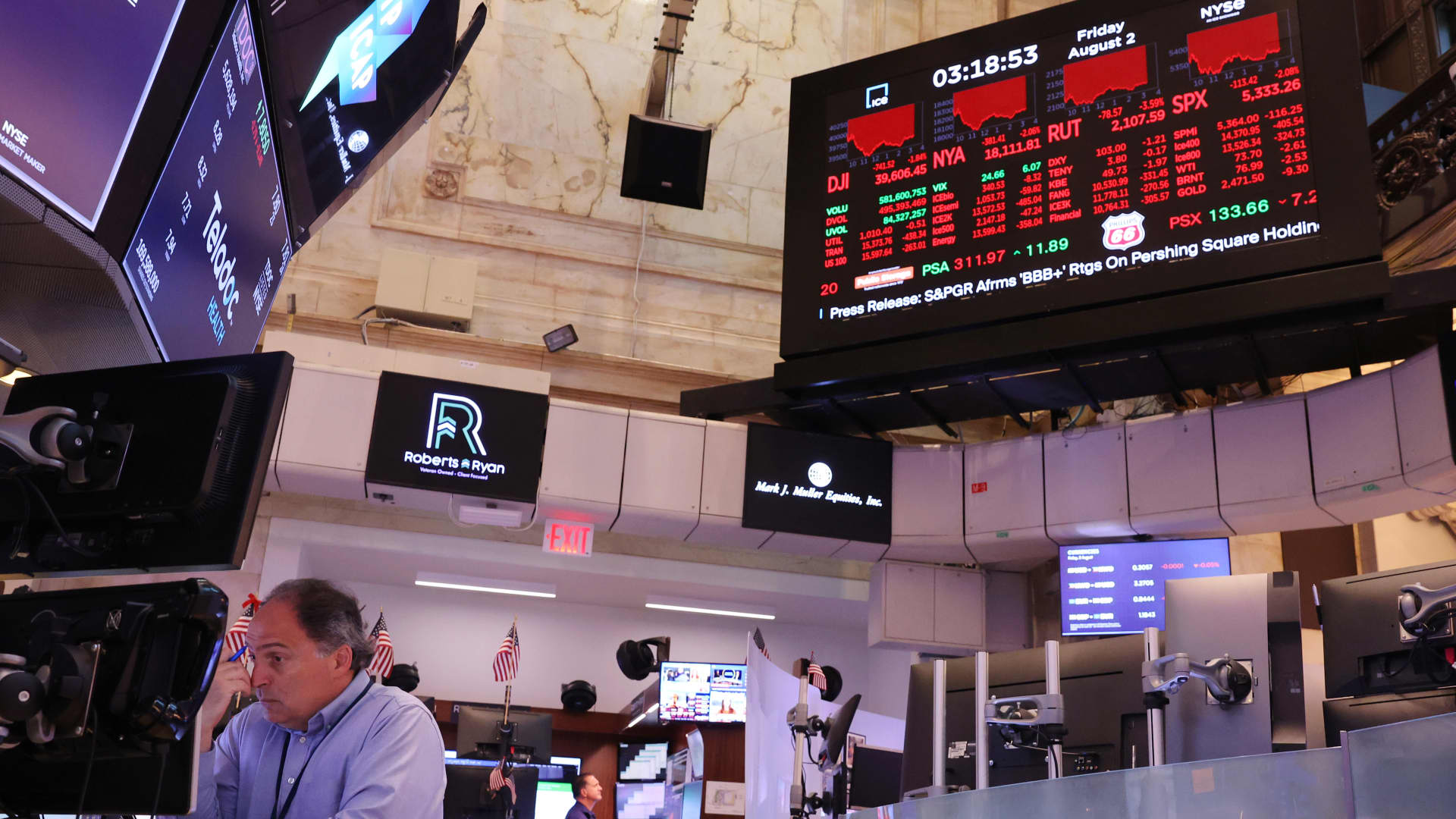
Traders on the floor of the New York Stock Exchange during afternoon trading on Aug. 02, 2024.
Michael M. Santiago | Getty Images
Recession fears led to a sharp stock-market selloff in recent days, with the S&P 500 index posting a 3% loss Monday, its worst in almost two years.
Weaker-than-expected job data on Friday fueled concerns that the U.S. economy is on shaky footing, and that the Federal Reserve may have erred in its goal of achieving a so-called “soft landing.”
A soft landing would mean the Fed charted a path with its interest-rate policy that tamed inflation without triggering an economic downturn.
Federal data on Friday showed a sharp jump in the U.S. unemployment rate. Investors worried this signaled a “hard landing” was becoming more likely.
However, the odds of a recession starting within the next year are still relatively low, economists said.
In other words, a soft landing is still in the cards, they said.

“I think far and away the most likely scenario is a soft landing: The economy avoids an economic downturn,” said Mark Zandi, chief economist at Moody’s.
Likewise, Jay Bryson, chief economist at Wells Fargo Economics, said a soft landing remains his “base case” forecast.
But recession worries aren’t totally unfounded due to some signs of economic weakness, he said.
“I think the fears are real,” he said. “I wouldn’t discount them.”
Avoiding recession would also require the Fed to soon start cutting interest rates, Zandi and Bryson said.
If borrowing costs remain high, it increases the danger of a recession, they said.
Why are people freaking out?
The “big shock” on Friday — and a root cause of the ensuing stock-market rout — came from the monthly jobs report issued by the Bureau of Labor Statistics, Bryson said.
The unemployment rate rose to 4.3% in July, up from 4.1% in June and 3.5% a year earlier, it showed.
A 4.3% national jobless rate is low by historical standards, economists said.
But its steady increase in the past year triggered the so-called “Sahm rule.” If history is a guide, that would suggest the U.S. economy is already in a recession.
The Sahm rule is triggered when the three-month moving average of the U.S. unemployment rate is half a percentage point (or more) above its low over the prior 12 months.
That threshold was breached in July, when the Sahm rule recession indicator hit 0.53 points.
Goldman Sachs raised its recession forecast over the weekend to 25% from 15%. (Downturns occur every six to seven years, on average, putting the annual odds around 15%, economists said.)
Zandi estimates the chances of a recession starting over the next year at about 1 in 3, roughly double the historical norm. Bryson puts the probability at about 30% to 40%.
The Sahm rule may not be accurate this time
However, there’s good reason to think the Sahm rule isn’t an accurate recession indicator in the current economic cycle, Zandi said.
This is due to how the unemployment rate is calculated: The unemployment rate is a share of unemployed people as a percent of the labor force. So, changes in two variables — the number of unemployed and the size of the labor force — can move it up or down.
More from Personal Finance:
‘Don’t panic’ amid stock market volatility
This labor data trend is a ‘warning sign,’ economist says
Now is the time to buy stocks ‘on sale’
The Sahm rule has historically been triggered by a weakening demand for workers. Businesses laid off employees, and the ranks of unemployed people swelled.
However, the unemployment rate’s rise over the past year is largely for “good reasons” — specifically, a big increase in labor supply, Bryson said.
More Americans entered the job market and looked for work. Those who are on the sidelines and looking for work are officially counted amid the ranks of “unemployed” in federal data, thereby boosting the unemployment rate.
The labor force grew by 420,000 people in July relative to June — a “pretty big” number, Bryson said.
Meanwhile, some federal data suggest businesses are holding on to workers: The layoff rate was 0.9% in June, tied for the lowest on record dating to 2000, for example.
‘The flags are turning red’
That said, there have been worrying signs of broader cooling in the labor market, economists said.
For example, hiring has slowed below its pre-pandemic baseline, as have the share of workers quitting for new gigs. Claims for unemployment benefits have gradually increased. The unemployment rate is at its highest level since the fall of 2021.
“The labor market is in a perilous spot,” Nick Bunker, economic research director for North America at job site Indeed, wrote in a memo Friday.
“Yellow flags had started to pop up in the labor market data over the past few months, but now the flags are turning red,” he added.
Other positive signs
There are some positive indicators that counter the negatives and suggest the economy remains resilient, however.
For example, “real” consumer spending (i.e., spending after accounting for inflation) remains strong “across the board,” Zandi said.
That’s important since consumer spending accounts for about two-thirds of the U.S. economy. If consumers keep spending, the economy will “be just fine,” Zandi said.
I think far and away the most likely scenario is a soft landing: The economy avoids an economic downturn.
Mark Zandi
chief economist at Moody’s
Underlying fundamentals in the economy like the financial health of households are “still pretty good” in aggregate, Bryson said.
It’s also a near certainty the Fed will start cutting interest rates in September, taking some pressure off households, especially lower earners, economists said.
“This is not September 2008, by any stretch of the imagination, where it was ‘jump into a fox hole as fast as you can,'” Bryson said. “Nor is it March 2020 when the economy was shutting down.”
“But there are some signs the economy is starting to weaken here,” he added.




S&P 500 September Outlook: Tech Rally Holds Index at 7,600

India Unveils ‘Saptadhara’ Reform Agenda Targeting Technology, Youth Skilling, and Growth

S&P 500 Outperforms Amid Strong Corporate Earnings as Treasury Yields Cap Equity Multiples

Armanino adds Strategic Accounting Outsourced Solutions

New 2023 K-1 instructions stir the CAMT pot for partnerships and corporations

Tax Strategy: Employee Retention Credit update
-

 Technology6 days ago
AI Infrastructure Boom Hits Physical Limits: Power, Financing, and Supply Chain Strain
-

 Economics4 days ago
U.S.- Canada Trade Talks Collapse; Carney Says Retaliatory Tariffs Begin September 8
-
 Stock News7 hours ago
S&P 500 September Outlook: Tech Rally Holds Index at 7,600
-

 Technology4 days ago
Flock Cameras and the Future of Public Security
-
 Finance8 hours ago
S&P 500 Outperforms Amid Strong Corporate Earnings as Treasury Yields Cap Equity Multiples
-

 Insights8 hours ago
Climate Resilience and Offshore Wind and Land Restoration Milestones
-

 Accounting8 hours ago
Mandatory ESG Reporting Standards Demand Standardized Non-Financial Audit Trails
-
 Leaders8 hours ago
India Unveils ‘Saptadhara’ Reform Agenda Targeting Technology, Youth Skilling, and Growth