
Accounting
After Hurricane Milton, IRS grants widespread tax relief

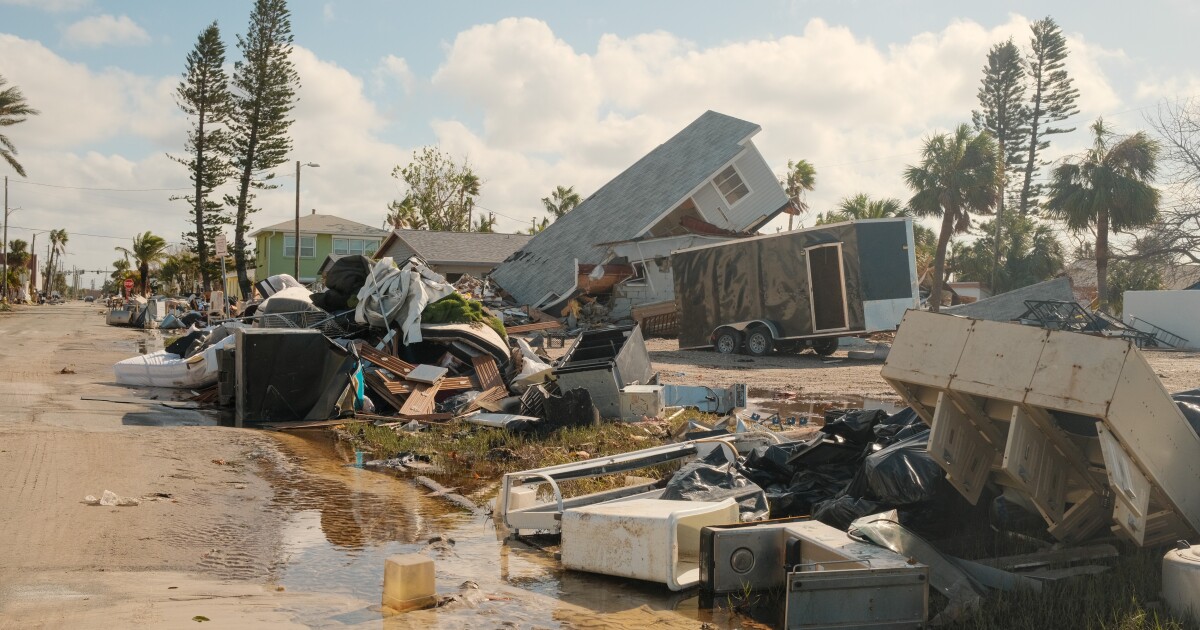
The Internal Revenue Service is offering filing and payment relief in the wake of Hurricane Milton to individuals and businesses in 51 counties in Florida. Individuals and businesses in six counties that previously did not qualify for relief under either Hurricane Debby or Hurricane Helene will receive disaster tax relief beginning Oct. 5 and concluding next May 1.
They are Broward, Indian River, Martin, Miami-Dade, Palm Beach and St. Lucie Counties.
In addition, individuals and businesses in 20 counties previously receiving relief under Debby, but not Helene, will receive disaster tax relief under Hurricane Milton from Aug. 1, 2024, through May 1, 2025. They are Baker, Brevard, Clay, DeSoto, Duval, Flagler, Glades, Hardee, Hendry, Highlands, Lake, Nassau, Okeechobee, Orange, Osceola, Polk, Putnam, Seminole, St. Johns and Volusia Counties.

Tristan Wheelock/Bloomberg
Affected taxpayers in all of Florida now have until May 1, 2025, to file various federal individual and business tax returns and make tax payments, including 2024 individual and business returns normally due during March and April 2025 and 2023 individual and corporate returns with valid extensions and quarterly estimated tax payments.
The IRS is offering relief to any area designated by the Federal Emergency Management Agency. Individuals and households that reside or have a business in any one of the localities listed above qualify for tax relief. The current list of eligible localities is on the
The Milton-related tax relief postpones various tax filing and payment deadlines that occurred between Oct. 5, 2024, and May 1, 2025. Affected individuals and businesses have until May 1, 2025, to file returns and pay any taxes that were originally due during this period. The May deadline now applies to:
- Any individual or business that has a 2024 return normally due during March or April 2025.
- Any individual, C corporation or tax-exempt organization that has a valid extension to file their calendar-year 2023 federal return. (Payments on these returns are ineligible for the extra time because they were due last spring, before the hurricane.)
- 2024 quarterly estimated tax payments normally due on Jan. 15, 2025, and 2025 estimated tax payments normally due on April 15, 2025.
- Quarterly payroll and excise tax returns normally due on Oct. 31, 2024, Jan. 31, 2025, and April 30, 2025.
For localities affected by Milton, penalties for failing to make payroll and excise tax deposits due on or after Oct. 5, 2024, and before Oct. 21, 2024, will be abated, as long as the deposits are made by Oct. 21, 2024. Localities eligible for this relief are: Alachua, Baker, Bradford, Brevard, Broward, Charlotte, Citrus, Clay, Collier, Columbia, DeSoto, Dixie, Duval, Flagler, Gilchrist, Glades, Hamilton, Hardee, Hendry, Hernando, Highlands, Hillsborough, Indian River, Lafayette, Lake, Lee, Levy, Madison, Manatee, Marion, Martin, Miami-Dade, Monroe, Nassau, Okeechobee, Orange, Osceola, Palm Beach, Pasco, Pinellas, Polk, Putman, Sarasota, Seminole, St. Johns, St. Lucie, Sumter, Suwannee, Taylor, Union and Volusia Counties.
Deposit penalty relief and other relief was previously provided to taxpayers affected by Debby and Helene. For details, see the
The IRS
The service automatically provides filing and penalty relief to any taxpayer with an address of record in the disaster area. If an affected taxpayer does not have an address in the area (because, for example, they moved to the disaster area after filing their return), and they receive a late-filing or late-payment penalty notice from the IRS for the postponement period, they should call the number on the notice to have the penalty abated.
The IRS will work with any taxpayer who lives outside the disaster area but has records necessary to meet a deadline occurring during the postponement period in the affected area. Qualifying taxpayers who live outside the disaster area should call the IRS at (866) 562-5227, including workers assisting the relief activities who are with a recognized government or philanthropic organization. Tax preparers in the disaster area with clients who are outside the disaster area can use the
After a disaster, people who temporarily relocate should notify the IRS of their new address by submitting
Individuals and businesses in a federally declared disaster area who suffered uninsured or unreimbursed disaster-related losses can choose to claim them on either the return for the year the loss occurred (in this instance, the 2024 return normally filed next year), or the return for the prior year (2023, filed this year). Taxpayers have extra time — up to six months after the due date of the taxpayer’s federal income tax return for the disaster year (without regard to any extension of time to file) — to make the election. For individual taxpayers, this means Oct. 15, 2025.
Taxpayers and tax professionals should write the FEMA declaration number — 3622-EM — on any return claiming a loss.
Extension relief
In the wake of the recent hurricanes in Florida and the Southeast, the IRS says taxpayers in the entire states of Alabama, Florida, Georgia, North Carolina and South Carolina and parts of Tennessee and Virginia who received extensions to file their 2023 returns now have until May 1, 2025, to file.
Tax-year 2023 tax payments are not eligible for this extension. May 1 is also the deadline for filing 2024 returns and paying any tax due.
Dyed diesel fuel
In response to Hurricane Milton, the IRS will also not impose a penalty when dyed diesel fuel with a sulfur content that does not exceed 15 parts-per-million is sold for use or used on the highway throughout Florida. This is in addition to the limited relief provided in response to Hurricane Helene.
The relief began on Oct. 9 and will remain in effect through Oct. 30.
This penalty relief is available to any person who sells or uses dyed diesel fuel in vehicles suitable for highway use. In the case of the operator of the highway vehicle in which the dyed diesel fuel is used, the relief is available only if the operator or the person selling such fuel pays the tax of 24.4 cents per gallon that is normally applied to undyed diesel fuel for highway use.
The IRS will not impose penalties for failure to make semi-monthly deposits of tax for dyed diesel fuel sold for use or used in diesel powered vehicles on the highway in Florida during the relief period.





Treasury Bond Volatility Forces Bessent to Double Debt Buyback Size as Yields Swing

Nvidia Earnings Preview: What Wall Street Expects From the AI Bellwether’s Q2 Report

SEC’s Semiannual Reporting Proposal Faces Investor Pushback: What CFOs Need to Know

Armanino adds Strategic Accounting Outsourced Solutions

New 2023 K-1 instructions stir the CAMT pot for partnerships and corporations

Tax Strategy: Employee Retention Credit update
-

 Economics1 week ago
U.S. Retail Sales Fall for the First Time in Nine Months as Consumer Spending Slows
-

 Economics1 week ago
Nvidia’s Potential $3 Billion SB Energy Investment Could Reshape AI Infrastructure
-

 Economics4 days ago
Top 10 Largest Economies by 2030: IMF & World Bank GDP Projections for Global Powerhouses
-

 Stock News4 days ago
How to understand Intel $15B Stock Offering
-

 Technology1 week ago
U.S.-China AI Competition Intensifies as Washington Pushes Allies to Choose Sides
-

 Economics4 days ago
Economic Profile of the United States of America (2026–2030 Horizon)
-

 Leaders3 days ago
Jackson Hole 2026: What the First Symposium Under Fed Chair Kevin Warsh Means for Markets
-

 Economics3 days ago
U.S. National Debt Surpasses $40 Trillion for the First Time: What It Means for the Economy