
Finance
AI-powered financial advisor has $20 billion in assets


AI-generated responses are becoming more common, whether travelers know or not.
Westend61 | Getty Images
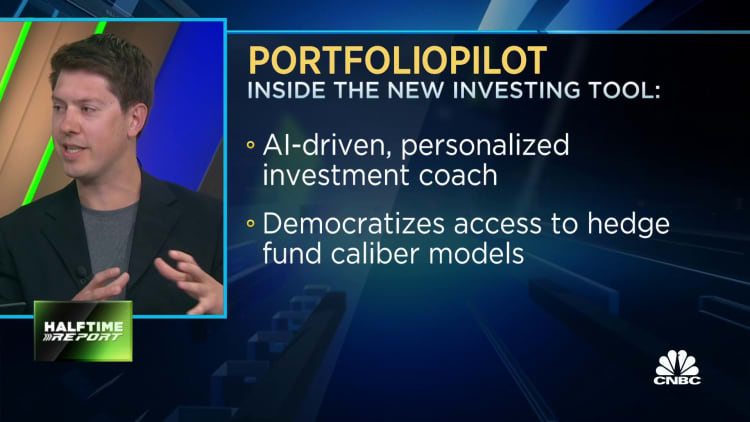
An automated financial advisor called PortfolioPilot has quickly gained $20 billion in assets in a possible preview of how disruptive artificial intelligence could be for the wealth management industry.
The service has added more than 22,000 users since its launch two years ago, according to Alexander Harmsen, co-founder of Global Predictions, which launched the product.
The San Francisco-based startup raised $2 million this month from investors including Morado Ventures and the NEA Angel Fund to fund its growth, CNBC has learned.
The world’s largest wealth management firms have rushed to implement generative AI after the arrival of OpenAI’s ChatGPT, rolling out services that augment human financial advisors with meeting assistants and chatbots. But the wealth management industry has long feared a future where human advisors are no longer necessary, and that possibility seems closer with generative AI, which uses large language models to create human-sounding responses to questions.
Still, the advisor-led wealth management space, with giants including Morgan Stanley and Bank of America, has grown over the past decade even amid the advent of robo-advisors like Betterment and Wealthfront. At Morgan Stanley, for instance, advisors manage $4.4 trillion in assets, far more than the $1.2 trillion managed in its self-directed channel.
Many providers, whether human or robo-advisor, end up putting clients into similar portfolios, said Harmsen, 32, who previously cofounded an autonomous drone software company called Iris Automation.
“People are fed up with cookie-cutter portfolios,” Harmsen told CNBC. “They really want opinionated insights; they want personalized recommendations. If we think about next-generation advice, I think it’s truly personalized, and you get to control how involved you are.”
AI-generated report cards
The startup uses generative AI models from OpenAI, Anthropic and Meta’s Llama, meshing it with machine learning algorithms and traditional finance models for more than a dozen purposes throughout the product, including for forecasting and assessing user portfolios, Harmsen said.
When it comes to evaluating portfolios, Global Predictions focuses on three main factors: whether investment risk levels match the user’s tolerance; risk-adjusted returns; and resilience against sharp declines, he said.
Users can get a report card-style grade of their portfolio by connecting their investment accounts or manually inputting their stakes into the service, which is free; a $29 per month “Gold” account adds personalized investment recommendations and an AI assistant.
“We will give you very specific financial advice, we will tell you to buy this stock, or ‘Here’s a mutual fund that you’re paying too much in fees for, replace it with this,'” Harmsen said.
“It could be simple stuff like that, or it could be much more complicated advice, like, ‘You’re overexposed to changing inflation conditions, maybe you should consider adding some commodities exposure,'” he added.
Global Predictions targets people with between $100,000 and $5 million in assets — in other words, people with enough money to begin worrying about diversification and portfolio management, Harmsen said.
The median PortfolioPilot user has a $450,000 net worth, he said.
The startup doesn’t yet take custody of user funds; instead it gives paying customers detailed directions on how to best tailor their portfolios. While that has lowered the hurdle for users to get involved with the software, a future version could give the company more control over client money, Harmsen said.
“It’s likely that over the next year or two, we will build more and more automation and deeper integrations into these institutions, and maybe even a Gen 2 robo-advisor system that allows you to custody funds with us, and we’ll just execute the trades for you.”
‘Massive shake up’
Harmsen said he created the first version of PortfolioPilot a few years ago to manage his own newfound wealth after selling his first company.
He’d grown frustrated after meeting more than a dozen financial advisors and realizing that they were “basically just salespeople trying to give access to this fairly standard” approach, he said.
“It felt like a very real problem for me, because the only alternative I saw on the market was, you know, basically becoming a day trader and becoming my own portfolio manager,” Harmsen said.
“I wanted hedge fund-quality tools and ways to think about risk and downside protection, and portfolio management across all of my different accounts and the buckets of money in crypto and real estate,” he said.
So around the time he was starting a family and buying a home in San Francisco, he began coding a program that could manage his investments.
After realizing it could have a broader use, Harmsen began building a team for Global Predictions, including three former employees of Bridgewater Associates, the world’s largest hedge fund.
The company’s rise has attracted regulatory scrutiny; in March, the Securities and Exchange Commission accused Global Predictions of making misleading claims in 2023 on its website, including that it was the “first regulated AI financial advisor.” Global Predictions paid a $175,000 fine and changed its tagline as a result.
While today’s dominant providers have been rushing to implement AI, many will be left behind by the transition to fully automated advice, Harmsen predicted.
“The real key is you need to find a way to use AI and economic models and portfolio management models to generate advice automatically,” he said.
“I think that is such a huge jump for the traditional industry; it’s not incremental, it’s very black or white,” he said. “I don’t know what’s going to happen over the next 10 years, but I suspect there will be a massive shake up for traditional human financial advisors.”




S&P 500 September Outlook: Tech Rally Holds Index at 7,600

India Unveils ‘Saptadhara’ Reform Agenda Targeting Technology, Youth Skilling, and Growth

S&P 500 Outperforms Amid Strong Corporate Earnings as Treasury Yields Cap Equity Multiples

Armanino adds Strategic Accounting Outsourced Solutions

New 2023 K-1 instructions stir the CAMT pot for partnerships and corporations

Tax Strategy: Employee Retention Credit update
-

 Stock News1 week ago
Nvidia Q2 FY2027 Earnings beats Wall Street Expectation with Record $96.2 Billion Revenue
-

 Technology6 days ago
AI Infrastructure Boom Hits Physical Limits: Power, Financing, and Supply Chain Strain
-

 Economics4 days ago
U.S.- Canada Trade Talks Collapse; Carney Says Retaliatory Tariffs Begin September 8
-

 Technology4 days ago
Flock Cameras and the Future of Public Security
-
 Stock News1 hour ago
S&P 500 September Outlook: Tech Rally Holds Index at 7,600
-

 Insights2 hours ago
Climate Resilience and Offshore Wind and Land Restoration Milestones
-

 Accounting2 hours ago
Mandatory ESG Reporting Standards Demand Standardized Non-Financial Audit Trails
-
 Finance2 hours ago
S&P 500 Outperforms Amid Strong Corporate Earnings as Treasury Yields Cap Equity Multiples