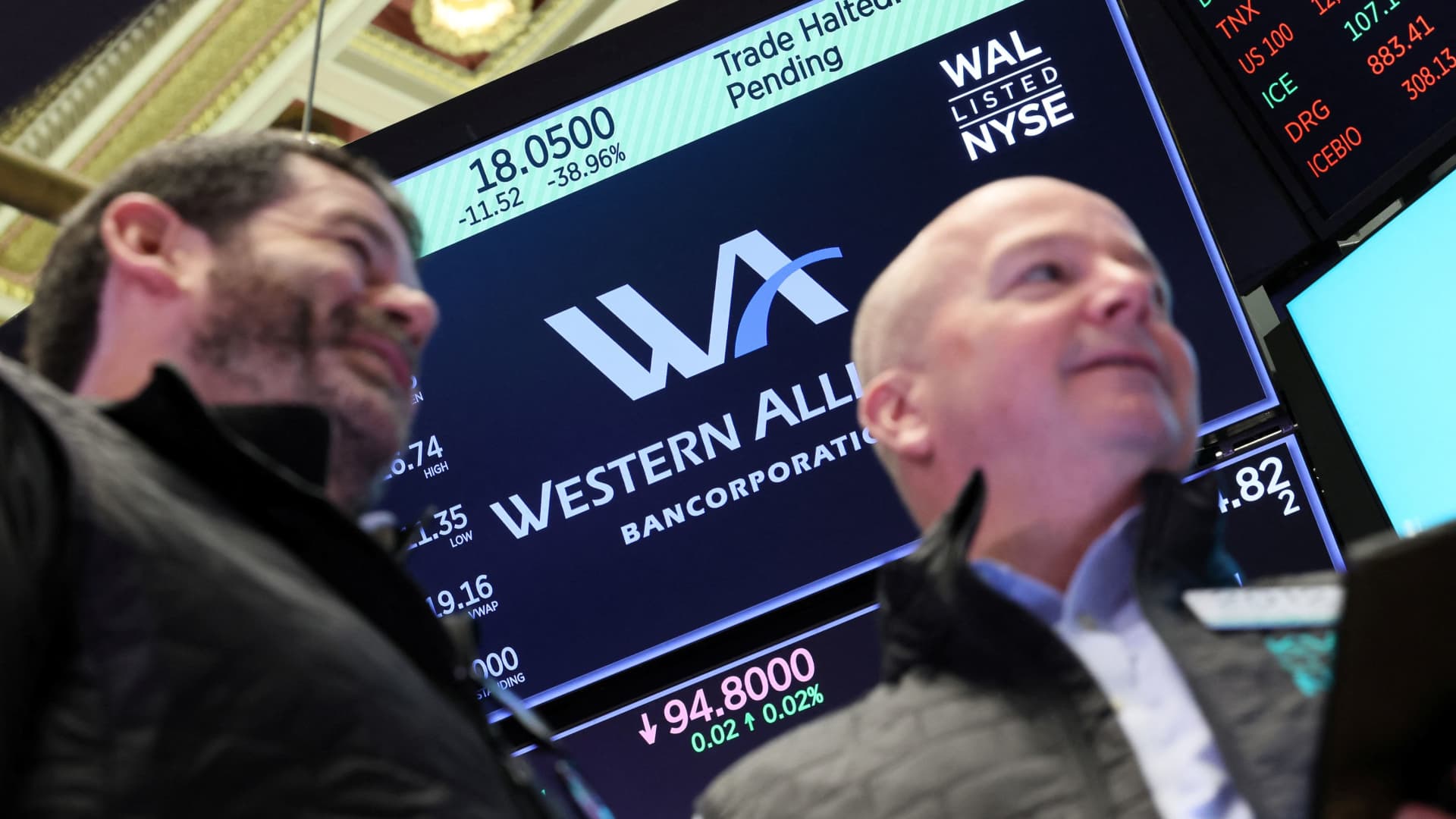
A screen displays that trading is halted for Western Alliance Bancorporation on the floor of the New York Stock Exchange (NYSE), May 4, 2023.
Brendan McDermid | Reuters
Western Alliance, one of the regional banks at the center of concerns over loans made to non-bank financial players, said Wednesday it believes the loan that sparked last week’s selloff is an isolated case.
The bank reported third-quarter earnings Tuesday afternoon and noted it had set aside $30 million in reserves for possible losses on a $98 million loan made to the Cantor Group. Last week, Western Alliance disclosed that it had sued the borrowers behind the Cantor Group for alleged fraud related to the collateral for the loans.
“While incredibly frustrating, we believe this is a one-off issue in our note finance business and have adjusted our onboarding and ongoing portfolio monitoring practices,” Western Alliance CEO Kenneth Vecchione told analysts on Wednesday.
Shares of Western Alliance rose almost 2% in midday trading.
Regional banks are getting a reprieve this week after Western Alliance and Zions, which also had exposure to the alleged loan fraud, reported results that didn’t include any new loan meltdowns. Each of the banks posted rising hauls from net interest income on lower funding costs, while some of their metrics around credit quality actually improved from previous quarters.
The Cantor Group episode forced Western Alliance to review other loans in its note finance portfolio, Vecchione said Wednesday.
“Today we have reverified titles and liens for all notes greater than $10 million and have found no irregularities,” he said.
Analysts grilled Vecchione during the Wednesday call for more details around the bank’s loan collateral and lending to non-depository financial institutions, or NDFIs.
“What are you doing to validate your collateral and safeguard against future frauds?” Autonomous Research analyst Casey Haire asked. “It just seems like as long as you’re not afraid to go to jail, it seems easy to double pledge collateral.”
Besides the recent review, Western Alliance periodically checks collateral to make sure the bank is still in a position to collect if the loan sours, executives said. Much of the bank’s NDFI book is tied to residential mortgages, which Western Alliance considers low-risk, they added.
‘Can’t unsee’
Western Alliance is also exposed to another recent blowup, the bankruptcy of the auto parts maker First Brands.
But in this case, a loan facility made to a fund managed by a subsidiary of the investment bank Jefferies “remains current, and we continue to receive principal and interest payments as modeled,” said Vecchione.
While this week’s reassurances have calmed markets for now, the sharp selloff in regionals last week is leaving a lasting mark on the industry. Shares of both Western Alliance and Zions plunged on Thursday after the banks disclosed problems with the Cantor Group.
Investors are ready to hit “sell” on any signs that the losses aren’t isolated, and share gains for the group will be capped for the foreseeable future because of these worries, said Timur Braziler, who covers mid-cap banks for Wells Fargo. He cut his recommendation on Western Alliance to “sell” on September 29.
“You can’t unsee these events,” Braziler said in an interview. “The timer for any kind of sustainable outperformance within the regional group has gotten reset once again.”
The landscape of institutional debt markets is undergoing a profound structural shift on July 21, 2026, as major corporate issuers and commercial banks rapidly accelerate the deployment of tokenized debt instruments. Data published by leading capital market consortiums indicates that primary issuances of digital commercial paper and tokenized corporate bonds have reached record volumes this month. By moving legacy debt origination, underwriting, and secondary distribution onto permissioned distributed ledgers, corporate treasurers are unlocking unprecedented operational flexibility and instantaneous cross-border liquidity.
The adoption of tokenized debt is fundamentally altering how enterprise balance sheets manage short-term liquidity needs. Traditional corporate bond settlement cycles historically required multi-day clearing processes involving numerous intermediaries, custodial entities, and clearinghouses. Through programmable smart contracts on distributed ledgers, issuers can now execute atomic settlement—enabling continuous, 24/7 access to institutional capital pools. This instantaneous clearing mechanism drastically reduces counterparty risk, eliminates costly settlement friction, and allows treasury teams to dynamically optimize working capital in real time.
A major catalyst driving this institutional migration is the establishment of comprehensive digital asset regulatory frameworks across major financial hubs. Clear legal guidelines regarding ledger-based securities ownership have provided institutional compliance officers with the regulatory confidence necessary to transition multi-billion-dollar liquidity facilities onto digital platforms. Furthermore, the integration of automated regulatory reporting directly into token smart contracts simplifies ongoing compliance audits, ensuring that secondary market trades automatically enforce investor accreditation limits and tax withholding requirements.
For chief financial officers and institutional portfolio managers, tokenized debt represents a fundamental evolution in fixed-income strategy. Companies that embrace ledger-based debt structures gain direct access to a broader, global base of digital-native institutional investors while substantially reducing borrowing overhead. As ledger interoperability continues to improve across global exchanges, tokenized debt is poised to become the standard infrastructure for global corporate finance.
Private credit has firmly established itself as a foundational pillar of global financial markets in 2026, transitioning from an alternative asset class into a dominant mechanism for middle-market corporate financing. Reports published in mid-July 2026 show that direct lending assets under management have expanded significantly, as corporate borrowers increasingly bypass traditional syndication desks in favor of customized private debt solutions. This structural migration has fundamentally altered corporate liquidity dynamics, providing middle-market enterprises with reliable access to tailored capital packages even during periods of regulatory bank tightening.
The primary driver of this continued growth is the structural flexibility inherent in private debt agreements. Unlike public bond markets or conservative commercial bank loans—which often carry rigid covenants and slow underwriting timelines—private credit funds offer speed of execution, flexible payment-in-kind structures, and customized debt-service frameworks. For companies undertaking strategic acquisitions, capital expenditures, or complex balance sheet recapitalizations, the ability to negotiate directly with a unified syndicate of private lenders provides significant certainty and confidentiality.
However, the expansion of private credit is attracting heightened regulatory attention and risk scrutiny. Financial regulatory bodies are closely evaluating the lack of secondary market price discovery and the potential concentration of illiquidity risks within non-bank financial institutions. Because private debt instruments are held to maturity and marked to model rather than marked to market, evaluating real-time enterprise valuations during economic shifts requires robust internal credit assessment standards. Analysts note that as loan portfolios mature, performance variations between disciplined lenders and aggressive underwriters will become increasingly apparent.
For corporate financial officers and institutional portfolio managers, private credit represents both a powerful strategic tool and a vital diversification strategy. Borrowers must weigh the higher nominal coupon rates of private debt against the tangible value of operational flexibility and execution certainty. Meanwhile, investors must maintain rigorous credit due diligence, prioritizing funds with proven restructuring capabilities and deep operational expertise in underwriting resilient middle-market businesses.
The integration of blockchain technology with legacy financial markets has reached a decisive tipping point in July 2026, driven by the rapid scaling of Real-World Asset (RWA) tokenization. Major global investment banks, custodial entities, and asset managers are actively shifting sovereign debt, commercial paper, and private fund shares onto permissioned distributed ledgers. Recent industry data confirms that the aggregate market capitalization of tokenized treasury products and private credit funds has surged past major milestones, illustrating that ledger-based settlement is no longer experimental, but core financial infrastructure.
The fundamental value proposition of asset tokenization rests on operational efficiency, continuous liquidity, and automated compliance execution. By embedding regulatory checks, investor accreditation limits, and automated coupon distributions directly into smart contract code, financial institutions eliminate vast amounts of manual back-office reconciliation. Furthermore, fractionalized ownership structures allow high-value asset classes—such as prime commercial real estate and private equity funds—to be split into accessible units, significantly expanding liquidity pools and enabling real-time collateral optimization.
A key catalyst behind this institutional momentum is the establishment of comprehensive regulatory clarity across major financial jurisdictions. The implementation of standardized digital asset frameworks in the United States and Europe has provided institutional compliance officers with the legal certainty required to deploy capital on-chain. As a result, premier custodian banks are now offering unified digital asset custody, seamlessly bridging traditional securities depositories with programmable ledger ecosystems.
Looking forward, the maturation of tokenized assets will continue to transform secondary market trading and treasury management. Corporate treasurers can now yield-optimize idle cash in real time by moving into tokenized money market instruments that settle instantaneously on a 24/7 basis. To remain competitive, financial leaders must ensure their institutional architectures are interoperable with modern digital ledger protocols, positioning their organizations at the forefront of modern capital market efficiency.