U.S.-China AI Competition Enters a New Phase
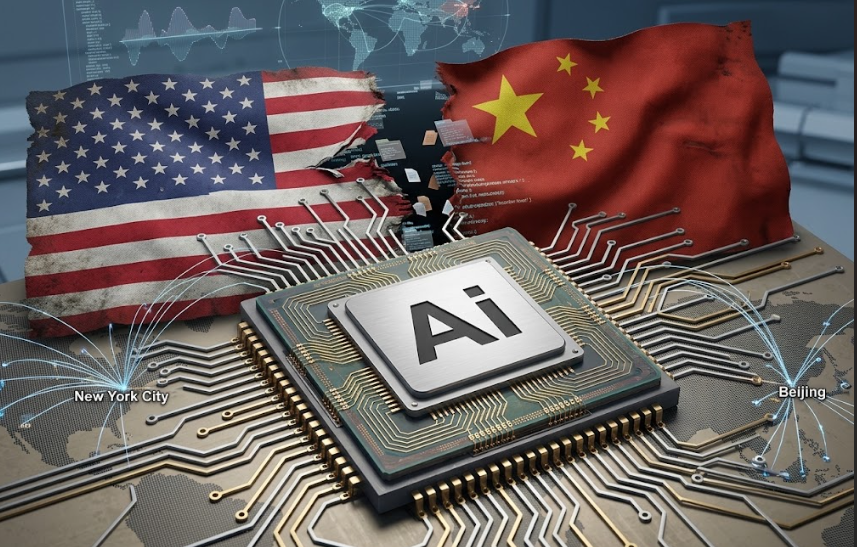
The competition between the United States and China over artificial intelligence is becoming increasingly geopolitical. Washington is preparing to tell dozens of countries that they may have to choose between competing U.S.- and China-backed AI ecosystems, according to a U.S. official and an internal draft reviewed by Reuters. Countries that participate in China’s competing framework could potentially be excluded from a U.S.-led AI coalition.
The development represents a major escalation in the global AI competition because the rivalry is no longer limited to which country can develop the most powerful models. It increasingly involves semiconductor supply chains, computing infrastructure, critical minerals, data centers, cloud services, investment and international alliances.
Why the U.S.-China AI Race Matters
Artificial intelligence has become strategically important because it can influence economic productivity, national security, military capabilities and technological leadership.
The United States currently has major advantages in advanced computing infrastructure and frontier AI development. However, China has demonstrated rapid progress in AI research, model development and industrial deployment.
Brookings describes the competition as spanning several dimensions, including computing power, models, adoption, integration and deployment. It argues that the United States retains an important lead at the technological frontier while China is advancing through efficiency improvements, open-source development and integration into the real economy.
Washington Wants to Strengthen a U.S.-Led AI Ecosystem
The latest U.S. initiative reflects concerns that countries could simultaneously participate in American and Chinese technology ecosystems.
Washington has already pursued policies designed to strengthen supply chains involving AI models, semiconductors and critical minerals. Reuters reported that the United States launched the Pax Silica initiative last year with the goal of strengthening these strategic supply chains.
The new pressure on partner countries could therefore be viewed as an attempt to turn technological partnerships into a broader geopolitical alliance.
For countries caught between Washington and Beijing, however, choosing sides could be economically difficult.
China Is Building Its Own AI Ecosystem
China is not simply responding to American policy. Beijing is actively attempting to establish itself as a global leader in artificial intelligence.
Recent Chinese initiatives have emphasized domestic AI development, semiconductor capabilities, industrial applications and broader international cooperation.
Barron’s reported that China’s AI strategy combines rapid technological development with substantial regulatory oversight. Beijing’s “AI Plus” strategy seeks to expand AI integration across industries such as manufacturing, healthcare, education and government.
Chinese companies including DeepSeek, Moonshot AI and Alibaba have contributed to the country’s rapidly developing AI ecosystem.
Semiconductors Are at the Center of the Rivalry
The U.S.-China AI competition cannot be separated from the semiconductor industry.
Advanced AI systems require powerful processors, and access to leading-edge chips is therefore a strategic advantage. Washington has used export controls and other policies to restrict China’s access to some advanced semiconductor technologies.
China, meanwhile, is investing heavily in domestic semiconductor production in an effort to reduce dependence on foreign suppliers.
The outcome of this competition could reshape the global semiconductor industry for years.
Critical Minerals Add Another Layer
AI infrastructure requires more than semiconductors. Data centers need electricity, networking equipment, construction materials and various critical minerals.
China occupies an important position in global processing and supply chains for several critical minerals. This gives Beijing an additional strategic lever in technology competition.
The United States and its allies are therefore attempting to diversify critical-mineral supply chains and develop alternative sources.
The result is an increasingly complex relationship between artificial intelligence, energy security, mining, manufacturing and international trade.
Countries Face Difficult Economic Choices
The biggest challenge for third countries is that many want access to both American and Chinese technology.
American AI companies have enormous influence in cloud computing, software and advanced chips. China offers competitive technology, manufacturing capabilities and infrastructure investment.
For emerging economies, maintaining relationships with both sides may provide economic advantages. Being forced to choose could increase costs and reduce technological options.
Countries may consequently attempt to pursue a middle path, although Washington’s reported proposal could make that strategy increasingly difficult.
AI Competition Could Reshape Global Trade
The consequences extend beyond technology companies.
If the world divides into separate AI ecosystems, businesses may face incompatible technology standards, duplicated supply chains and higher compliance costs.
Manufacturers could need to maintain separate technology systems for different markets. Cloud providers could face restrictions on cross-border services. Semiconductor companies could have to navigate increasingly complicated export-control regimes.
Such fragmentation could reduce some of the efficiency created by globalization.
The Economic Stakes Are Enormous
The AI industry is attracting extraordinary amounts of investment. Nvidia alone has become deeply involved in financing the infrastructure required for AI expansion, including a reported initiative designed to mobilize up to $500 billion for AI infrastructure.
This demonstrates why governments view AI leadership as an economic priority.
The country that builds the strongest AI ecosystem could gain advantages in productivity, manufacturing, scientific research and high-value technology exports.
U.S.-China AI Talks Could Provide a Pressure Valve
Despite intensifying competition, Washington and Beijing are not completely disengaged.
Reuters previously reported that U.S. and Chinese officials were expected to hold AI discussions in September, reflecting growing concern on both sides about the accelerating AI race.
Dialogue could help establish rules around AI safety, technology transfers and international cooperation.
However, negotiations will be complicated because AI is increasingly viewed through the lens of national security.
What the U.S.-China AI Competition Means for the Future
The U.S.-China AI rivalry is evolving from a competition between technology companies into a contest between broader economic and geopolitical systems.
The United States is attempting to strengthen an allied technology ecosystem built around advanced computing, semiconductors and critical-mineral security. China is developing its own AI capabilities while expanding industrial adoption and international partnerships.
For investors, businesses and governments, this means AI policy will increasingly matter as much as AI innovation.
The next phase of the competition will likely be determined not simply by who develops the most powerful AI model, but by who can build the largest, most resilient and internationally connected AI ecosystem. That makes the U.S.-China AI competition one of the most consequential economic and technological developments of the decade.

















 Technology1 week ago
 Economics7 days ago

 Finance3 days ago
 Technology7 days ago
 Insights3 days ago
 Accounting3 days ago