
Personal Finance
As Dow nears 40,000, here’s what experts say to do in case of a pullback

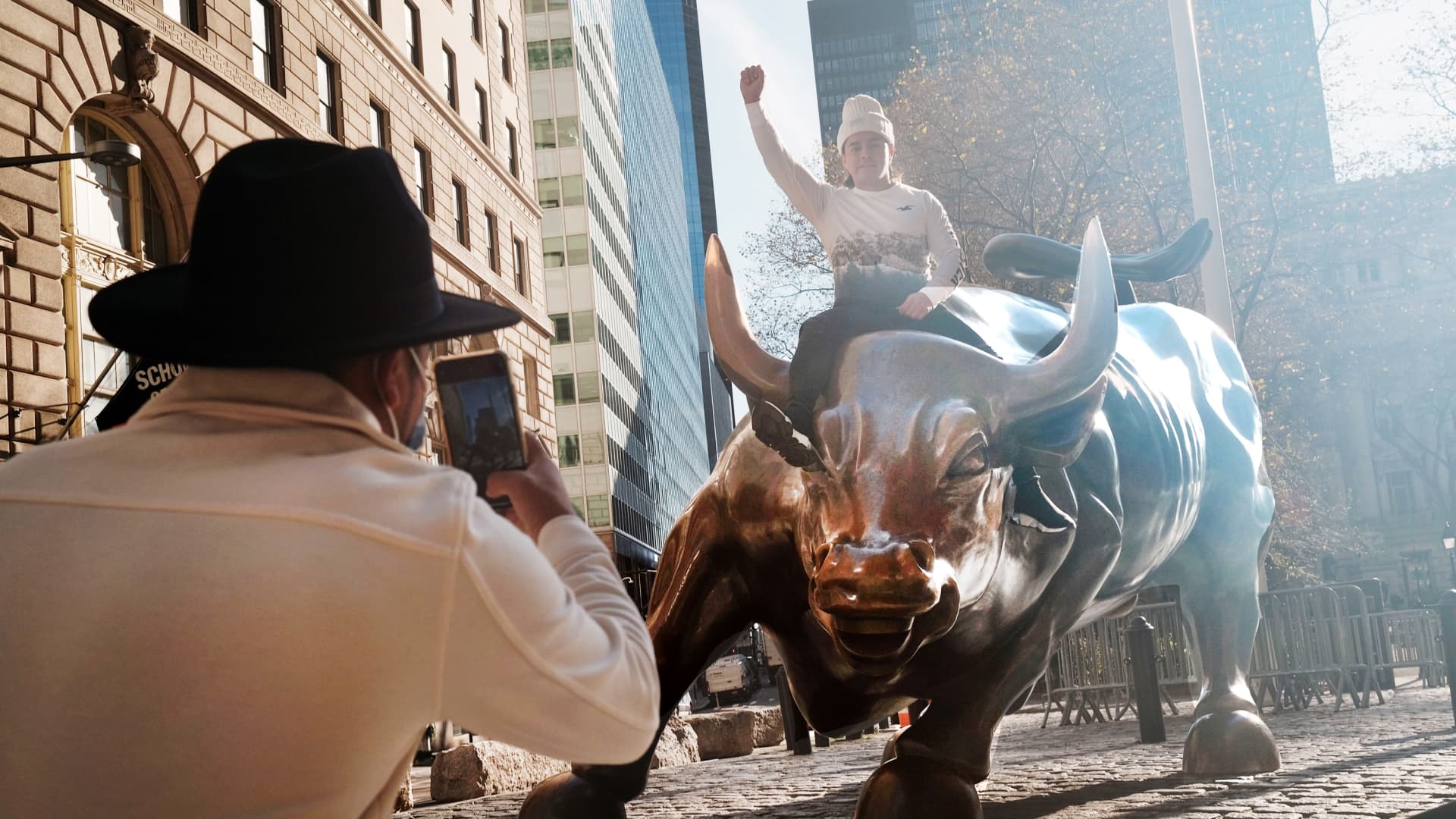
A man sits on the Wall street bull near the New York Stock Exchange (NYSE) on November 24, 2020 in New York City.
Spencer Platt | Getty Images
The stock market could hit a milestone if the Dow Jones Industrial Average reaches 40,000.
However, even as stocks have climbed higher, investors are worried there could be a pullback, financial advisors say.
They’re not alone in those concerns.
A recent CNBC survey of investment professionals found 61% think the market has run too far too fast and a market drop could be coming.
“It does feel like we’re at an inflection point where things could go either way,” said Christine Benz, director of personal finance and retirement planning at Morningstar.
Will there be a pullback?
After a mostly uninterrupted market rally over the past four or five months, it would not be surprising to see a pullback, said Angelo Kourkafas, senior investment strategist at Edward Jones.
That would more likely come in the form of a temporary correction rather than a prolonged bear market, he said.
For investors who have gravitated toward cash, certificates of deposit, or bonds, a pullback may be an opportunity to deploy those funds in the market, Kourkafas said.
If you’re investing toward your retirement or other life goals, it’s best to avoid trying to time the market, said Ted Jenkin, a certified financial planner and the CEO and founder of oXYGen Financial, a financial advisory and wealth management firm based in Atlanta.
“The stock market is a long-term investment,” said Jenkin, who is also a member of CNBC’s Financial Advisor Council.
Will the election hurt the markets?
Investors are jittery that the presidential election results may throw the markets off track, surveys show.
But experts say those worries are misguided.
“It is really very hard to find any evidence in the data that politics is a long-term determinant of market performance,” Kourkafas said.
However, there may be increased volatility in the months preceding the election, he said.
What’s unique this time around is we are already familiar with both of the likely candidates — current President Joe Biden and former President Donald Trump — and the markets have performed equally well under both leaders, he said.
Instead, the outlook may depend more on other factors such as interest rates, corporate earnings and economic growth, he said.
Financial advisors including Louis Barajas, a CFP and enrolled agent, said their clients are concerned the election may affect their portfolios.
“I tell them, ‘Listen, presidents come, presidents go, the economy’s going to change. But in the long term, the market tends to be up,'” said Barajas, who is CEO of International Private Wealth Advisors in Irvine, California, and also a member of the CNBC FA Council.
Barajas said he steers his clients to focus on their personal goals rather than on outside events.
How to make sure you’re protected ‘no matter what happens’
Today’s market uncertainty is a reminder of the value of humility, said Morningstar’s Benz.
And the best way to express humility in portfolios is to diversify, she said.
“No matter what happens, we’re reasonably well protected,” Benz said.
For young investors, that may mean moving away from U.S. stocks to non-U.S. holdings, she said. That may be done through a fund that reflects global market capitalization, such as the Vanguard Total World Stock ETF.
Older investors may want to take advantage of higher fixed-income yields and add safer assets to their portfolios, she said. That can include cash and short- and intermediate-term high-quality bonds to build a runway to spend from, even if stocks do go down.
“You can have a safer portfolio and expect to earn a decent rate of return today,” Benz said.
If you’re already in retirement and spending from your portfolio, it’s worth having those safeguards in place.
Finding the right mix of assets will depend on your personal timeline.
For financial goals that aren’t at least five years away, it makes no sense to invest in the stock market, Jenkin said.
To test your own portfolio allocation based on your age, Jenkin suggested following the rule of 120 – subtract your age from that number to find out how you should be invested. So if you’re 60 years old, for example, a 60% allocation to stocks may make sense.
When it comes to revisiting your portfolio allocations, it’s wise to set your own schedule rather than react to market or other news events.
“Make a plan to do that once a year or so,” Benz said.


Personal Finance
Next-Generation Retirement Planning: Managing Longevity Risk and Variable Income Streams


U.S.- Canada Trade Talks Collapse; Carney Says Retaliatory Tariffs Begin September 8

Flock Cameras and the Future of Public Security

AI Infrastructure Boom Hits Physical Limits: Power, Financing, and Supply Chain Strain

Armanino adds Strategic Accounting Outsourced Solutions

New 2023 K-1 instructions stir the CAMT pot for partnerships and corporations

Tax Strategy: Employee Retention Credit update
-

 Stock News1 week ago
Nvidia Earnings Preview: What Wall Street Expects From the AI Bellwether’s Q2 Report
-

 Accounting1 week ago
SEC’s Semiannual Reporting Proposal Faces Investor Pushback: What CFOs Need to Know
-

 Stock News1 week ago
Nvidia Q2 FY2027 Earnings beats Wall Street Expectation with Record $96.2 Billion Revenue
-

 Finance1 week ago
Treasury Bond Volatility Forces Bessent to Double Debt Buyback Size as Yields Swing
-
 Technology4 days ago
AI Infrastructure Boom Hits Physical Limits: Power, Financing, and Supply Chain Strain
-
 Economics2 days ago
U.S.- Canada Trade Talks Collapse; Carney Says Retaliatory Tariffs Begin September 8
-
 Technology2 days ago
Flock Cameras and the Future of Public Security