Maryland and Baltimore may jump ahead of states that have waited more than a decade for emergency highway funding, as the federal government swoops in with aid after the collapse of the Francis Scott Key Bridge.
The Federal Highway Administration’s emergency relief fund, which reimburses states for expenses to repair or reconstruct roadways after disasters, has a $2.1 billion backlog of projects and only $890 million on hand, according to data obtained by The Washington Post.
That money is not paid on a first-come, first-served basis, leaving some states waiting years to be made whole after a disaster. Baltimore’s needs could both move to the top of the list and also wipe out the money left in the FHWA’s emergency account, pressing Congress into urgent action to replenish the agency’s coffers.
“We have to come to the realization that it needs to be tripled, quadrupled, just to have that money ready so we’re not debating it while one of our key arteries is broken,” Rep. Mike Quigley (Ill.), the top Democrat on the House Appropriations transportation subcommittee, said in an interview. “We have to be honest with ourselves. This fund always needs more money. It’s critical for people, for our economy, for safety. And now, this should be bipartisan. I hope it will be.”
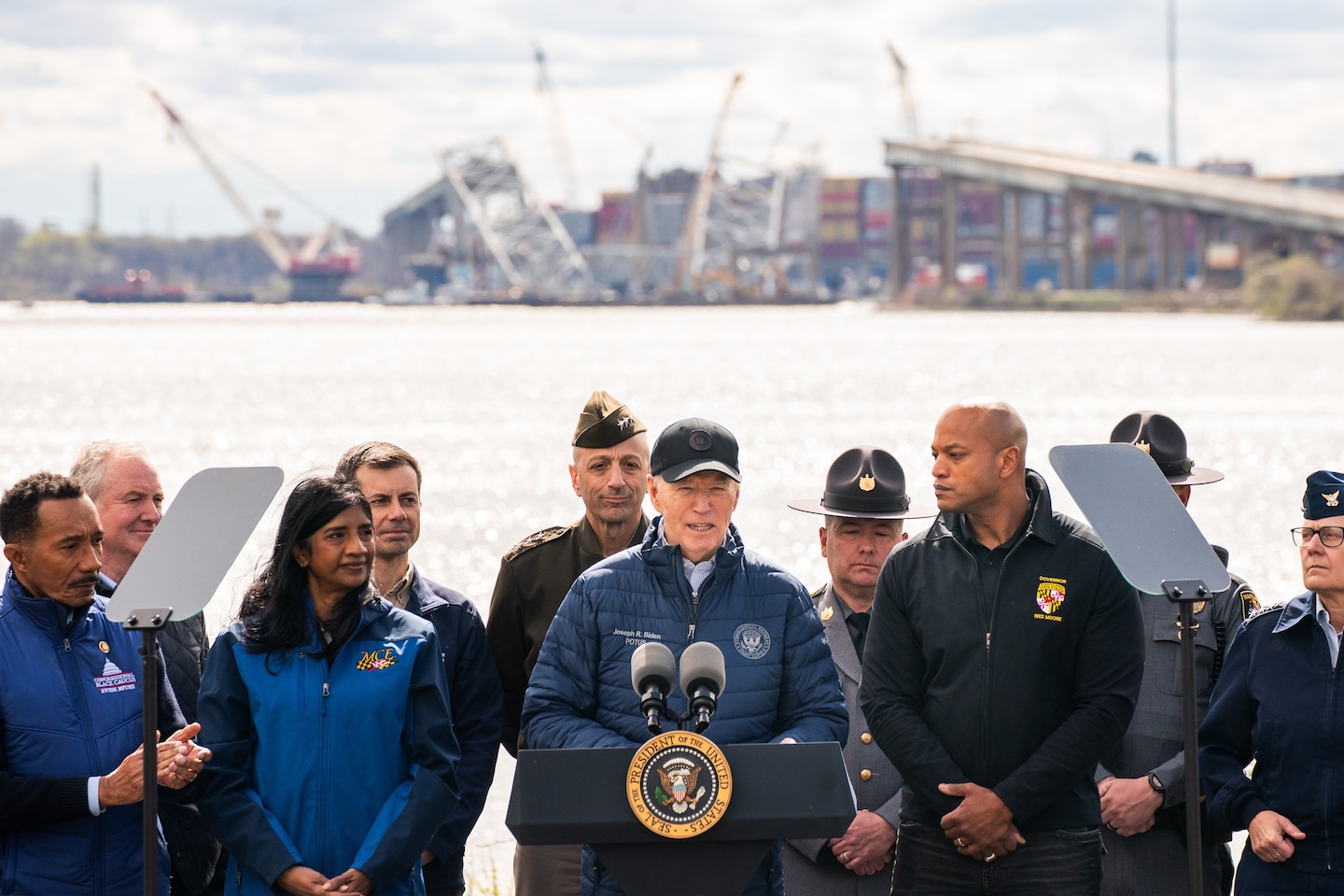
Maryland could require more than $1 billion to rebuild the Key Bridge, which collapsed on March 26 after it was struck by the massive container ship Dali. But state and federal officials still aren’t sure of the exact needs — 12,000 tons of steel and concrete lie at the bottom of the murky Patapsco River, and 5,000 tons lie atop the grounded Dali, according to the Army Corps of Engineers.
Federal transportation officials have already given Maryland $60 million in “quick release” funding to divert traffic away from the roadway and assist other highways that are absorbing the nearly 30,000 vehicles that traversed the bridge each day.
President Biden immediately after the collapse said the federal government should pay for the full cost of reopening Baltimore’s shipping channel and reconstructing the bridge, consistent with past catastrophic bridge collapses, including the 2007 failure of the Interstate 35W bridge in Minnesota.
Sen. Ben Cardin (D-Md.) and Rep. Steny H. Hoyer (D-Md.) introduced legislation Thursday evening to authorize the federal government to cover the full cost of the bridge rebuilding.
But there’s a long list of other projects also waiting for federal support.
California, for instance, is still waiting on $1.5 million to recover from statewide storms in 2005, $7.4 million in highway relief funding from a 2012 rainstorm and flooding, and $722 million total, according to data obtained by The Post. Hawaii is awaiting $3.7 million from a 2012 storm, $77.7 million for recovery after fires ravaged Maui in 2019, and $123 million total.
“We also have a responsibility to support every other community that has been devastated by a disaster because we are all in this together. No state or county, big or small, red or blue, wealthy or not, can shoulder the burden alone,” Sen Brian Schatz (D-Hawaii), chair of the Senate Appropriations transportation subcommittee, said on the Senate floor Wednesday. “When a disaster is so big, so catastrophic for any one state or locality to handle, it falls on the federal government to step up and help.”
Puerto Rico has not been reimbursed for $257 million in highways damage from Hurricanes Irma and Maria in 2017. Tennessee is entitled to $61.8 million after severe storms, floods and landslides in 2019.
FHWA officials declined to comment on the record.
Some backlog in emergency roadway funding is normal. States are reimbursed for work already completed to restore highways, which means there’s a natural lag as projects are finished. The FHWA pays for 90 percent of expenses for federal highways and 80 percent for state highways. The fund is automatically replenished each year with $100 million, and some repairs take years to complete, cushioning the emergency account from immediate payouts most of the time.
“The imperfect arrangement is, you will have a federal commitment to get paid at some point, but you don’t know when that point is going to be,” said Greg Nadeau, who served as the Federal Highways administrator in the Obama administration.
That can create struggles among states to secure that funding, he said, as each presses the case that its project is vital. Maryland Gov. Wes Moore (D) came to Capitol Hill on Tuesday and again Thursday to lobby members of Congress on his state’s behalf.
“For [state transportation departments], there’s never enough money and there’s always a need. It’s really a function of budget timing and competition for resources with the rest of the government,” Nadeau said.
Federal transportation officials have other avenues to funnel money to Baltimore in addition to the emergency relief fund, said Jeff Davis, senior fellow at the Eno Center for Transportation think tank. The state received $828 million from the FHWA for general highway upkeep in the 2024 fiscal year and got another $88 million specifically for bridges.
The Infrastructure Investment and Jobs Act, one of Biden’s chief legislative achievements, also created federal bridge grant programs for which Maryland would now be a strong candidate, Davis said. The state could receive between $5 billion and $6 billion in the next two fiscal years, if selected.
That 2021 law also renewed the $100 million in annual funding for the emergency relief program, but its balance is far from enough to keep the program solvent, experts and lawmakers say, and to keep enough cash on hand for both quick-release funding in the immediate aftermath of disasters and long-term funding to rebuild crucial roadways.
“There are lots of other states of all political persuasions that rely on that fund, so we look forward to working together on a bipartisan basis to making sure that fund is available for all those projects,” Sen. Chris Van Hollen (D-Md.) said Tuesday.
Congress has appropriated $11.5 billion for the FHWA emergency fund since 2011, including $800 million most recently in 2022, according to the Congressional Research Service. Biden in October sought $634 million for the fund as part of a larger spending request that included money for child care, broadband access and energy security priorities.
That request hasn’t yet passed Congress, but it could gain momentum as lawmakers look to tackle a growing number of spending concerns, including some that have gotten more acute since October. The Affordable Connectivity Program, which has helped roughly 23 million American households receive free or heavily discounted high-speed internet, is set to expire at the end of the month, and it is a major funding priority for some Democrats, including many in the Maryland delegation.
That has the potential to complicate the funding picture for Baltimore. Senate Republicans and the new House Appropriations chair are broadly in favor of aid for Maryland and new federal highways funding, but skeptical of authorizing resources for other programs.
“This is not just a local or regional problem, this is a national problem because of the amount of trade that goes through the port. I think we need to be supportive,” Sen. John Boozman (R-Ark.) said Tuesday. “ … But I think we need to stick to what’s at hand. There’s all kinds of things that could go in there, but that’s where people get upset when you put all those other things that are unrelated in there.”
Erin Cox and Tony Romm contributed to this report.







 Stock News1 week ago
 Accounting1 week ago
 Stock News1 week ago
 Finance1 week ago

