
Personal Finance
Bitcoin soared in 2024. How much — if any — should you own?

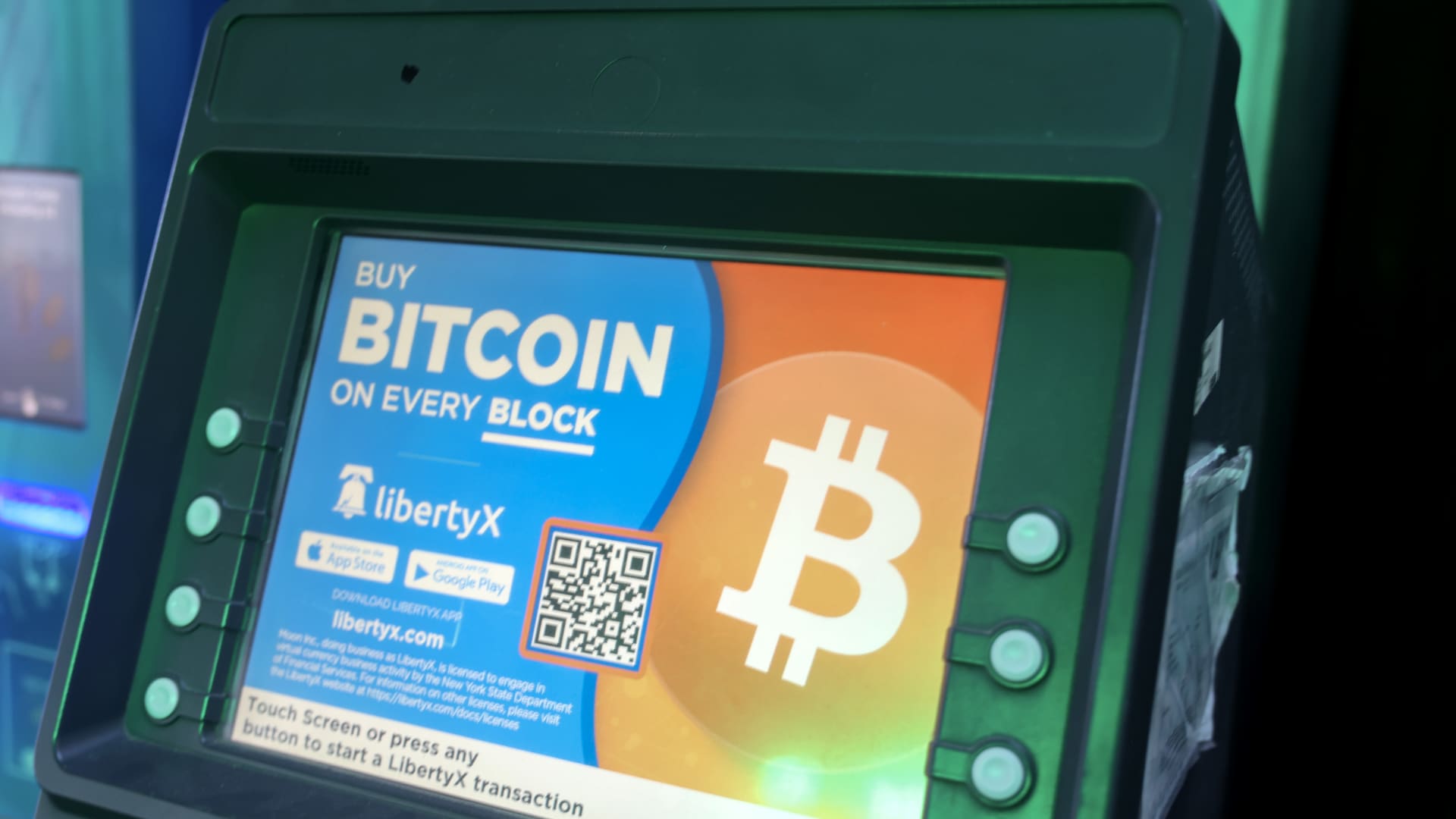
A bitcoin ATM in Miami.
Joe Raedle | Getty Images News | Getty Images
Bitcoin prices soared in 2024. But you may want to tread with caution before euphoria leads you on a hasty buying spree.
Bitcoin and other crypto should generally account for just a sliver of investor portfolios — generally no more than 5% — due to its extreme volatility, according to financial experts.
Some investors may be wise to stay away from it altogether, they said.
“You’re not going to have the same size allocation in bitcoin as you would Nasdaq or the S&P 500,” said Ivory Johnson, a certified financial planner and founder of Delancey Wealth Management, based in Washington, D.C.
“Whenever you have a real volatile asset class, you need less of it in the portfolio to have the same impact” as traditional assets like stocks and bonds, said Johnson, a member of the CNBC Financial Advisor Council.
Why bitcoin prices increased in 2024
Bitcoin, the largest cryptocurrency, was the top-performing investment of 2024, by a long shot. Prices surged about 125%, ending the year around $94,000 after starting in the $40,000 range.
By comparison, the S&P 500, a U.S. stock index, rose 23%. The Nasdaq, a tech-heavy stock index, grew 29%.
Prices popped after Donald Trump’s U.S. presidential election win. His administration is expected to embrace deregulatory policies that would spur crypto demand.
A cartoon image of President-elect Donald Trump holding a bitcoin token in Hong Kong, China, on Dec. 5, 2024, to mark the cryptocurrency reaching over $100,000.
Justin Chin/Bloomberg via Getty Images
Last year, the Securities and Exchange Commission also — for the first time — approved exchange-traded funds that invest directly in bitcoin and ether, the second-largest cryptocurrency, making crypto easier for retail investors to buy.
But experts cautioned that lofty profits may belie an underlying danger.
“With high returns come high risk, and crypto is no exception,” Amy Arnott, a portfolio strategist for Morningstar Research Services, wrote in June.
Bitcoin has been nearly five times as volatile as U.S. stocks since September 2015, and ether has been nearly 10 times as volatile, Arnott wrote.
“A portfolio weighting of 5% or less seems prudent, and many investors may want to skip cryptocurrency altogether,” she said.
1% to 2% is ‘reasonable’ for bitcoin, BlackRock says
Bitcoin lost 64% and 74% of its value in 2022 and 2018, respectively.
Mathematically, investors need a 100% return to recover from a 50% loss.
So far, crypto returns have been high enough to offset its additional risk — but it’s not a given that pattern will continue, Arnott said.
You’re not going to have the same size allocation in bitcoin as you would Nasdaq or the S&P 500.
Ivory Johnson
CFP, founder of Delancey Wealth Management
There are a few reasons for this: Crypto has become less valuable as a portfolio diversifier as it’s gotten more mainstream, Arnott wrote. Its popularity among speculative buyers also “makes it prone to pricing bubbles that will eventually burst,” she added.
BlackRock, a money manager, thinks there’s a case for owning bitcoin in a diversified portfolio, for investors who are comfortable with the “risk of potentially rapid price plunges” and who believe it will become more widely adopted, experts at the BlackRock Investment Institute wrote in early December.
(BlackRock offers a bitcoin ETF, the iShares Bitcoin Trust, IBIT.)
More from Personal Finance:
Why to tweak your investments after lofty stock returns
How to make the most of crypto in 401(k) plans
Target-date funds don’t work for everyone
A 1% to 2% allocation to bitcoin is a “reasonable range,” BlackRock experts wrote.
Going beyond would “sharply increase” bitcoin’s share of a portfolio’s total risk, they said.
For example, a 2% bitcoin allocation accounts for roughly 5% of the risk of a traditional 60/40 portfolio, BlackRock estimated. But a 4% allocation swells that figure to 14% of total portfolio risk, it said.
More ‘speculation’ than investment?
By comparison, Vanguard, another asset manager, doesn’t currently have plans to launch a crypto ETF or offer one on its brokerage platform, officials said.
“In Vanguard’s view, crypto is more of a speculation than an investment,” Janel Jackson, Vanguard’s former global head of ETF Capital Markets and Broker & Index Relations, wrote in January 2024.

Stock investors own shares of companies that produce goods or services, and many investors get dividends; bond investors receive regular interest payments; and commodities are real assets that meet consumption needs, Jackson wrote.
“While crypto has been classified as a commodity, it’s an immature asset class that has little history, no inherent economic value, no cash flow, and can create havoc within a portfolio,” wrote Jackson, now an executive in the firm’s Financial Advisor Services unit.
Dollar-cost average and hold for the long term
Ultimately, one’s total crypto allocation is a function of an investor’s appetite for and ability to take risk, according to financial advisors.
“Younger, more aggressive investors might allocate more [crypto] to their portfolios,” said Douglas Boneparth, a CFP based in New York and member of CNBC’s Advisor Council.
Investors generally hold about 5% of their classic 80/20 or 60/40 portfolio in crypto, said Boneparth, president and founder of Bone Fide Wealth.
“I think it could be a good idea to have some exposure to bitcoin in your portfolio, but it’s not for everyone and it will remain volatile,” Boneparth said. “As far as other cryptocurrencies are concerned, it’s difficult to pinpoint which ones are poised to be a good long-term investment. That’s not to say there won’t be winners.”
Investors who want to buy into crypto should consider using a dollar-cost-averaging strategy, said Johnson, of Delancey Wealth Management.
“I buy 1% at a time until I get to my target risk,” Johnson said. “And that way I’m not putting 3%, 4%, 5% at one time and then something happens where it drops precipitously.”
It’d also be prudent for investors interested in crypto to buy and hold it for the long term, as they would with other financial assets, Johnson said.
Morningstar suggests holding cryptocurrency for at least 10 years, Arnott wrote.


Personal Finance
Next-Generation Retirement Planning: Managing Longevity Risk and Variable Income Streams


U.S.- Canada Trade Talks Collapse; Carney Says Retaliatory Tariffs Begin September 8

Flock Cameras and the Future of Public Security

AI Infrastructure Boom Hits Physical Limits: Power, Financing, and Supply Chain Strain

Armanino adds Strategic Accounting Outsourced Solutions

New 2023 K-1 instructions stir the CAMT pot for partnerships and corporations

Tax Strategy: Employee Retention Credit update
-

 Stock News1 week ago
Nvidia Q2 FY2027 Earnings beats Wall Street Expectation with Record $96.2 Billion Revenue
-
 Technology5 days ago
AI Infrastructure Boom Hits Physical Limits: Power, Financing, and Supply Chain Strain
-
 Technology3 days ago
Flock Cameras and the Future of Public Security
-
 Economics3 days ago
U.S.- Canada Trade Talks Collapse; Carney Says Retaliatory Tariffs Begin September 8