
Finance
BYD rolls out driver assist tech for EVs with DeepSeek’s AI help

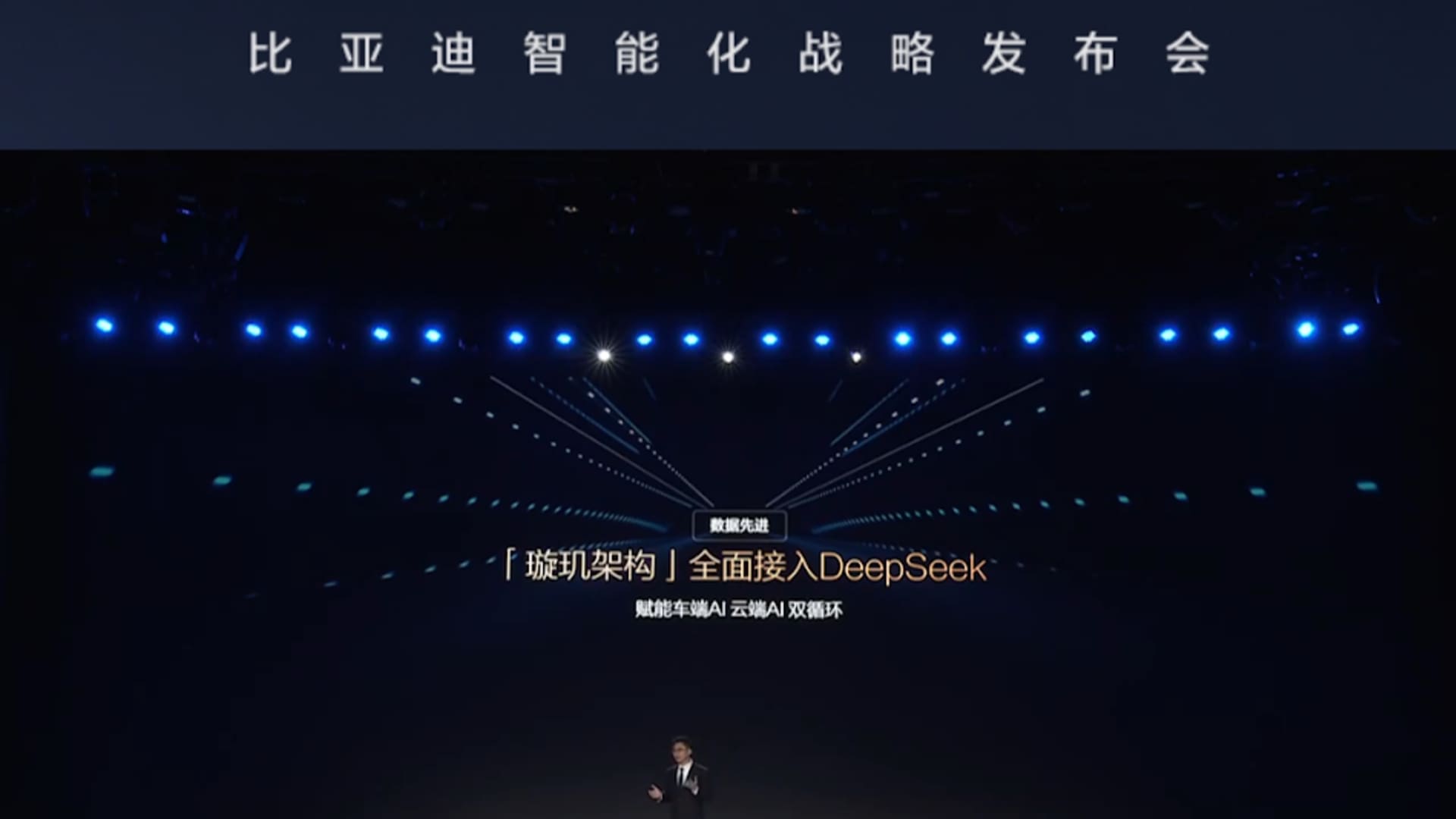
Chinese electric car giant BYD announced on Feb. 10, 2025, that it would integrate DeepSeek into its artificial intelligence model that powers its new driver-assistance technology.
Screenshot
BEIJING — Chinese electric car giant BYD is going all in on driver assistance with the help of DeepSeek, after previously taking a more cautious approach on autonomous driving technology.
Advanced smart driving will become a standard safety feature similar to seatbelts and air bags, BYD’s founder and chairman Wang Chuanfu said at a China-focused launch event livestreamed late Monday.
The automaker announced that it was releasing a “DiPilot” assisted driving system across its range of cars, which includes a 69,800 yuan ($9,555) low-cost vehicle.
That makes BYD likely the first automaker in China to offer such advanced driver-assistance capabilities for a vehicle below 70,000 yuan, Nomura analysts said in a Tuesday note. “BYD is changing its competition strategy from price cutting last year to functions’ upgrade in 2025,” the analysts said.
BYD also said it was integrating artificial intelligence from Chinese startup DeepSeek into at least the most advanced version of the new driver-assistance system. Such systems use a combination of software, AI and cameras or other sensors to control a vehicle, minimizing the need for human intervention.

“The DeepSeek integration is very significant,” said Tu Le, founder and managing director of Sino Auto Insights, “because now there’s a homegrown standalone AI technology that BYD can work with to offer equivalent intelligent features offered by their competitors.”
“This puts BYD firmly back in the driver’s seat dictating the pace” of technological features, he said, noting the company previously lagged its Chinese competitors.
More than two years ago, Chinese automakers had started offering driver-assistance features as a way to stand out in China’s fiercely competitive electric car market. But BYD management told investors in March 2023 that when it comes to “smart driving,” it was difficult to determine liability in the event of an accident involving autonomous vehicles. But they did note advanced assisted driving tech had the potential to improve overall safety.
On Monday, BYD said so-called smart vehicles can improve road safety by monitoring road conditions and avoiding dangers, while big data and AI models will improve the tech over time.
More than 20 models with BYD’s new driver-assistance tech were launched Monday. The automaker, which has been rapidly expanding overseas, did not say anything about global availability.
Tesla still waiting for approval
Driver-assistance rollout in China has faced regulatory restrictions, although an increasing number of local authorities have allowed more cars to use assisted driving software on congested city streets.
Chinese startup Xpeng was an early mover, first rolling out driver-assist for urban roads in its home city of Guangzhou in September 2022, before expanding to Shenzhen and Shanghai by early 2023. By February 2024, Xpeng said the feature was usable across most of China. The company’s mass-market brand Mona launched its first car in August with some driver-assistance capabilities.
Competing cars from Li Auto, Huawei partners, Nio and Xiaomi all claim to offer some driver-assistance functions, such as automatic parking. Several of the automakers use Nvidia’s chips for cars.
Tesla‘s most advanced version of driver assistance, called “Full-Self Driving,” has yet to receive Beijing’s approval despite Elon Musk’s repeated statements that it could be available in China, as soon as the end of 2024. In an earnings call in January, Musk attributed the delay to U.S. and Chinese restrictions that prevent Tesla from quickly developing a locally compliant version of the driver-assistance software.
Though DeepSeek integration enhances BYD’s competitive edge, Brian Tycangco, an analyst at Stansberry Research, cautioned that the collaboration “increases the likelihood that BYD vehicles will face more difficulties entering Western markets like the U.S. due to national security reasons.”
— CNBC’s Bernice Ooi contributed to this report.





Nvidia Q2 FY2027 Earnings beats Wall Street Expectation with Record $96.2 Billion Revenue

Treasury Bond Volatility Forces Bessent to Double Debt Buyback Size as Yields Swing

Nvidia Earnings Preview: What Wall Street Expects From the AI Bellwether’s Q2 Report

Armanino adds Strategic Accounting Outsourced Solutions

New 2023 K-1 instructions stir the CAMT pot for partnerships and corporations

Tax Strategy: Employee Retention Credit update
-

 Economics1 week ago
Nvidia’s Potential $3 Billion SB Energy Investment Could Reshape AI Infrastructure
-

 Economics4 days ago
Top 10 Largest Economies by 2030: IMF & World Bank GDP Projections for Global Powerhouses
-
 Stock News4 days ago
How to understand Intel $15B Stock Offering
-
 Technology1 week ago
U.S.-China AI Competition Intensifies as Washington Pushes Allies to Choose Sides
-
 Stock News1 day ago
Nvidia Earnings Preview: What Wall Street Expects From the AI Bellwether’s Q2 Report
-

 Economics4 days ago
Economic Profile of the United States of America (2026–2030 Horizon)
-

 Leaders3 days ago
Jackson Hole 2026: What the First Symposium Under Fed Chair Kevin Warsh Means for Markets
-

 Economics3 days ago
U.S. National Debt Surpasses $40 Trillion for the First Time: What It Means for the Economy