
Finance
China gears up for big week ahead of U.S. elections, stimulus hopes

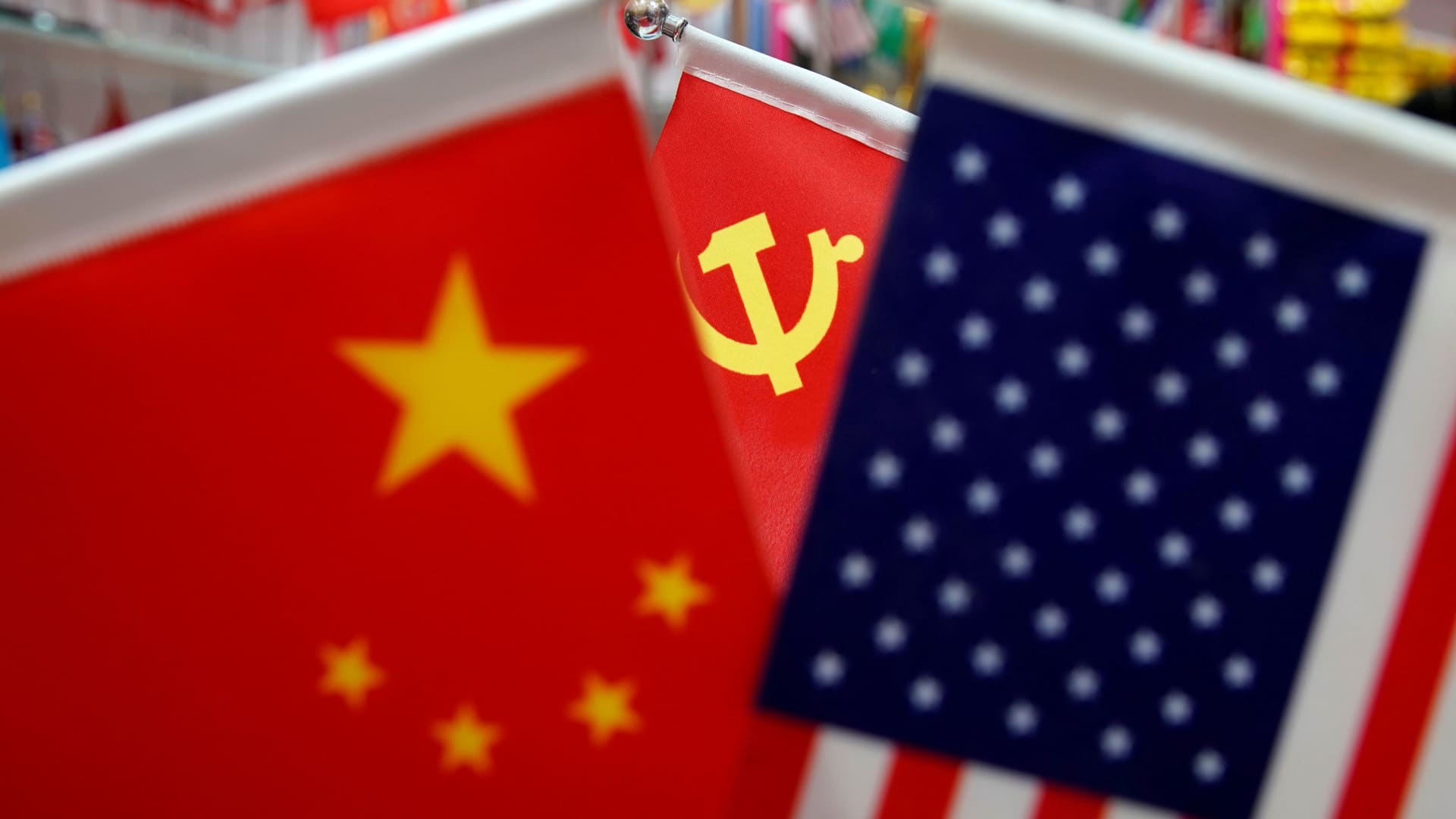
A flag stall at the Yiwu Wholesale Market in Zhejiang province, China, on May 10, 2019.
Aly Song | Reuters
BEIJING — The size of China’s highly anticipated stimulus plans will likely depend on the outcome of the U.S. presidential election, analysts said.
Investors expect Beijing to announce details on fiscal support Friday. That’s when the standing committee of the National People’s Congress — China’s parliament — is due to wrap up a five-day meeting. The same gathering last year oversaw a rare increase in the fiscal deficit.
This year, the meeting’s timing means any details will be out just days after the U.S. has voted Republican nominee Donald Trump or Democrat rival Kamala Harris in as the next president. Polls are set to close Tuesday local time.
“The size of China’s fiscal stimulus package would be around 10~20% bigger under a Trump win than under the scenario of a Harris win,” Ting Lu, chief China economist at Nomura, said in a note last week.
He cautioned that most of China’s challenges are domestic, though there will be some impact from the U.S. election result.

Trump has threatened to raise tariffs on U.S. imports from China by 60% — or reportedly by even 200% in an extreme scenario. Harris, currently vice president, has not yet signaled a major departure from the Biden administration’s approach of restricting China’s access to advanced technology.
More tariffs would hit China’s exports, a bright spot in an economy grappling with a real estate slump and tepid consumer demand.
Increased trade restrictions would require China to rely more on domestic demand to boost growth, Zhu Bin, chief economist of Nanhua Futures, said in a video presentation last week. That’s according to a CNBC translation of his Mandarin-language comments.
“Without question we can be certain of one thing — if Trump wins the election, China’s domestic stimulus will only be larger, not smaller,” Zhu said. He expects Trump has a greater chance of winning, which he said would increase downward pressure on the Chinese yuan versus the U.S. dollar.
Political analysts debate whether China’s relations with the U.S. would be better under Trump or Harris.
“I think at this point, probably from China’s view, a potential president Harris [makes it] easier to expect what policies likely come,” said Liqian Ren, leader of quantitative investment at WisdomTree.
That doesn’t mean Beijing will embark on large-scale support. Chinese authorities are “constrained by the U.S.-China competition, so the priority number one is to be able to upgrade technology across the board,” She said. “I think as long as that’s your goal then the government’s willingness to stimulate is still going to be lukewarm.”
Ren expects the scale of stimulus will be determined not by who wins the election, but the stock market reaction.
Market volatility in China, but not the United states, is likely to make “China feel more obligated to counter this volatility,” she said. In contrast to three or four years ago, Ren said, Chinese stock market volatility today has a greater impact on economic confidence.
Chinese stocks have tempered their gains in recent weeks after surging in late September. Chinese President Xi Jinping on Sept. 26 led a high-level meeting calling for strengthening fiscal and monetary policy support, and halting the decline in real estate.
While the People’s Bank of China has cut interest rates, the Ministry of Finance has yet to release details on widely anticipated fiscal stimulus. Finance Minister Lan Fo’an last month hinted at an increase in the deficit, and indicated any changes needed to undergo an approval process before being announced.
How large?
Analyst forecasts for additional debt issuance vary. China is considering more than 10 trillion yuan in debt issuance over a few years, Reuters reported Tuesday, citing sources.
Chinese authorities may not announce a specific number, but if they do, it should be more than 4 trillion yuan, given that was the amount issued in the wake of the 2008 financial crisis, said Zong Liang, chief researcher at Bank of China. He expects the deficit could be expanded beyond 4%.
The Chinese government set a deficit target of 3% for this year, after increasing it to 3.8% late last year.
WisdomTree’s Ren said her analysis of official statements, media reports and investment notes revealed that stimulus expectations are inherently about the same. Whether it is 10 trillion yuan over three to five years, or 2 trillion yuan in one year, the average is about 2 trillion yuan in support a year, she pointed out.
Consumption still in question
“I think people right now are focusing a lot on the topline number,” Ren said. “But they are missing [how] the local government, they are doing a lot of things that are actually counter[ing] stimulus.”
She noted how local authorities have so strictly enforced tax collection in some areas that they have discouraged business activity. Despite some central government support, she said, she expects it will “probably be quite a while” before local authorities “feel they have the cash to spend.”
Dozens of companies in China this year disclosed in stock exchange filings that they have received notices from local authorities to pay back taxes tied to operations as far back as 1994. Local governments once relied on land sales to real estate developers for revenue.
The finance ministry has emphasized its focus on addressing local government debt problems. Analysts have pointed out how additional stimulus will also likely go toward banks, not direct handouts to consumers.
Consumption stimulus may come more from property support at this stage, Citi analysts said in a report Friday. “Having said that, we believe more decisive consumption support could still be a realistic option under more adverse tariff scenarios.”





Treasury Bond Volatility Forces Bessent to Double Debt Buyback Size as Yields Swing

Nvidia Earnings Preview: What Wall Street Expects From the AI Bellwether’s Q2 Report

SEC’s Semiannual Reporting Proposal Faces Investor Pushback: What CFOs Need to Know

Armanino adds Strategic Accounting Outsourced Solutions

New 2023 K-1 instructions stir the CAMT pot for partnerships and corporations

Tax Strategy: Employee Retention Credit update
-

 Economics1 week ago
U.S. Retail Sales Fall for the First Time in Nine Months as Consumer Spending Slows
-

 Economics1 week ago
Nvidia’s Potential $3 Billion SB Energy Investment Could Reshape AI Infrastructure
-

 Economics4 days ago
Top 10 Largest Economies by 2030: IMF & World Bank GDP Projections for Global Powerhouses
-

 Stock News4 days ago
How to understand Intel $15B Stock Offering
-
 Technology1 week ago
U.S.-China AI Competition Intensifies as Washington Pushes Allies to Choose Sides
-

 Economics4 days ago
Economic Profile of the United States of America (2026–2030 Horizon)
-

 Leaders3 days ago
Jackson Hole 2026: What the First Symposium Under Fed Chair Kevin Warsh Means for Markets
-
 Stock News19 hours ago
Nvidia Earnings Preview: What Wall Street Expects From the AI Bellwether’s Q2 Report