
Finance
China invites U.S. business leaders to Beijing, tries to gauge Trump

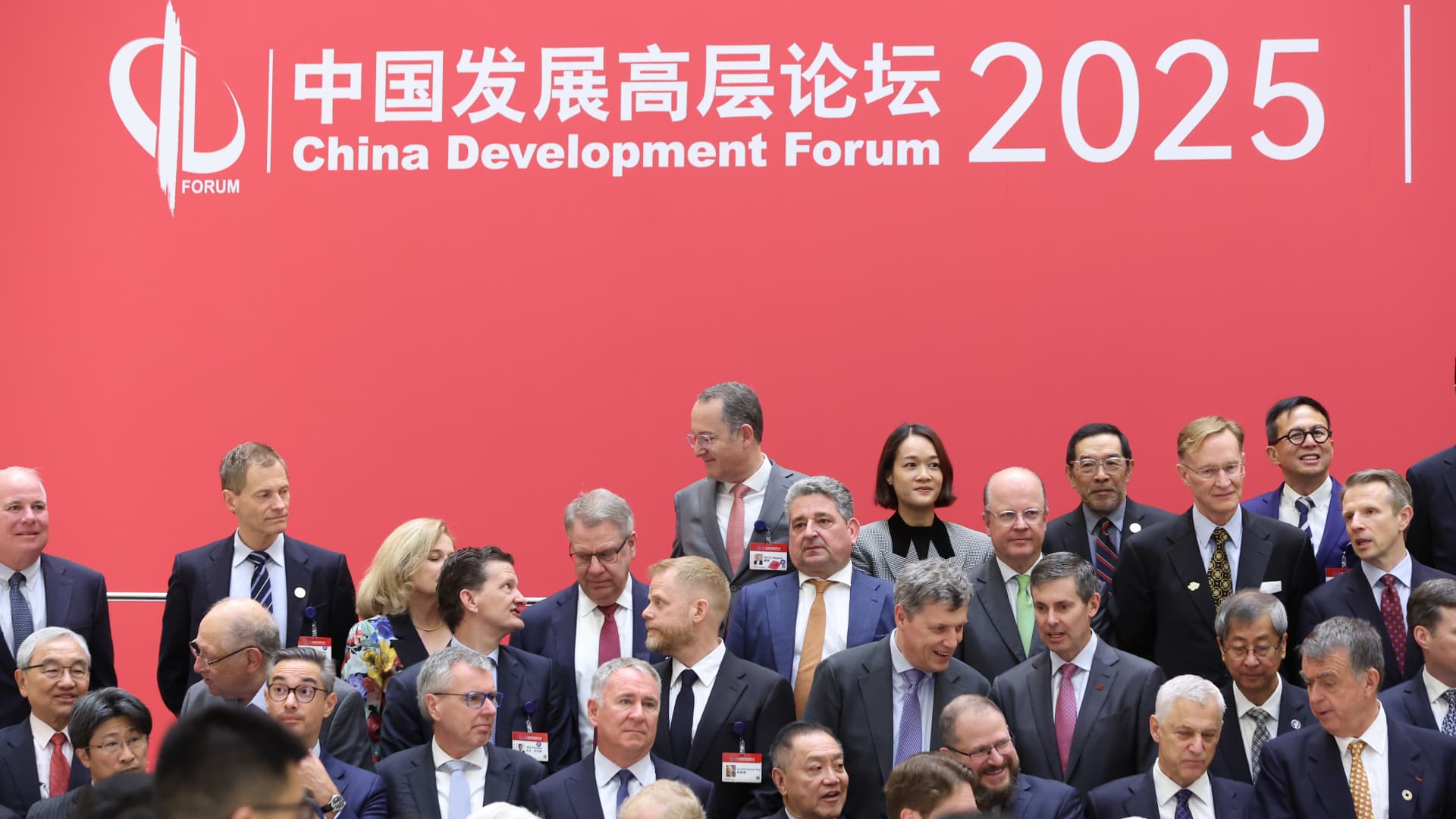
Attendees pose for a group photo before the opening ceremony of the China Development Forum 2025 at the Diaoyutai Guesthouse on March 23, 2025, in Beijing.
China News Service | China News Service | Getty Images
BEIJING — China courted the executives of major U.S. businesses at an annual conference this week in a sign of how Beijing seeks to offset trade pressures, rather than retaliate forcefully.
China has long sought to attract foreign investment as a way to bolster growth, while tapping business interests for potential influence on the White House, particularly under U.S. President Donald Trump. The U.S. has twice increased tariffs across all Chinese goods since January, but Beijing has only announced targeted duties and restrictions on a handful of American companies.
Conversation on the sidelines of the state-organized China Development Forum this week in Beijing reinforced a more conciliatory stance than official rhetoric this month about how China is prepared to fight “any type of war” with the United States.
Chinese conference attendees weren’t that focused on what can be done to respond to U.S. tariffs, Stephen Roach, senior fellow at Yale Law School’s Paul Tsai China Center, told CNBC.
“The questions I’ve been getting more [are], why is Trump doing this? What is he trying to achieve? What does he think it takes to really make America great?” Roach said. He has attended the event since the early 2000s.

“My answer is this is an unprecedented period for America’s role in the world economy. We’re going back to a tariff regime that history tells us can be extremely destructive,” Roach said, adding he expects more policy uncertainty in the U.S. and around the world “for a long, long time.”
U.S. stocks have swung in recent weeks as investors try to assess the economic impact of Trump’s changing plans for tariffs on major U.S. trading partners. U.S. Federal Reserve Chair Jerome Powell last week said tariffs could delay progress on lowering inflation in the U.S.
A message of ‘reassurance’
At this week’s conference, China was trying to send a message of “reassurance” — on how it plans to boost consumption and how the country is headed in a “modestly positive direction” relative to what is happening in the U.S., said Scott Kennedy, senior advisor and trustee chair in Chinese business and economics at the Center for Strategic and International Studies, a think tank based in Washington, D.C.
If the U.S. imposes significantly large tariffs in early April, “then you go from managing costs and de-risking to possibly de-coupling,” Kennedy told CNBC. “And then that might mean the game is up. So I think the level of anxiety is pretty high. And that’s why China is trying to provide this message of reassurance.”
The Trump administration has threatened a swath of new tariffs on major trading partners starting early April. China has increased its trade with Southeast Asian countries and the European Union, but the U.S. remains Beijing’s largest trading partner on a single-country basis.
The China Development Forum ran Sunday and Monday. Apple CEO Tim Cook was among the executives who attended, but Tesla CEO Elon Musk was not.
“The increased optimism this year compared to last year at the CDF has been just so heart warming,” Ken Griffin, CEO of hedge fund Citadel, said during an official panel at the forum.
Trump “is committed to American companies having access to a global market,” Griffin said. “And the President is willing to use tariffs to seek to enforce this worldview.”
First step toward Xi-Trump meeting?
Also on Sunday, U.S. Republican Senator Steve Daines met Chinese Premier Li Qiang in Beijing — the first time a U.S. politician has visited China since Trump began his latest term in January.
“This was the first step to an important next step, which will be a meeting between President Xi and President Trump,” Daines told the Wall Street Journal. “When that occurs and where it occurs is to be determined.”
The White House did not immediately respond to a request for comment.
Li urged cooperation and said no one can gain from a trade war, according to state media.
FedEx CEO Raj Subramaniam, Boeing Senior Vice President Brendan Nelson, Cargill CEO Brian Sikes, Medtronic CEO Geoffrey Martha, Pfizer CEO Albert Bourla, Qualcomm CEO Cristiano Amon, UL Solutions CEO Jennifer Scanlon and U.S. China Business Council President Sean Stein were also present at Daines’ meeting with Li, according to a foreign media pool report.
China, the world’s second-largest economy, remains a significant source of revenue for many multinational corporations, not to mention a major part of their supply chains.
Despite its efforts to bolster international business ties, the country has warned of countermeasures on U.S. tariffs and taken incremental steps.
Following U.S. sanctions on Chinese telecommunications giant Huawei during Trump’s first term as president, Beijing launched an unreliable entities list that restricts foreign business activity with China.
China added Calvin Klein parent PVH and a few other U.S. companies to the list after this year’s tariff increases. On Monday, China also said it would soon reveal new measures that would give it a legal basis for countering foreign pressure.
Economic factors
For U.S. companies in China, the state of the economic recovery has also been an important factor for local business plans.
Since late September, China has stepped up efforts to support the economy. Top policymakers earlier this month affirmed stimulus plans and a recent effort to encourage private-sector tech entrepreneurs in the wake of DeepSeek’s artificial intelligence breakthroughs.
“This year, you feel a lot of positive momentum beginning in China. So I feel like recovery is underway,” Wendell P. Weeks, CEO of Corning, told CNBC.
However, China’s economy has struggled with deflationary pressure and a real estate slump, weighing on regional growth prospects for international businesses.
Even Beijing’s push to support high-tech manufacturing has so far only added an average 1.1 percentage points to gross domestic product growth in each of the last three years — not enough to offset the 1.7 percentage point drag from real estate during that time, according to Goldman Sachs estimates.
“We will remain optimistic because the role of technology is important, I think more than ever,” Qualcomm’s Amon told CNBC. “I think technology is going to be part of economic growth.”





Nvidia Q2 FY2027 Earnings beats Wall Street Expectation with Record $96.2 Billion Revenue

Treasury Bond Volatility Forces Bessent to Double Debt Buyback Size as Yields Swing

Nvidia Earnings Preview: What Wall Street Expects From the AI Bellwether’s Q2 Report

Armanino adds Strategic Accounting Outsourced Solutions

New 2023 K-1 instructions stir the CAMT pot for partnerships and corporations

Tax Strategy: Employee Retention Credit update
-

 Economics1 week ago
Nvidia’s Potential $3 Billion SB Energy Investment Could Reshape AI Infrastructure
-

 Economics4 days ago
Top 10 Largest Economies by 2030: IMF & World Bank GDP Projections for Global Powerhouses
-
 Stock News4 days ago
How to understand Intel $15B Stock Offering
-
 Technology1 week ago
U.S.-China AI Competition Intensifies as Washington Pushes Allies to Choose Sides
-
 Stock News1 day ago
Nvidia Earnings Preview: What Wall Street Expects From the AI Bellwether’s Q2 Report
-

 Economics4 days ago
Economic Profile of the United States of America (2026–2030 Horizon)
-
 Leaders3 days ago
Jackson Hole 2026: What the First Symposium Under Fed Chair Kevin Warsh Means for Markets
-
 Economics3 days ago
U.S. National Debt Surpasses $40 Trillion for the First Time: What It Means for the Economy