
Finance
China is easing monetary policy. The economy needs fiscal support

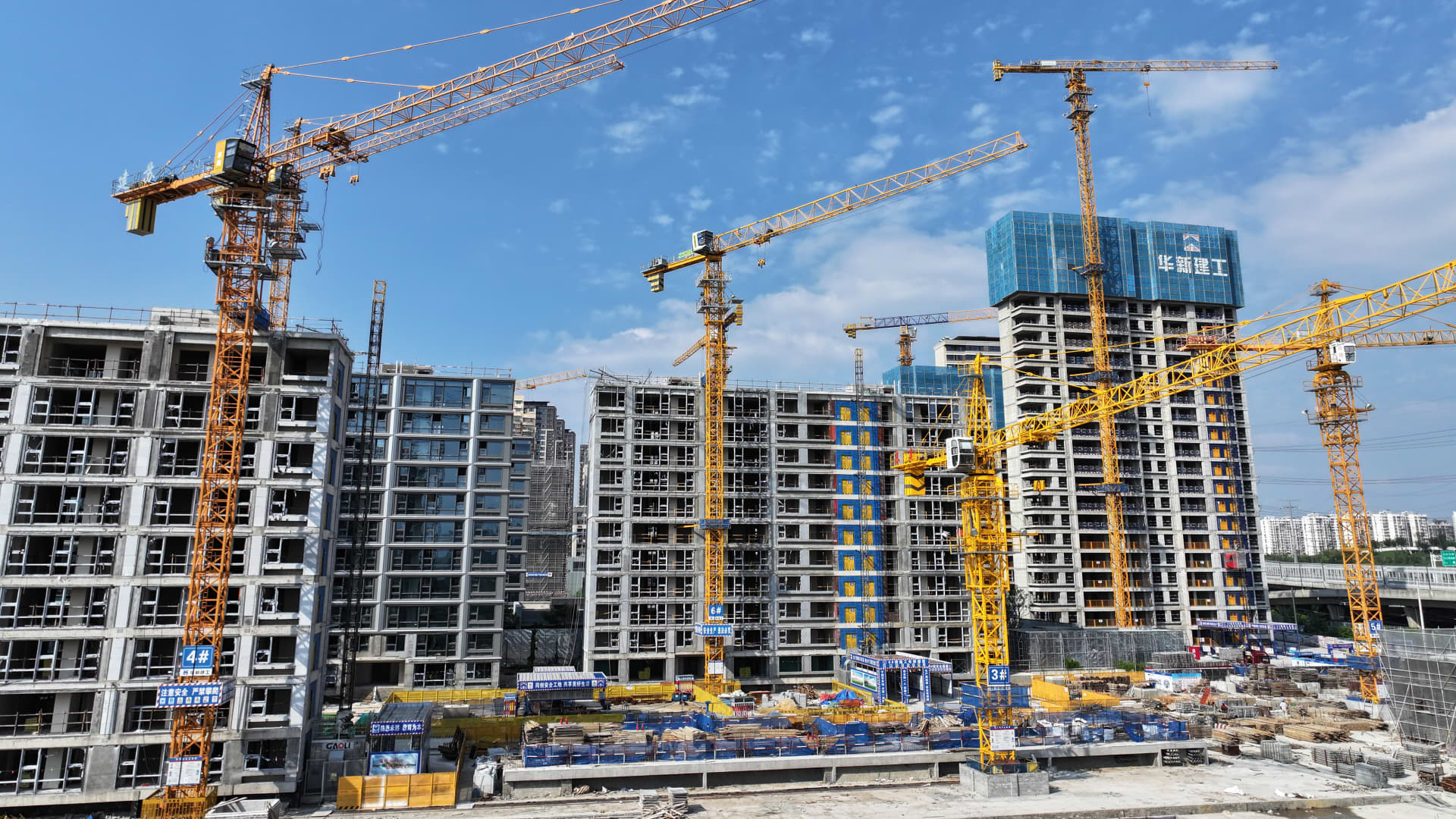
A China Resources property under construction in Nanjing, Jiangsu province, China, Sept 24, 2024.
Cfoto | Future Publishing | Getty Images
BEIJING — China’s slowing economy needs more than interest rate cuts to boost growth, analysts said.
The People’s Bank of China on Tuesday surprised markets by announcing plans to cut a number of rates, including that of existing mortgages. Mainland Chinese stocks jumped on the news.
The move may mark “the beginning of the end of China’s longest deflationary streak since 1999,” Larry Hu, chief China economist at Macquarie, said in a note. The country has been struggling with weak domestic demand.
“The most likely path to reflation, in our view, is through fiscal spending on housing, financed by the PBOC’s balance sheet,” he said, stressing that more fiscal support is needed, in addition to more efforts to bolster the housing market.
The bond market reflected more caution than stocks. The Chinese 10-year government yield fell to a record low of 2% after the rate cut news, before climbing to around 2.07%. That’s still well below the U.S. 10-year Treasury yield of 3.74%. Bond yields move inversely to price.
“We will need major fiscal policy support to see higher CNY government bond yields,” said Edmund Goh, head of China fixed income at abrdn. He expects Beijing will likely ramp up fiscal stimulus due to weak growth, despite reluctance so far.
“The gap between the U.S. and Chinese short end bond rates are wide enough to guarantee that there’s almost no chance that the US rates would drop below those of the Chinese in the next 12 months,” he said. “China is also cutting rates.”

The differential between U.S. and Chinese government bond yields reflects how market expectations for growth in the world’s two largest economies have diverged. For years, the Chinese yield had traded well above that of the U.S., giving investors an incentive to park capital in the fast-growing developing economy versus slower growth in the U.S.
That changed in April 2022. The Fed’s aggressive rate hikes sent U.S. yields climbing above their Chinese counterpart for the first time in more than a decade.
The trend has persisted, with the gap between the U.S. and Chinese yields widening even after the Fed shifted to an easing cycle last week.
“The market is forming a medium to long-term expectation on the U.S. growth rate, the inflation rate. [The Fed] cutting 50 basis points doesn’t change this outlook much,” said Yifei Ding, senior fixed income portfolio manager at Invesco.
As for Chinese government bonds, Ding said the firm has a “neutral” view and expects the Chinese yields to remain relatively low.
China’s economy grew by 5% in the first half of the year, but there are concerns that full-year growth could miss the country’s target of around 5% without additional stimulus. Industrial activity has slowed, while retail sales have grown by barely more than 2% year-on-year in recent months.
Fiscal stimulus hopes
China’s Ministry of Finance has remained conservative. Despite a rare increase in the fiscal deficit to 3.8% in Oct. 2023 with the issuance of special bonds, authorities in March this year reverted to their usual 3% deficit target.
There’s still a 1 trillion yuan shortfall in spending if Beijing is to meet its fiscal target for the year, according to an analysis released Tuesday by CF40, a major Chinese think tank focusing on finance and macroeconomic policy. That’s based on government revenue trends and assuming planned spending goes ahead.
“If general budget revenue growth does not rebound significantly in the second half of the year, it may be necessary to increase the deficit and issue additional treasury bonds in a timely manner to fill the revenue gap,” the CF40 research report said.
Asked Tuesday about the downward trend in Chinese government bond yields, PBOC Gov. Pan Gongsheng partly attributed it to a slower increase in government bond issuance. He said the central bank was working with the Ministry of Finance on the pace of bond issuance.
The PBOC earlier this year repeatedly warned the market about the risks of piling into a one-sided bet that bond prices would only rise, while yields fell.
Analysts generally don’t expect the Chinese 10-year government bond yield to drop significantly in the near future.
After the PBOC’s announced rate cuts, “market sentiment has changed significantly, and confidence in the acceleration of economic growth has improved,” Haizhong Chang, executive director of Fitch (China) Bohua Credit Ratings, said in an email. “Based on the above changes, we expect that in the short term, the 10-year Chinese treasury bond will run above 2%, and will not easily fall through.”
He pointed out that monetary easing still requires fiscal stimulus “to achieve the effect of expanding credit and transmitting money to the real economy.”
That’s because high leverage in Chinese corporates and households makes them unwilling to borrow more, Chang said. “This has also led to a weakening of the marginal effects of loose monetary policy.”
Breathing room on rates
The U.S. Federal Reserve’s rate cut last week theoretically eases pressure on Chinese policymakers. Easier U.S. policy weakens the dollar against the Chinese yuan, bolstering exports, a rare bright spot of growth in China.
China’s offshore yuan briefly hit its strongest level against the U.S. dollar in more than a year on Wednesday morning.
“Lower U.S. interest rates provide relief on China’s FX market and capital flows, thus easing the external constraint that the high U.S. rates have imposed on the PBOC’s monetary policy in recent years,” Louis Kuijs, APAC Chief Economist at S&P Global Ratings, pointed out in an email Monday.
For China’s economic growth, he is still looking for more fiscal stimulus: “Fiscal expenditure lags the 2024 budget allocation, bond issuance has been slow, and there are no signs of substantial fiscal stimulus plans.”





Treasury Bond Volatility Forces Bessent to Double Debt Buyback Size as Yields Swing

Nvidia Earnings Preview: What Wall Street Expects From the AI Bellwether’s Q2 Report

SEC’s Semiannual Reporting Proposal Faces Investor Pushback: What CFOs Need to Know

Armanino adds Strategic Accounting Outsourced Solutions

New 2023 K-1 instructions stir the CAMT pot for partnerships and corporations

Tax Strategy: Employee Retention Credit update
-

 Economics1 week ago
U.S. Retail Sales Fall for the First Time in Nine Months as Consumer Spending Slows
-

 Economics1 week ago
Nvidia’s Potential $3 Billion SB Energy Investment Could Reshape AI Infrastructure
-

 Economics4 days ago
Top 10 Largest Economies by 2030: IMF & World Bank GDP Projections for Global Powerhouses
-

 Stock News4 days ago
How to understand Intel $15B Stock Offering
-

 Technology1 week ago
U.S.-China AI Competition Intensifies as Washington Pushes Allies to Choose Sides
-

 Economics4 days ago
Economic Profile of the United States of America (2026–2030 Horizon)
-

 Leaders3 days ago
Jackson Hole 2026: What the First Symposium Under Fed Chair Kevin Warsh Means for Markets
-

 Economics3 days ago
U.S. National Debt Surpasses $40 Trillion for the First Time: What It Means for the Economy