
Finance
China is tackling weak consumption with child care subsidies

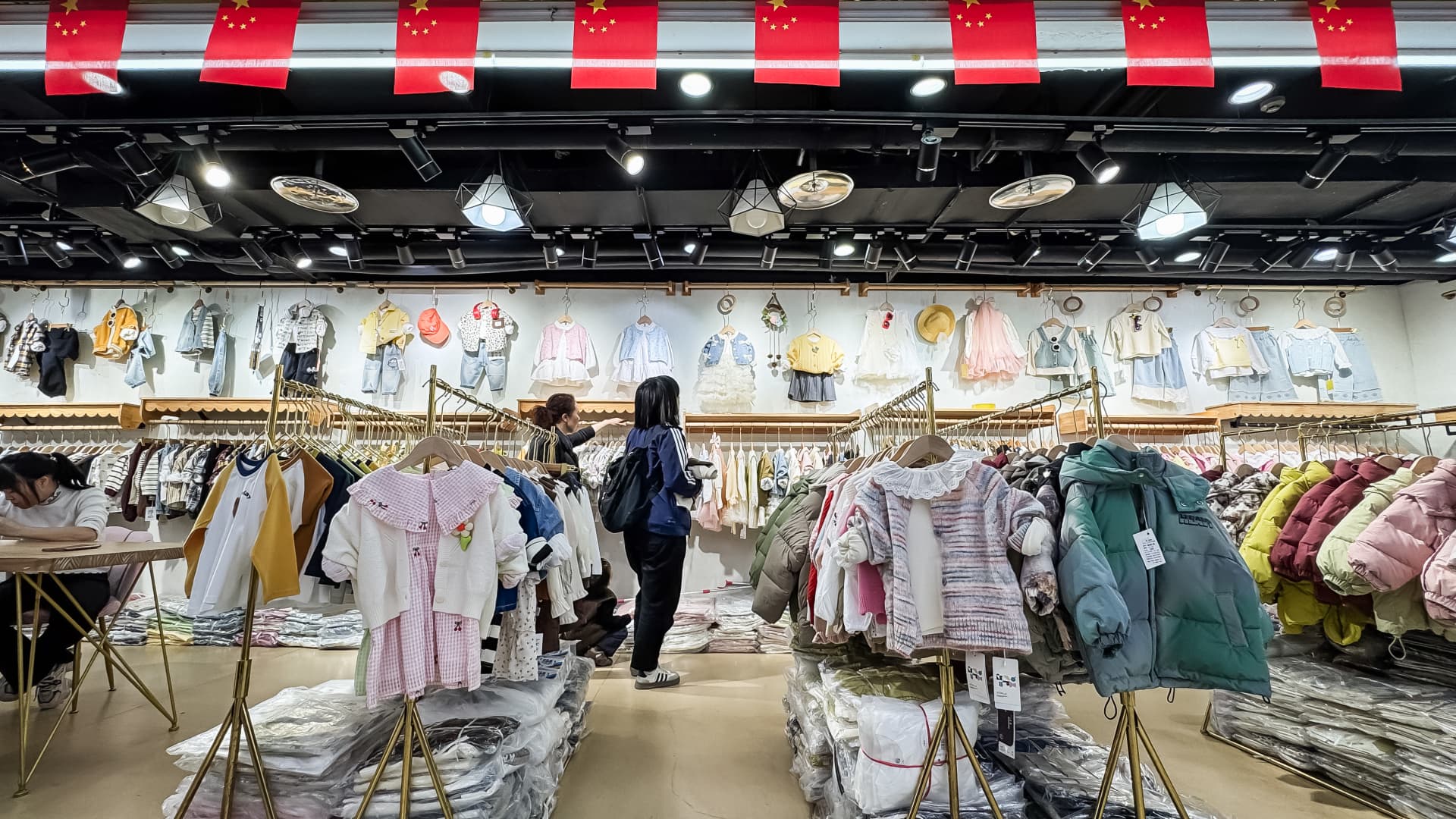
Customers browse children’s clothing at a wholesale store in Chongqing, China, on March 1, 2025.
Cheng Xin | Getty Images News | Getty Images
BEIJING — Among the top five priorities China has laid out for boosting consumption is child care subsidies.
It’s an effort to tackle the country’s rapid drop in births, while freeing up cash for discretionary spending.
As with many Chinese policies, the plan released Sunday only lays out a framework: “Strengthen support for childbirth and raising children. Research and establish a system for subsidizing child care.” That’s according to a CNBC translation of the Chinese.
Beijing is moving relatively quickly, however.
The National Health Commission is already drafting an operational plan for subsidizing child care, Li Chunlin, deputy director of the economic planner, the National Development and Reform Commission, told reporters Monday.

A national-level policy of 100 billion yuan ($13.84 billion) for child care subsidies could come soon this year, Jianguang Shen, chief economist at Chinese e-commerce company JD.com, said in Mandarin, translated by CNBC.
That’s based on his estimate of around 9 million births this year, and monthly handouts of around 800 yuan to parents, regardless of income, Shen said. He noted half of the cash could come in the form of vouchers for baby products to prevent households from saving the money.
China recorded 9.54 million births last year, up by 520,000 from the prior year, as many locals considered 2024 an auspicious year for births based on the Chinese zodiac’s year of the Dragon. However, World Bank data showed that the fertility rate, defined as births per woman, was 1.2 in China in 2022, down from 1.8 in 2012.
“The key is to increase fiscal resources,” Shen said, noting that in the context of 300 billion yuan for trade-in subsidies, 100 billion yuan for child care isn’t too much to ask for. He forecasts around 3.5% to 4.5% growth in retail sales this year.
China’s retail sales grew by a modest 3.5% last year, according to official data. The January to February period, which covers the annul Lunar New Year holiday, saw a modest pick up to 4% year on year, the statistics bureau said Monday.
How much is enough?
In a glimpse of what is already being rolled out, the Inner Mongolian capital of Hohhot, last week announced subsidies of up to 100,000 yuan for children of registered locals who live and work in the city.
The couple can enjoy a one-time subsidy of 10,000 yuan upon the birth of their first child. Their second child is eligible for 10,000 yuan in annual subsidies until the age of five. If the couple have a third child, the city will provide 10,000 yuan each year until the child turns 10.
The tech hub of Shenzhen this month said it is considering a smaller-scale subsidy. State media noted that National Health Commission data as of October showed several local governments in more than 20 provinces were already offering some kind of child care subsidy.
“If the childcare subsidy in Hohhot can be extended to the whole country, it could amount to another 0.2% of retail sales in the initial year,” Citi analysts said in a report Tuesday. They said the subsidy could be most meaningful for low-income families and “could become more significant if the central government steps in to share the burden.”
“It remains to be seen if it will be effective in boosting fertility rate in the longer term,” the Citi analysts said, noting the total cost of raising a child in China is reportedly around 538,000 yuan, not to mention the opportunity cost for working mothers.
The per capita disposable income of rural residents was 23,119 yuan in 2024, while that of urban residents was more than two times higher at 54,188 yuan, according to official figures.
Short-term subsidies for child care could still significantly ease financial pressure on Chinese households.
When Beijing resident Song Jingli, now 41, gave birth to her daughter nearly 10 years ago, there was no child care support. Song said she made 8,000 yuan a month at the time, and day care cost 4,000 yuan.
“We didn’t have a choice,” she said. My husband “needed to go to work, I needed to go to work, and my parents-in-law were not able to take care of her.”
By the time her daughter was in kindergarten, Song said, she was able to benefit from a relatively new policy that halved the cost to around 2,000 yuan. The new policies on child care are “right to the point,” she said. “The only pity [is] it’s too late for us who were born in the 1980s. Hopefully younger generations can benefit from these policies.”
What to watch next
China’s efforts to boost consumption also include calls for increasing the minimum wage, stabilizing the stock market, boosting farmers’ income and resolving payment delays for businesses.
“The direction of [China’s] consumption-boosting measures is correct,” Goldman Sachs analysts said in a report Monday, “but both funding and implementation matter for the effectiveness of China’s consumption stimulus.”
“The announcement of a nationwide childcare subsidy and the April Politburo meeting are key to watch in coming months,” the analysts said, referring to a high-level policy meeting typically held in late April.





Nvidia Q2 FY2027 Earnings beats Wall Street Expectation with Record $96.2 Billion Revenue

Treasury Bond Volatility Forces Bessent to Double Debt Buyback Size as Yields Swing

Nvidia Earnings Preview: What Wall Street Expects From the AI Bellwether’s Q2 Report

Armanino adds Strategic Accounting Outsourced Solutions

New 2023 K-1 instructions stir the CAMT pot for partnerships and corporations

Tax Strategy: Employee Retention Credit update
-

 Economics1 week ago
Nvidia’s Potential $3 Billion SB Energy Investment Could Reshape AI Infrastructure
-

 Economics4 days ago
Top 10 Largest Economies by 2030: IMF & World Bank GDP Projections for Global Powerhouses
-

 Stock News4 days ago
How to understand Intel $15B Stock Offering
-

 Technology1 week ago
U.S.-China AI Competition Intensifies as Washington Pushes Allies to Choose Sides
-
 Stock News1 day ago
Nvidia Earnings Preview: What Wall Street Expects From the AI Bellwether’s Q2 Report
-

 Economics4 days ago
Economic Profile of the United States of America (2026–2030 Horizon)
-

 Leaders3 days ago
Jackson Hole 2026: What the First Symposium Under Fed Chair Kevin Warsh Means for Markets
-
 Economics3 days ago
U.S. National Debt Surpasses $40 Trillion for the First Time: What It Means for the Economy