
Finance
China keeps tight grip on rare earths, costing at least one company ‘millions of euros’

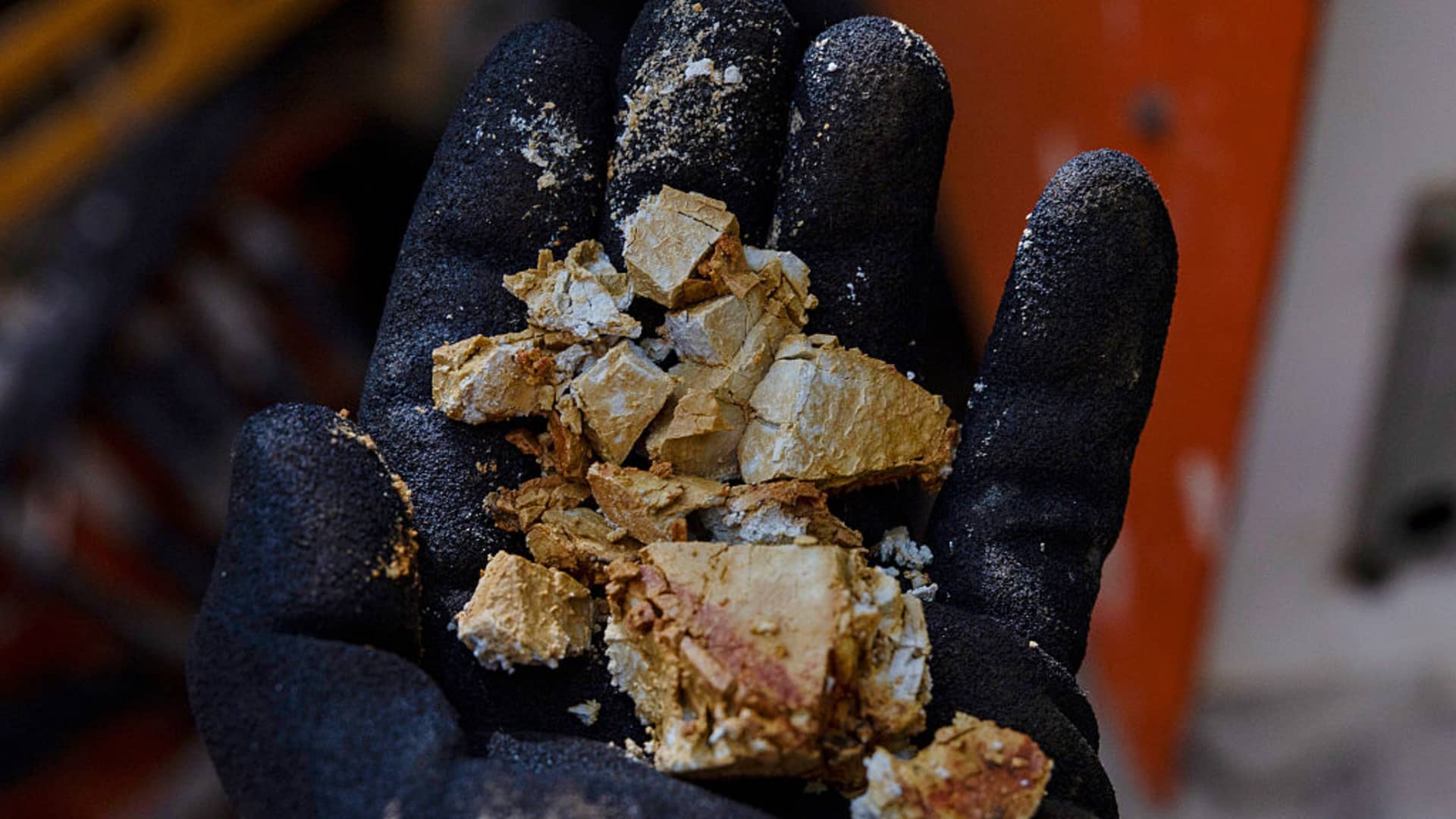
Mineral explorers hoping to meet the growing demand for rare earths are vying for a slice of nearly $1 billion in Brazilian funding to help make their projects a reality in a country with the largest reserves after China.
Bloomberg | Bloomberg | Getty Images
BEIJING — Beijing still isn’t giving foreign companies access to critically needed rare earths, according to the European Chamber of Commerce in China.
At least one member has lost “millions of euros” as a result, the ECCC told reporters Monday.
The nearly 25-year-old business organization declined to share the name of the affected company, but said that other members still didn’t have clarity on a consistent process for accessing the minerals.
Rare earths are a category of minerals that are critical for a swath of products from cars to semiconductors. China controlled over 69% of rare earth mine production in 2024, and nearly half of the world’s reserves, according to the U.S. Geological Survey.
Beijing has leveraged this control in trade talks with the U.S. and other partners. Since late last year, China has ramped up its restrictions on exports of rare earths, even demanding proof that they will not be used for military purposes. China started issuing single-use export licenses following a mid-May trade truce with the U.S.
A spokesperson for German automaker Volkswagen said its “supply of parts containing rare earths is stable, and we are not experiencing any shortages. Our suppliers are continuously working with their subcontractors to obtain the necessary export licenses.”
But the ECCC said that after a pickup in approvals in June and July, members have reported increasing challenges in getting the export licenses. The business group also emphasized that the licenses still do not guarantee steady access to the rare earths, increasing uncertainty for businesses.
Nearly half of the EU’s rare earth imports came from China last year, followed by Russia and Malaysia, according to the bloc.

Growing restrictions on access to rare earths is the latest challenge for international businesses caught in the midst of trade tensions involving China.
Foreign business confidence in China has declined since Covid-19 when pandemic restrictions disrupted supply chains — the domestic economy has remained sluggish, dragged down by a real estate slump and overcapacity in industrial sectors.
The American Chamber of Commerce in Shanghai last week said its survey of members between May and June showed businesses’ confidence about the next five years hit a new low. The study also found that nearly half the respondents — highest on record — had diverted investments planned for China to other regions, primarily Southeast Asia.
European and U.S. businesses have warned a rare earths shortage would hit in the third quarter, on top of disruptions to production earlier this year.

Subscribe now
The ECCC said it plans to meet with European Union policymakers next week in Brussels to update them on the business situation. It also released Wednesday its annual position paper, which included several recommendations for China as the country prepares its next five-year plan.
The chamber has urged Beijing to consider ways to fix the root causes of overproduction and give the private sector a bigger role in major industries such as healthcare where state entities tend to hold a greater sway in China.
ECCC President Jens Eskelund told reporters this week that in the chamber’s recent meetings with China’s Commerce Ministry, the conversation has centered on access to rare earths.
China’s top leaders are scheduled to meet in October to discuss development goals for 2026 to 2030. Beijing lays out similar plans every five years. The 14th version, launched in 2021, wraps up at the end of this year, with the 15th starting next year.
European businesses will be closely watching that meeting, as China is the EU’s second-largest goods partner with trade standing at $732 billion euros in 2024.
Looking back at such plans, including “Made in China 2025,” “all of these things that we’re struggling [with] right now, to a big extent, is actually the outcome of policy choices,” Eskelund said. “Therefore these plans actually matter … They certainly set the direction.”
— CNBC’s Sam Meredith contributed to this report.




S&P 500 September Outlook: Tech Rally Holds Index at 7,600

India Unveils ‘Saptadhara’ Reform Agenda Targeting Technology, Youth Skilling, and Growth

S&P 500 Outperforms Amid Strong Corporate Earnings as Treasury Yields Cap Equity Multiples

Armanino adds Strategic Accounting Outsourced Solutions

New 2023 K-1 instructions stir the CAMT pot for partnerships and corporations

Tax Strategy: Employee Retention Credit update
-

 Stock News1 week ago
Nvidia Q2 FY2027 Earnings beats Wall Street Expectation with Record $96.2 Billion Revenue
-

 Technology6 days ago
AI Infrastructure Boom Hits Physical Limits: Power, Financing, and Supply Chain Strain
-

 Economics4 days ago
U.S.- Canada Trade Talks Collapse; Carney Says Retaliatory Tariffs Begin September 8
-
 Stock News3 hours ago
S&P 500 September Outlook: Tech Rally Holds Index at 7,600
-

 Technology4 days ago
Flock Cameras and the Future of Public Security
-
 Insights4 hours ago
Climate Resilience and Offshore Wind and Land Restoration Milestones
-
 Finance3 hours ago
S&P 500 Outperforms Amid Strong Corporate Earnings as Treasury Yields Cap Equity Multiples
-

 Accounting4 hours ago
Mandatory ESG Reporting Standards Demand Standardized Non-Financial Audit Trails