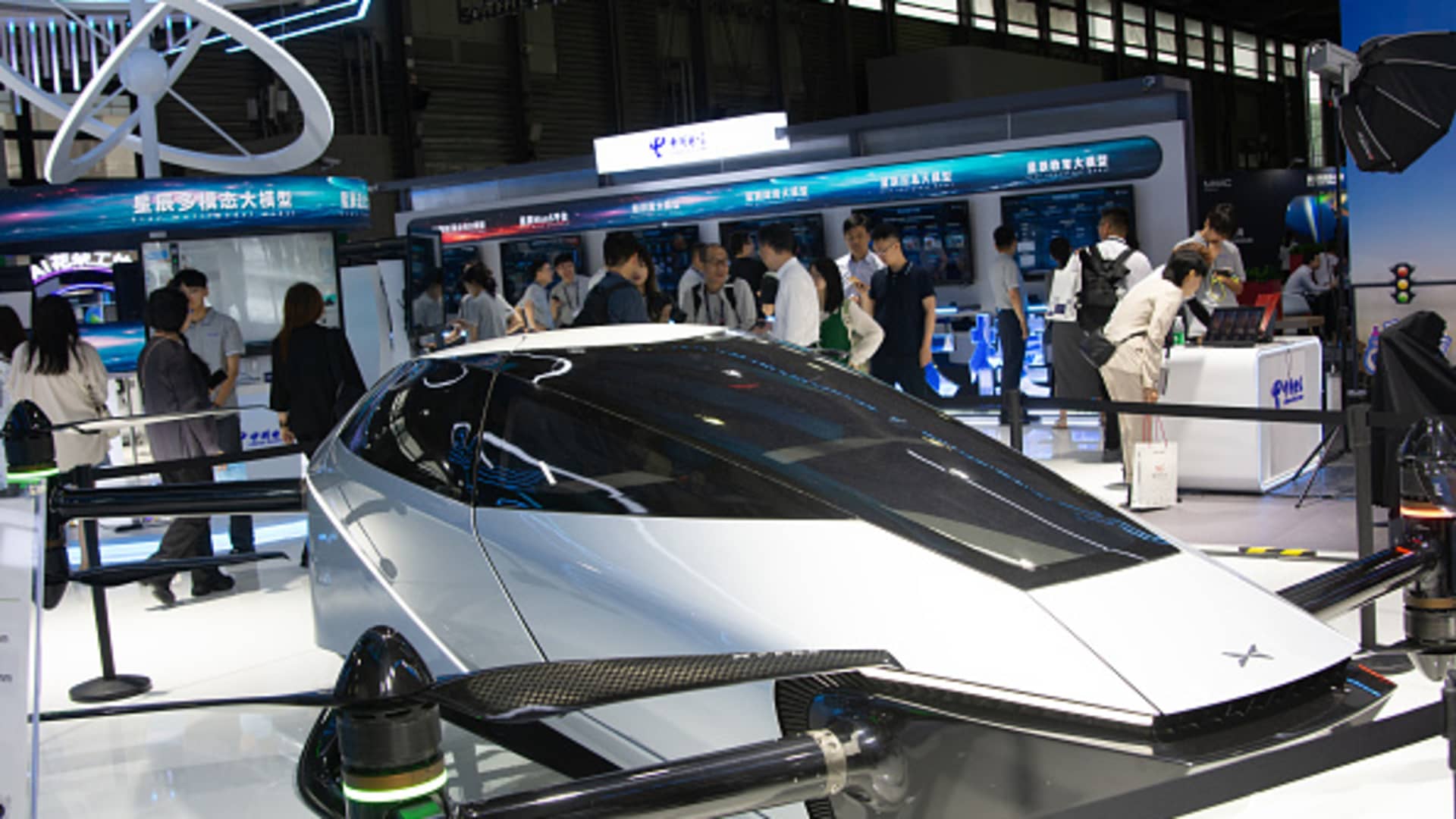
A flying taxi displayed at the China Telecom booth at SNIEC in Shanghai, on June 26, 2024, during the opening of Mobile World Congress 2024.
Nurphoto | Nurphoto | Getty Images
Flying taxis will become a viable method of transportation in China in the next three to five years, according to a senior executive at Ehang, a company that makes autonomous aerial vehicles (AAVs).
The prediction by Ehang’s Vice President He Tianxing comes days after the company became the first company, along with its joint venture partner Hefei Heyi Aviation, to obtain a certificate to operate “civil human-carrying pilotless aerial vehicles” from the Civil Aviation Administration of China.
Ehang said the certification clears the way for commercial operations of its vehicles, allowing for paid human-carrying services and any other low-altitude use cases the company develops.
At first, Ehang’s AAVs will be used for tourism, with passengers able to ride along designated routes in Guangzhou and Hefei by the end of June, He told CNBC in an interview translated from Mandarin.
The company will gradually explore air taxi services as its tourist operations progress. He named Hefei and Shenzhen as examples of some of the first cities expected to get air taxi services.
Ehang’s EH216-S, which received the certification, is a fully electric, pilotless two-seater aerial vehicle that features 16 propellers, according to Ehang’s website. It has a maximum design speed of 130 kilometers per hour, with a maximum range of 30 kilometers.
He expects to get certifications to operate in additional cities this year and next, with the second set of locations for tourist operations expected to include Zhuhai, Shenzhen, Taiyuan, Wuxi, Wenzhou and Wuhan.
For the forthcoming Hefei and Guangzhou locations, he declined to share the price per ride but hoped it would be reasonable enough to encourage more people to try out the pilotless aerial vehicle.
The experience should be “just like riding in a car,” added He, noting that no helmet or parachute is required. He said the initial length of rides offered by the company would vary from around three minutes to 10 minutes.
When asked about global markets, He said overseas partners had actively reached out since news of the certification, and he expected Ehang could expand overseas in the next few years.
Early lead
According to technology analysts, China’s allowing commercial use of passenger AAVs signifies its innovation and leadership in transportation and mobility.
“This is a major development and shot across the bow from China showing technology innovation is accelerating,” said Dan Ives, global head of technology research at Wedbush Securities.
China has already established itself as a global leader in electric vehicles and autonomous driving. Flying taxis, meanwhile, represent “one of the next frontiers for the auto and tech industry,” said Ives, adding that China already has created a clear lead in that space.
Beijing first released rules for unmanned aircraft flight — vehicles without a pilot on board — in June 2023. The U.S., on the other hand, has yet to roll out comparable regulations.
Instead, Washington’s Federal Aviation Administration last year unveiled general rules for “powered-lift” vehicles, which includes some electric vertical takeoff and landing (eVTOL) aircrafts.
eVTOL encompasses electric-powered aircrafts designed to carry passengers and take off and land vertically without the need for runways. However, the FAA has focused on those that are manually piloted.
Tu Le, founder of auto industry consultancy Sino Auto Insights, told CNBC that the U.S. has been falling behind China and even the EU in eVTOLs due to this lack of favorable policies, chalking it up to overregulation, lobbying from competing industries or “just plain politics.”
Meanwhile, China has been backing eVTOL technology as part of its “low-altitude economy,” the development of which has become a major policy goal. The term refers to economic activity taking place in airspace below 1,000 meters, well under the around 9,000 meters most commercial planes cruise around.
In addition to flying taxis and other eVTOLs, examples of the low-altitude economy include unmanned drones for delivery and helicopter-operated air shuttle routes.
The term was recently included in China’s annual work report for 2025, with the government promising to promote its development. Beijing has also committed to boosting consumption in the low-altitude economy, notably in low-altitude tourism, air sports, and consumer drones, as part of a special action plan in March.
Already, China’s low-altitude economy is one of its fastest-growing industries, with it projected to be worth 1.5 trillion yuan ($205 billion) by 2025, and almost double that by 2035, according to a report by the research group Hurun.
Competition ramping up
Sino Auto Insights’ Le also credits China’s progress in the eVTOLs sector to a high degree of domestic competition.
China has seen a major ramp-up of prospective players in recent years, as companies prepare for a high-tech future that was once confined to science fiction.
Firms investing in the space have included electric vehicle makers like GAC, Geely and Xpeng.
Xpeng’s flying car division, Xpeng Aero HT, last week, completed a maiden flight of its “Land Carrier” product — a van paired with a 2-man quadcopter, the company told CNBC.
Xpeng Aero HT said it will hold a pre-sale launch event and complete the construction of its mass production factory in the second half of the year. It also aims to obtain certifications for airworthiness by the end of the year.
Last month, XPeng Motors CEO He Xiaopeng told state media the company plans to mass-produce flying cars by 2026, as China’s low-altitude economy is boosted by supportive policy.
However, despite China leading in eVTOL regulation, it is expected to face competition from international companies also investing in and building various types of air vehicle technologies.
Some of those companies include international companies like America’s Boeing, France’s Airbus, and the Brazilian firm Embraer, which have taken steps to take advantage of future flying car demand.
Numerous startups, including Joby Aviation, Archer, and Wisk, in the U.S. are also planning on launching various commercial air taxi services over the next few years.
According to Wedbush’s Ives, the global electric vertical takeoff and landing (eVTOL) aircraft business could grow into a $30 billion market opportunity over the next decade.
A turbulent week in the U.S. Treasury market prompted the Treasury Department to sharply increase the size of its long-term debt buyback program, as bond prices fell even while equity markets pushed toward record highs. The divergence has drawn attention from fixed-income strategists who see it as a signal of underlying investor unease about federal borrowing levels.
What Happened This Week
U.S. Treasury Secretary Scott Bessent told CNBC on Thursday, August 20, 2026, that the Treasury had doubled the size of its long-term debt buyback operations, moving from roughly $2 billion to at least $4 billion per operation. Bessent indicated the figure could climb further, saying “we’re going to increase the size of the buyback,” and noted the accelerated pace could exceed the announced $4 billion threshold per issue.
Buybacks allow the Treasury to repurchase outstanding government bonds directly from the market, which can help support prices and dampen yield volatility during periods of stress. The expanded program came as stocks staged a late-week recovery: the S&P 500 and Russell 2000 both advanced on Friday, August 21, even as Treasuries logged mild losses, according to Bloomberg market data.
Why Bond and Equity Markets Are Diverging
Capital.com senior market analyst Daniela Hathorn described the week’s dynamic as markets “ending the week on a softer tone after the relative calm of early August was disrupted by renewed pressure in global bond markets, another rise in oil prices, and growing uncertainty around the Federal Reserve’s next move.” She noted that higher long-term borrowing costs are increasingly challenging elevated equity valuations, even as U.S. equities pull back modestly from record highs.
This divergence — equities near record levels while bonds sell off is unusual and reflects two different sets of investor concerns. Equity investors have remained focused on corporate earnings strength, particularly from large technology companies ahead of Nvidia’s closely watched August 26 earnings report. Bond investors, by contrast, are more directly exposed to concerns about the scale of federal borrowing, highlighted this week by the national debt crossing the $40 trillion threshold for the first time.
The Fed and Treasury “Working in Opposite Directions”
Wilmington Trust senior bond portfolio manager Wil Stith told Yahoo Finance that current conditions reflect “the Fed and the Treasury basically working in sort of opposite directions,” adding that the imbalance will likely require the Federal Reserve which he described as having “the larger sandbox” to adjust the federal funds rate rather than relying on Treasury market interventions alone to manage yields.
Notably, the bond market’s reaction to the Treasury’s buyback expansion was relatively muted; strategists described the move as being largely absorbed without a major rally, suggesting the underlying pressure on yields stems from factors, such as inflation persistence and debt sustainability concerns, that a buyback program alone cannot resolve.
What Comes Next
Markets are now looking to two major events in the days ahead: Nvidia’s earnings report on Wednesday, August 26, and the Federal Reserve’s Jackson Hole Economic Symposium, running August 27-29. This will be the first Jackson Hole gathering under new Fed Chair Kevin Warsh, whose public communication style and policy signals remain less established than his predecessors’, according to market commentary from Regards of Wall Street.
For investors, the key metrics to watch are the size and frequency of future Treasury buyback operations, movements in the 10-year Treasury yield, and any policy signals from Warsh’s keynote address. Continued yield volatility alongside record equity valuations would suggest the market imbalance identified this week has not yet been resolved.
The global banking system is undergoing a comprehensive modernization of cross-border payment infrastructure. Driven by real-time settlement networks, open banking APIs, and interoperable messaging standards, financial institutions and multinational corporations are eliminating multi-day delays and reducing transaction costs associated with legacy international wire transfers.
Transition to Real-Time Gross Settlement Networks
Historically, international business-to-business (B2B) payments relied on complex correspondent banking relationships involving intermediary fees and processing delays. In 2026, the widespread adoption of ISO 20022 messaging protocols alongside interconnected Real-Time Gross Settlement (RTGS) systems allows direct, end-to-end processing of cross-border transfers.
Commercial banks are providing corporate clients with continuous, 24/7 payment clearing capabilities. Real-time transaction confirmation and automated FX rate locking allow international businesses to settle cross-border trade obligations within minutes, significantly reducing counterparty risk.
Central Bank Digital Currency (CBDC) Interoperability
Wholesale Central Bank Digital Currency (CBDC) pilot initiatives are reaching operational maturity across several key financial centers. Collaborative multi-CBDC platforms enable participating central banks and commercial institutions to settle foreign exchange and international trade transactions directly on shared distributed ledgers.
These wholesale digital currency networks eliminate traditional clearinghouse delays and minimize foreign exchange slippage. Enterprise treasury departments benefit from enhanced liquidity management, as cross-border cash balances can be deployed and repatriated instantaneously.
Corporate Treasury Transformation
For enterprise treasurers, instant cross-border settlement transforms cash management strategies:
– Working Capital Optimization: Reduced transaction float allows companies to lower precautionary cash reserves and optimize short-term liquidity investments.
– Automated Reconciliation: Enriched data formats embedded in ISO 20022 payment messages streamline automated general ledger posting and invoice matching.
– Reduced Processing Overhead: Account-to-account (A2A) real-time clearing bypasses costly intermediary correspondent banking fees.
Strategic Financial Priorities
1. Upgrade Treasury Systems: Ensure internal core enterprise software supports real-time ISO 20022 payment messaging standards.
2. Leverage Instant Clearing Rails: Utilize direct payment networks to lower cross-border transaction fees and eliminate settlement delays.
3. Evaluate Multi-Currency Liquidity: Modernize liquidity management frameworks to capitalize on 24/7 real-time settlement capabilities.
The global private credit market has solidified its role as a fundamental pillar of enterprise finance, expanding rapidly across middle-market lending, asset-backed finance, and infrastructure financing. As non-bank financial institutions capture a larger share of corporate debt origination, global regulatory bodies are increasing oversight to evaluate market transparency and systemic risk interconnections.
Growth Drivers in Direct Lending
Direct lending platforms have continued to attract substantial institutional allocations from pension funds, sovereign wealth entities, and insurance companies seeking attractive risk-adjusted yields. Private debt funds offer corporate borrowers customized financing structures, faster execution timelines, and confidentiality compared to syndicated loan markets.
In 2026, private credit managers are increasingly financing larger corporate transactions, providing multi-billion-dollar credit facilities for buyout deals and corporate restructurings. The flexibility of private debt contracts—featuring unitranche pricing and tailored covenant packages—has made direct lending the preferred capital source for middle-market enterprise sponsors.
Regulatory Scrutiny and Systemic Risk Assessment
The rapid growth of non-bank intermediation has drawn heightened scrutiny from financial regulators in North America and Europe. Because private debt agreements are negotiated privately without public exchange disclosures, central banks are evaluating potential vulnerabilities related to asset valuation consistency and fund liquidity profiles.
Regulatory agencies are introducing guidelines aimed at improving reporting standards for private investment vehicles managing institutional assets. Key focus areas include monitoring leverage ratios within private credit funds and evaluating indirect credit exposures between commercial banking institutions and private debt funds.
Navigating Elevated Refinancing Costs
With benchmark interest rates remaining elevated, private debt borrowers face higher debt service obligations on floating-rate credit facilities. Financial advisory firms report an increase in proactive liability management strategies, including payment-in-kind (PIK) interest options, equity infusions from sponsors, and covenant modifications.
Private credit managers with deep operational capabilities are actively working alongside portfolio companies to optimize working capital and maintain cash flow coverage ratios during periods of higher borrowing costs.
Key Financial Takeaways
1. Mainstream Asset Class: Private credit has expanded beyond niche alternative asset status into a core corporate finance solution.
2. Enhanced Transparency Standards: Regulatory frameworks are evolving toward greater disclosure requirements for private debt managers.
3. Proactive Risk Management: Lenders and sponsors must prioritize debt sustainability and active portfolio monitoring amid high benchmark rates.









 Economics1 week ago
 Economics4 days ago
 Stock News4 days ago
 Technology1 week ago

 Economics4 days ago
 Leaders3 days ago
 Economics3 days ago