
Finance
China optimism is surging. Why some investors are cautious

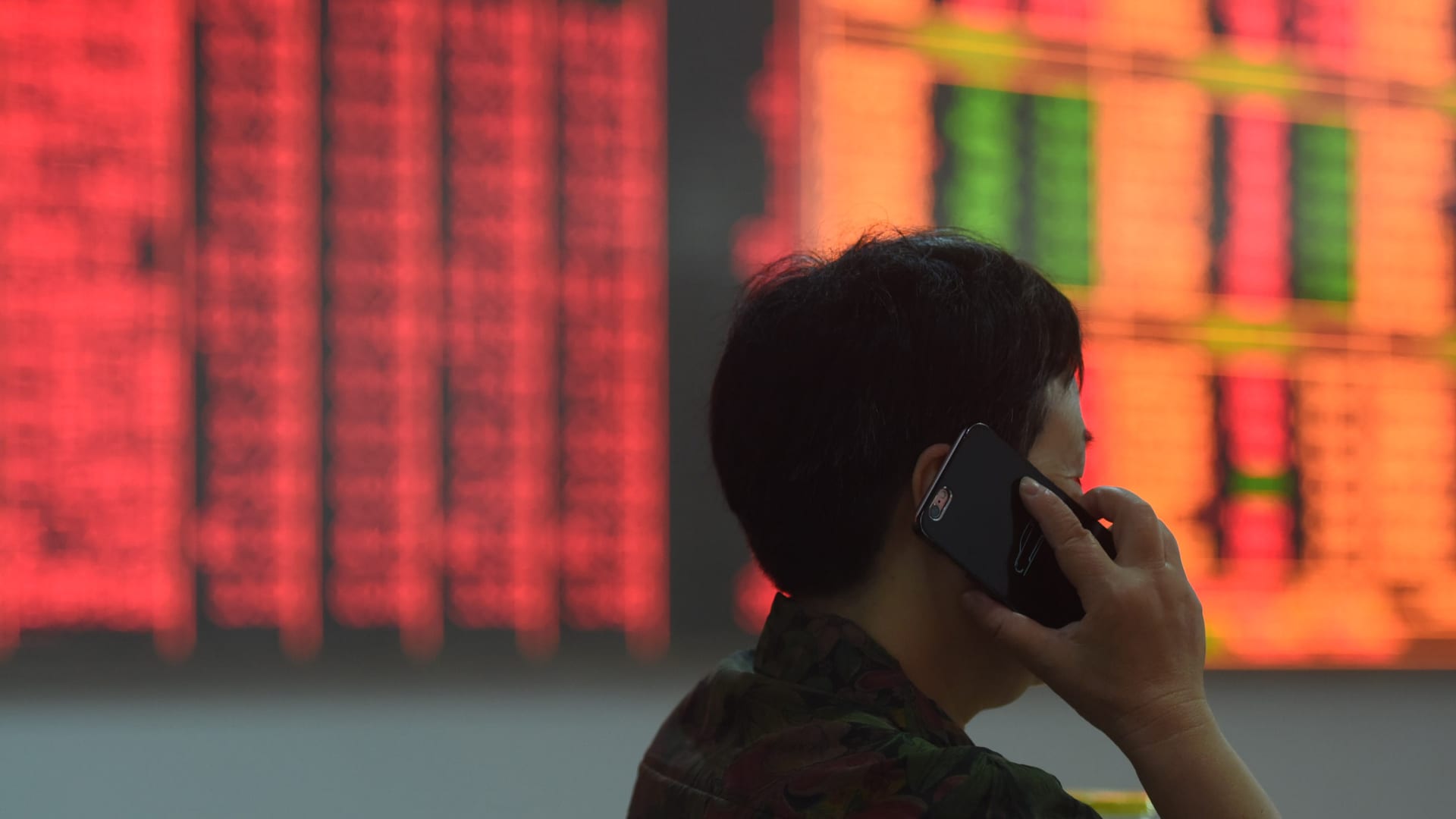
A shareholder at a securities hall in Hangzhou, the capital of Zhejiang province in east China, on Sept. 24, 2024.
Cfoto | Future Publishing | Getty Images
BEIJING — China’s latest policy signals have a bigger impact on sentiment than resolving deeper issues such as real estate, analysts said.
The Shanghai Composite rallied Thursday to close at a three-month high after state media reported Chinese President Xi Jinping led a Politburo meeting on the economy that morning.
The unexpected high-level gathering called for halting the property market decline, and strengthening fiscal and monetary policy. It provided few specifics, while affirming central bank rate cuts announced earlier in the week.
Markets should value how Beijing is recognizing the severity of the economic situation, and how its piecemeal approach so far hasn’t worked, Ting Lu, chief China economist at Nomura, said in a report Friday.
“The ‘shock and awe’ strategy could be meant to jumpstart the markets and boost confidence,” Lu said, but eventually it is still necessary to introduce well thought out policies to address many of the “deep-rooted problems.”

Growth in the world’s second-largest economy has slowed, dragged down by the real estate slump. Retail sales have risen by barely more than 2% in recent months, and industrial profits have barely grown for the first eight months of the year. Exports are one of the few bright spots.
Nomura’s Lu said policymakers in particular need to stabilize property since it is in its fourth year of contraction. He estimated the impact of additional stimulus wouldn’t exceed 3% of China’s annual GDP.
“Markets should place more emphasis on the specifics of the stimulus,” Lu said. “If not designed well, a stimulus program in a haste, even if seemingly large, could have a slow and limited impact on growth.”
The People’s Bank of China this week cut major interest rates, and announced plans to lower rates for existing mortgage holders. The Ministry of Finance has yet to release major policies, despite reports of such plans.
Questions about scale
For some investment institutions, that’s still not enough to move the needle on their China outlook.
“China’s policy moves to lower interest rates have not helped improve confidence among consumers who are fearful of borrowing in the first place,” Paul Christopher, head of global investment strategy at Wells Fargo Investment Institute, said in an email.
“We would be selling emerging market equities at this point,” he said, “as we have little confidence in Beijing’s willingness to extend the large stimulus that is needed.”
Christopher added that Thursday’s “announcement of coming fiscal stimulus is welcome, but it remains to be seen if China’s government is willing to take the steps necessary to reverse the psychological damage to household and private business sentiment.”
The Chinese government has cracked down on real estate developers, after-school tutoring businesses and the gaming industry in recent years. Policymakers have since eased their stance, but business and consumer confidence has yet to recover.
China’s latest interest rate cuts follow the U.S. Federal Reserve’s shift last week to easier monetary policy. U.S rate cuts theoretically give China’s central bank more room to reduce already-low domestic rates.
A survey in September of more than 1,200 companies in China by the U.S.-based China Beige Book found that corporate borrowing declined, despite historic lows in the costs to do so.
“One can certainly hope for a wealth effect from stocks and property, but stocks will be temporary and the wealth decline from property is overwhelming compared to any relief,” Shehzad Qazi, chief operating officer at the China Beige Book, a U.S.-based research firm, said in a note Thursday.
He expects retail sales could pick up slightly in the next four to six months.
Qazi also expects the latest rally in Chinese stocks to continue into the last three months of the year. But cautioned that policies announced this week for driving more capital into the stock market “are not yet operational, and some may never be.”
Sentiment change
Those caveats haven’t discouraged investors from piling into beaten-down Chinese stocks. The CSI 300 stock index climbed Friday, on pace for its best week since 2008.
The sentiment shift has spread globally.
“I thought that what the Fed did last week would lead to China easing, and I didn’t know that they were going to bring out the big guns like they did,” U.S. billionaire hedge fund founder David Tepper told CNBC’s “Squawk Box” on Thursday. “And I think there’s a whole shift.”
Tepper said he bought more Chinese stocks this week.
An important takeaway from Thursday’s high-level government meeting was the support for capital markets, in contrast to a more negative perception in China on the financial industry in recent years, said Bruce Liu, CEO of Esoterica Capital, an asset manager.
“Hopefully this meeting is going to correct this misperception,” he said. “For China to keep growing in a healthy way, [they] really need a well-functioning capital market.”
“I don’t think they sent any different messages,” Liu said. “It’s just [that] they emphasize it with detailed action plans. That made a difference.”





Treasury Bond Volatility Forces Bessent to Double Debt Buyback Size as Yields Swing

Nvidia Earnings Preview: What Wall Street Expects From the AI Bellwether’s Q2 Report

SEC’s Semiannual Reporting Proposal Faces Investor Pushback: What CFOs Need to Know

Armanino adds Strategic Accounting Outsourced Solutions

New 2023 K-1 instructions stir the CAMT pot for partnerships and corporations

Tax Strategy: Employee Retention Credit update
-

 Economics1 week ago
U.S. Retail Sales Fall for the First Time in Nine Months as Consumer Spending Slows
-

 Economics1 week ago
Nvidia’s Potential $3 Billion SB Energy Investment Could Reshape AI Infrastructure
-

 Economics4 days ago
Top 10 Largest Economies by 2030: IMF & World Bank GDP Projections for Global Powerhouses
-

 Stock News4 days ago
How to understand Intel $15B Stock Offering
-

 Technology1 week ago
U.S.-China AI Competition Intensifies as Washington Pushes Allies to Choose Sides
-

 Economics4 days ago
Economic Profile of the United States of America (2026–2030 Horizon)
-

 Leaders3 days ago
Jackson Hole 2026: What the First Symposium Under Fed Chair Kevin Warsh Means for Markets
-

 Economics3 days ago
U.S. National Debt Surpasses $40 Trillion for the First Time: What It Means for the Economy