Connect with us

Finance

China retaliates against U.S. port fees with charges on American ships

Published

on

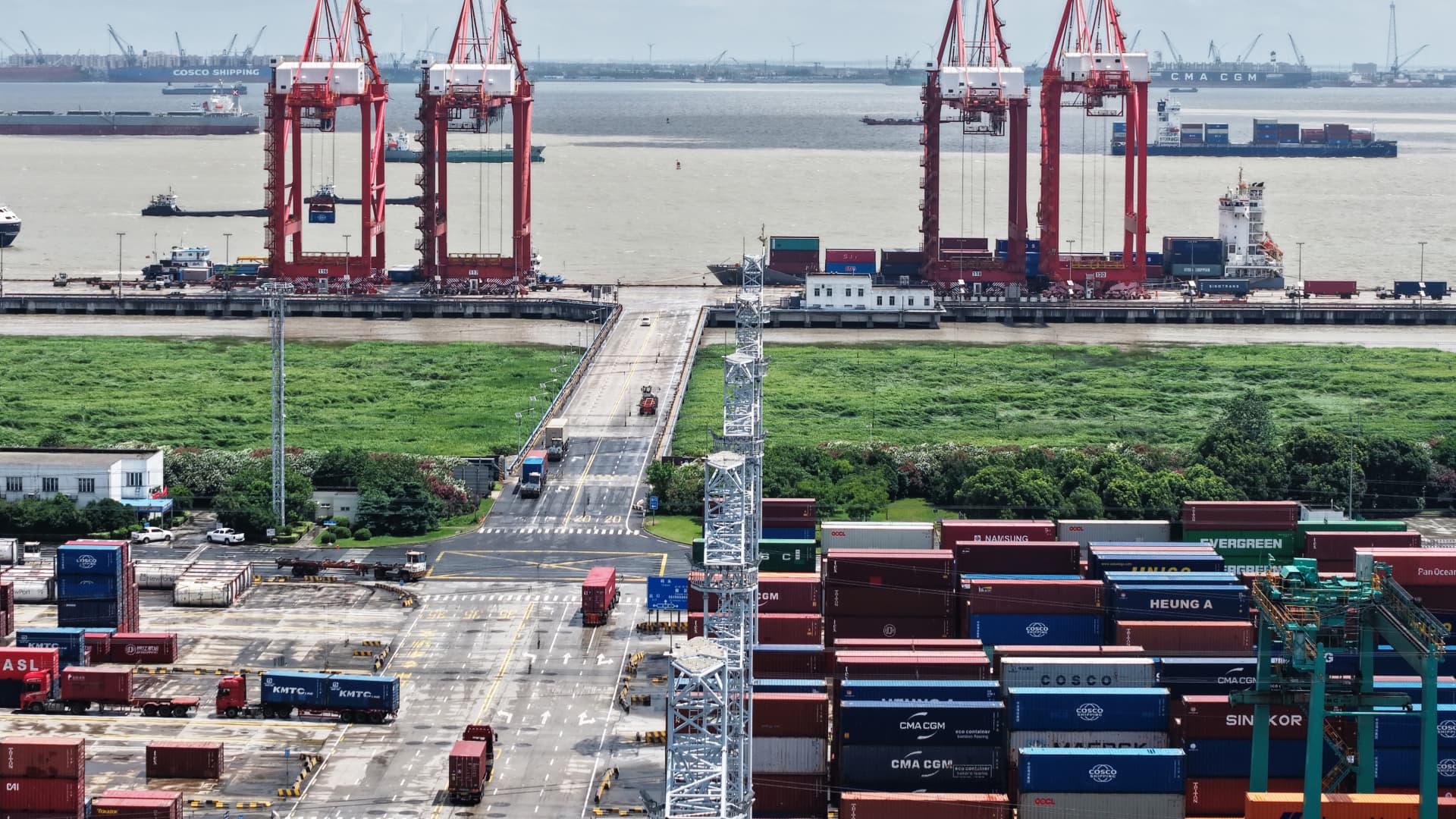
Pictured here is Shanghai Port’s foreign trade container terminal in Shanghai, China on October 9, 2025.

Cfoto | Future Publishing | Getty Images

BEIJING — China on Friday announced that starting Oct. 14, the country will start charging U.S. ships for docking at Chinese ports — a direct response to Washington for imposing fees on Chinese vessels arriving at U.S. ports, set to take effect the same day.

The U.S. fees “seriously violate” international trading principles and “seriously damages” China-U.S. maritime trade, the Chinese Ministry of Transport said in the announcement, translated by CNBC.

China will charge 400 yuan ($56) per net ton for the U.S. vessels, essentially the same as the $50 per net ton that the U.S. is imposing on Chinese ships. Beijing also matched the U.S. with plans to increase the fees over time through April 17, 2028, with the same effective dates.

In the “short term, this will result in an increase in costs for U.S. consumers, a decrease in profits for shippers, and a small decline in demand for exports to the U.S. in certain categories,” said Michael Hart, president of the American Chamber of Commerce in China.

In the longer term, he said there could be more demand for non-Chinese ships. But he didn’t expect an increase in demand for U.S.-made ships due to their high costs and low shipbuilding capacity.

The U.S. only accounts for 0.1% of global shipbuilding, versus 53.3% for China, according to the Center for Strategic and International Studies.

That outsized Chinese market share prompted the U.S. to develop a policy, beginning under the Biden administration, to charge Chinese-made ships when arriving at U.S. ports.

U.S. and China are both avoiding enforcing regulations that restrict AI development: Analyst

The Chinese Ministry of Transport said the fees would apply to vessels owned by U.S. businesses, organizations, individuals and entities holding a 25% or greater stake. Ships flying the U.S. flag or made in Washington would also be charged, the ministry said.

This is “just more tit-for-tat negotiating tactics. The U.S. placed similar fees on Chinese bound vessels and now China is doing the same,” said Peter Alexander, managing director of Z-Ben Advisors in Shanghai.

“The Trump administration continues to underestimate China and this needs to stop,” Alexander said. “There seems to be little consideration given to second and third-order effects of policy choices.”

He added: “China can give as good as it gets and has demonstrated a willingness to take direct action. Have there been any lessons learned by the Americans over the past six months?  It certainly doesn’t seem so.”

The Chinese port fee announcement comes after China doubled down on its export restrictions and broadened its “unreliable entities” blacklist to include chip consulting firm TechInsights, in the last two days.

U.S.-China tensions have remained elevated despite a call between U.S. President Donald Trump and Chinese President Xi Jinping last month, and expectations of a meeting between the two leaders in South Korea in coming weeks.

While Trump has played up progress on a deal for Beijing-based ByteDance to sell the U.S. operations of its TikTok app, China has been less conclusive.


Continue Reading

Finance

Tokenized Debt Shifts How Corporate Manage Short Term Liquidity

Published

on

Tokenized Debt Shifts Corporate Liquidity

The landscape of institutional debt markets is undergoing a profound structural shift on July 21, 2026, as major corporate issuers and commercial banks rapidly accelerate the deployment of tokenized debt instruments. Data published by leading capital market consortiums indicates that primary issuances of digital commercial paper and tokenized corporate bonds have reached record volumes this month. By moving legacy debt origination, underwriting, and secondary distribution onto permissioned distributed ledgers, corporate treasurers are unlocking unprecedented operational flexibility and instantaneous cross-border liquidity.

The adoption of tokenized debt is fundamentally altering how enterprise balance sheets manage short-term liquidity needs. Traditional corporate bond settlement cycles historically required multi-day clearing processes involving numerous intermediaries, custodial entities, and clearinghouses. Through programmable smart contracts on distributed ledgers, issuers can now execute atomic settlement—enabling continuous, 24/7 access to institutional capital pools. This instantaneous clearing mechanism drastically reduces counterparty risk, eliminates costly settlement friction, and allows treasury teams to dynamically optimize working capital in real time.

A major catalyst driving this institutional migration is the establishment of comprehensive digital asset regulatory frameworks across major financial hubs. Clear legal guidelines regarding ledger-based securities ownership have provided institutional compliance officers with the regulatory confidence necessary to transition multi-billion-dollar liquidity facilities onto digital platforms. Furthermore, the integration of automated regulatory reporting directly into token smart contracts simplifies ongoing compliance audits, ensuring that secondary market trades automatically enforce investor accreditation limits and tax withholding requirements.

For chief financial officers and institutional portfolio managers, tokenized debt represents a fundamental evolution in fixed-income strategy. Companies that embrace ledger-based debt structures gain direct access to a broader, global base of digital-native institutional investors while substantially reducing borrowing overhead. As ledger interoperability continues to improve across global exchanges, tokenized debt is poised to become the standard infrastructure for global corporate finance.

Continue Reading

Finance

Private Credit Expansion: How Alternative Lending Platforms Are Reshaping Corporate Liquidity

Published

on

How Alternative Lending Platforms Are Reshaping Corporate Liquidity

Private credit has firmly established itself as a foundational pillar of global financial markets in 2026, transitioning from an alternative asset class into a dominant mechanism for middle-market corporate financing. Reports published in mid-July 2026 show that direct lending assets under management have expanded significantly, as corporate borrowers increasingly bypass traditional syndication desks in favor of customized private debt solutions. This structural migration has fundamentally altered corporate liquidity dynamics, providing middle-market enterprises with reliable access to tailored capital packages even during periods of regulatory bank tightening.

The primary driver of this continued growth is the structural flexibility inherent in private debt agreements. Unlike public bond markets or conservative commercial bank loans—which often carry rigid covenants and slow underwriting timelines—private credit funds offer speed of execution, flexible payment-in-kind structures, and customized debt-service frameworks. For companies undertaking strategic acquisitions, capital expenditures, or complex balance sheet recapitalizations, the ability to negotiate directly with a unified syndicate of private lenders provides significant certainty and confidentiality.

However, the expansion of private credit is attracting heightened regulatory attention and risk scrutiny. Financial regulatory bodies are closely evaluating the lack of secondary market price discovery and the potential concentration of illiquidity risks within non-bank financial institutions. Because private debt instruments are held to maturity and marked to model rather than marked to market, evaluating real-time enterprise valuations during economic shifts requires robust internal credit assessment standards. Analysts note that as loan portfolios mature, performance variations between disciplined lenders and aggressive underwriters will become increasingly apparent.

For corporate financial officers and institutional portfolio managers, private credit represents both a powerful strategic tool and a vital diversification strategy. Borrowers must weigh the higher nominal coupon rates of private debt against the tangible value of operational flexibility and execution certainty. Meanwhile, investors must maintain rigorous credit due diligence, prioritizing funds with proven restructuring capabilities and deep operational expertise in underwriting resilient middle-market businesses.

Continue Reading

Finance

Tokenized Real-World Assets: Institutional Ledger Adoption Achieves Scale in July 2026

Published

on

Institutional Ledger Adoption Achieves Scale in July 2026

The integration of blockchain technology with legacy financial markets has reached a decisive tipping point in July 2026, driven by the rapid scaling of Real-World Asset (RWA) tokenization. Major global investment banks, custodial entities, and asset managers are actively shifting sovereign debt, commercial paper, and private fund shares onto permissioned distributed ledgers. Recent industry data confirms that the aggregate market capitalization of tokenized treasury products and private credit funds has surged past major milestones, illustrating that ledger-based settlement is no longer experimental, but core financial infrastructure.

The fundamental value proposition of asset tokenization rests on operational efficiency, continuous liquidity, and automated compliance execution. By embedding regulatory checks, investor accreditation limits, and automated coupon distributions directly into smart contract code, financial institutions eliminate vast amounts of manual back-office reconciliation. Furthermore, fractionalized ownership structures allow high-value asset classes—such as prime commercial real estate and private equity funds—to be split into accessible units, significantly expanding liquidity pools and enabling real-time collateral optimization.

A key catalyst behind this institutional momentum is the establishment of comprehensive regulatory clarity across major financial jurisdictions. The implementation of standardized digital asset frameworks in the United States and Europe has provided institutional compliance officers with the legal certainty required to deploy capital on-chain. As a result, premier custodian banks are now offering unified digital asset custody, seamlessly bridging traditional securities depositories with programmable ledger ecosystems.

Looking forward, the maturation of tokenized assets will continue to transform secondary market trading and treasury management. Corporate treasurers can now yield-optimize idle cash in real time by moving into tokenized money market instruments that settle instantaneously on a 24/7 basis. To remain competitive, financial leaders must ensure their institutional architectures are interoperable with modern digital ledger protocols, positioning their organizations at the forefront of modern capital market efficiency.

Continue Reading

Trending