Connect with us

Finance

China self-driving truck company TuSimple pivots to genAI for games

Published

on

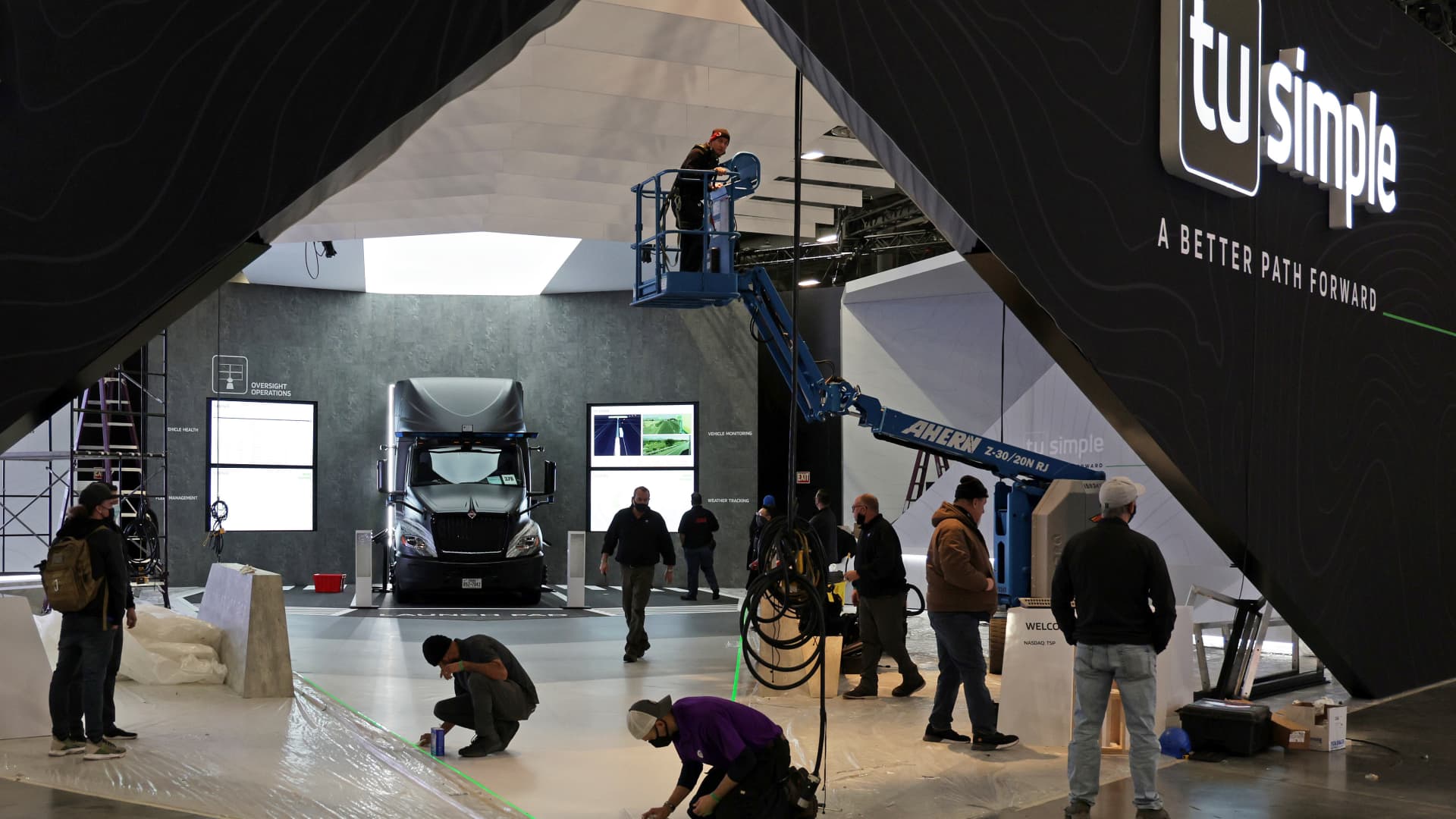
Workers setting up the TuSimple booth for CES 2022 at the Las Vegas Convention Center on Jan. 3, 2022.

Alex Wong | Getty Images News | Getty Images

Embattled Chinese autonomous trucking company TuSimple has rebranded to CreateAI, focusing on video games and animation, the company announced Thursday.

The news comes as GM folded its Cruise robotaxi business this month, and the once-hot sector of self-driving startups has started to weed out stragglers. TuSimple, which straddled the U.S. and China markets, had its own challenges: concerns over vehicle safety, a $189 million settlement of a securities fraud lawsuit and delisting from the Nasdaq in February.

Now, just over two years after CEO Cheng Lu rejoined the company in the role after being pushed out, he expects the business can break even in 2026.

That’s thanks to a video game based on the hit martial arts novels by Jin Yong that’s slated to release an initial version that year, Cheng said. He anticipates “several hundred million” in revenue in 2027 when the full version is launched.

Before the delisting, TuSimple said it lost $500,000 in the first three quarters of 2023, and spent $164.4 million on research and development during that time.

Company co-founder Mo Chen has a “long history” with the Jin Yong family and started work in 2021 to develop an animated feature based on the stories, Cheng said.

Kunst: AI stocks are cyclical. NVIDIA is the leader, but they will eventually trade down.

The company claims its artificial intelligence capabilities in developing autonomous driving software give it a base from which to develop generative AI. That’s the next-level tech powering OpenAI’s ChatGPT, which generates human-like responses to user prompts.

Along with the CreateAI rebrand, the company debuted its first major AI model called Ruyi, an open-source model for visual work, available via the Hugging Face platform.

“It’s clear our shareholders see the value in this transformation and want to move forward in this direction,” Cheng said. “Our management team and Board of Directors have received overwhelming support from shareholders at the annual meeting.”

He said the company plans to increase headcount to around 500 next year, up from 300.

Cutting production costs by 70%

While still under the name TuSimple, the company in August announced a partnership with Shanghai Three Body Animation to develop the first animated feature film and video game based on the science fiction novel series “The Three-Body Problem.”

The company said at the time that it was launching a new business segment to develop generative AI applications for video games and animation.

CreateAI expects to lower the cost of top-tier, so-called triple A game production by 70% in the next five to six years, Cheng said. He declined to share whether the company was in talks with gaming giant Tencent.

When asked about the impact of U.S. restrictions, Cheng claimed there were no issues and said the company used a mix of China and non-China cloud computing providers.

The U.S. under the Biden administration has ramped up limits on Chinese businesses’ access to advanced semiconductors used to power generative AI.


Continue Reading

Finance

Treasury Yields Rise as Fed Cut Expectations Shift

Published

on

Treasury Yields Rise as Fed Cut Expectations Shift

Fixed-income markets recorded significant re-pricing during the week ending July 25, 2026, as a convergence of strong labor market metrics and surging energy costs drove U.S. Treasury yields higher across all maturities. The benchmark 10-year Treasury yield climbed toward 4.70%, reaching its highest point in several months. Institutional bond investors rapidly adjusted portfolio durations as expectations for near-term interest rate cuts by the Federal Reserve faded in response to inflation concerns.

The upward shift in sovereign yields reflects a broader fundamental reassessment of global monetary policy. Earlier in the quarter, money markets had priced in a series of rate reductions designed to support economic activity. However, with initial jobless claims falling to 187,000 and crude oil breaching $100 per barrel, fixed-income traders are pricing in a ‘higher-for-longer’ interest rate environment. The inversion between short-term Treasury bills and long-term bonds narrowed, indicating a shift toward term premium expansion.

Rising Treasury yields present both challenges and opportunities for institutional wealth managers. While commercial lenders and mortgage origination volumes face headwinds from elevated borrowing costs, fixed-income investors are locking in attractive real yields on high-quality sovereign and investment-grade corporate bonds. Institutional debt issuers, conversely, are recalibrating their capital structures, opting for shorter-term refinancing instruments or private credit facilities to avoid committing to elevated long-term coupon rates.

Navigating the current bond market landscape demands strict duration management and credit selection. Wealth advisors recommend maintaining flexible fixed-income allocations, combining short-duration Treasuries with inflation-protected securities (TIPS) to shield capital against potential energy-driven inflation spikes while earning dependable nominal income.

Continue Reading

Finance

Private Credit Expansion Transforms Corporate Loans

Published

on

Private Credit Expansion Transforms Corporate Loans

Private credit markets reached a pivotal milestone during the week ending July 25, 2026, as non-bank direct lending consortiums captured a record share of middle-market corporate debt originations. With commercial banks maintaining conservative credit standards and public bond yields remaining elevated, corporate borrowers are increasingly turning to private fund managers for customized capital solutions. This expansion marks a permanent structural shift in enterprise finance, establishing private credit as a primary pillar of institutional corporate liquidity.

The acceleration of private credit deals is driven by speed, deal certainty, and flexible terms. Unlike traditional syndicated bank loans that require lengthy underwriting, credit rating approvals, and public roadshows, private direct lenders can structure tailored financing packages within days. Middle-market firms facing upcoming debt maturities are utilizing private debt facilities to execute recapitalizations, strategic acquisitions, and growth capital deployments without risking execution delay in public markets.

However, financial regulators and central bank supervisors are scrutinizing the sector’s rapid growth. Supervisory agencies are evaluating potential systemic risks associated with non-bank leverage, valuation transparency, and liquidity mismatches during economic downturns. Despite regulatory interest, major pension funds, insurance firms, and sovereign wealth entities continue to expand capital allocations to private credit funds, attracted by reliable floating-rate yields that outperform public fixed-income benchmarks.

As private credit matures into a dominant asset class, corporate chief financial officers must evaluate non-bank lenders alongside traditional banking relationships. Direct lending partnerships provide valuable balance sheet resilience, enabling companies to secure flexible financing terms even during periods of public market turbulence.

Continue Reading

Finance

Tokenized Debt Shifts How Corporate Manage Short Term Liquidity

Published

on

Tokenized Debt Shifts Corporate Liquidity

The landscape of institutional debt markets is undergoing a profound structural shift on July 21, 2026, as major corporate issuers and commercial banks rapidly accelerate the deployment of tokenized debt instruments. Data published by leading capital market consortiums indicates that primary issuances of digital commercial paper and tokenized corporate bonds have reached record volumes this month. By moving legacy debt origination, underwriting, and secondary distribution onto permissioned distributed ledgers, corporate treasurers are unlocking unprecedented operational flexibility and instantaneous cross-border liquidity.

The adoption of tokenized debt is fundamentally altering how enterprise balance sheets manage short-term liquidity needs. Traditional corporate bond settlement cycles historically required multi-day clearing processes involving numerous intermediaries, custodial entities, and clearinghouses. Through programmable smart contracts on distributed ledgers, issuers can now execute atomic settlement—enabling continuous, 24/7 access to institutional capital pools. This instantaneous clearing mechanism drastically reduces counterparty risk, eliminates costly settlement friction, and allows treasury teams to dynamically optimize working capital in real time.

A major catalyst driving this institutional migration is the establishment of comprehensive digital asset regulatory frameworks across major financial hubs. Clear legal guidelines regarding ledger-based securities ownership have provided institutional compliance officers with the regulatory confidence necessary to transition multi-billion-dollar liquidity facilities onto digital platforms. Furthermore, the integration of automated regulatory reporting directly into token smart contracts simplifies ongoing compliance audits, ensuring that secondary market trades automatically enforce investor accreditation limits and tax withholding requirements.

For chief financial officers and institutional portfolio managers, tokenized debt represents a fundamental evolution in fixed-income strategy. Companies that embrace ledger-based debt structures gain direct access to a broader, global base of digital-native institutional investors while substantially reducing borrowing overhead. As ledger interoperability continues to improve across global exchanges, tokenized debt is poised to become the standard infrastructure for global corporate finance.

Continue Reading

Trending