Connect with us

Finance

China to bolster consumption, tech development as U.S. tensions simmer

Published

on

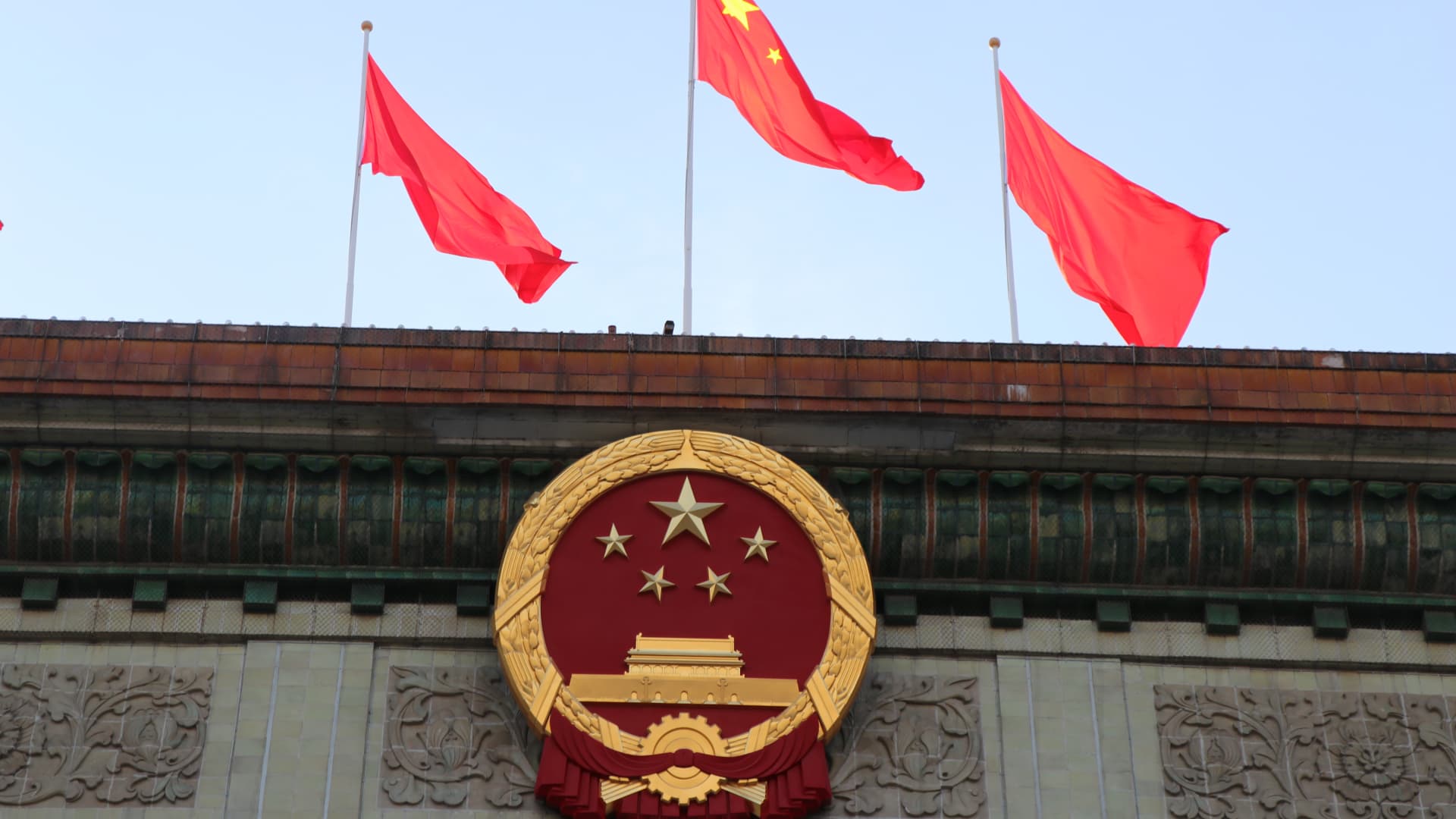
Pictured here is the Great Hall of the People in Beijing, China, ahead of the 76th anniversary of the founding of the People’s Republic of China on September 30, 2025.

Anadolu | Anadolu | Getty Images

BEIJING — China’s top leaders on Thursday stressed their resolve to boost domestic consumption over the next five years, on top of widely expected plans to bolster homegrown tech.

That’s according to a state media readout of the closely watched “Fourth Plenum” meeting for setting five-year development targets. China on Thursday also confirmed that Vice Premier He Lifeng, who participated in the plenary meeting, will visit Malaysia from Friday to Monday for U.S. trade talks — as anticipation grows over a possible meeting between the U.S. and Chinese presidents at the end of the month.

Despite broad calls to bolster China’s international influence and “safeguard the multilateral trading system,” the readout did not mention major countries by name as the meeting focuses largely on domestic development.

China must “vigorously boost consumption,” the meeting readout said, according to a CNBC translation of the Chinese. The leaders elaborated on the need for consumption with calls to balance it with “effective investment” and “adhere to the strategic point of expanding domestic demand.”

“New demand will lead to new supply, and new supply will create new demand,” the report said. The leaders also called for effective implementation of policies to support businesses and “special actions” to boost consumption.

The tone indicates that China’s policymakers are taking a closer look at the relationship between economic supply and demand than they have in past years, said Zong Liang, former chief researcher at the Bank of China.

That change — which doesn’t come lightly in China’s ideologically driven government — still isn’t a green light for cash handouts. Even with muted retail sales since the pandemic, Beijing has steered away from directly giving consumers money, in contrast with U.S. stimulus checks in the wake of Covid-19.

A reconstruction of the global monetary order is underway: CICC

The readout “signals a continued emphasis on investment — this time as a means to stimulate consumption — rather than a bold, direct push to expand consumption itself,” Yue Su, Beijing-based principal economist for China at the Economist Intelligence Unit, said in a note.

“We can therefore expect investment to focus more on consumption-related sectors and activities, such as improved urban planning, public services, and elderly care,” she said. Su pointed out that over the past decade China has heavily relied on investment for growth, leading to concerns about overinvestment.

In the last two years, China has sought to boost consumption with subsidies targeted at home appliances and certain other consumer goods. The country has also encouraged local governments to hold sporting events and other entertainment to boost spending.

Since the readout didn’t call for “vigorously boosting income,” Eurasia Group’s China Director Dan Wang is more cautious about Beijing’s consumption plans.

“It is just a wishful goal,” she said. “I can’t see fiscal commitment in this.”

The readout emphasized achieving the 2025 growth target of around 5% and other previously shared goals for 2027 and 2035.

That all implies annual growth of 4.6% through 2035, Wang said, noting it will be “very costly” to achieve. She expects that ultimately resources will be concentrated in high tech and emerging industries, with little improvement on the demand side while deflationary pressure remains entrenched.

China’s previous policy goals to become a global leader in electric cars, for example, have been criticized for encouraging companies to flock into subsidy-supported industries, resulting in a race to the bottom that’s then pressured industries in other countries.

A ‘significant leap forward’ in tech

Beijing this year has sought to address some of the excessive competition. But the country has meanwhile had to ramp up its technological development as the U.S. has increased restrictions on China’s ability to access advanced tech.

China’s top leaders on Thursday called for improving tech self-reliance. “We will strive for the next five years, to achieve a significant leap forward in [China’s] economic strength, scientific and technological strength, national defense strength, comprehensive national power and international influence by 2035,” the readout said.

It also called for developing a “strong agricultural nation” and “accelerating the establishment of a strong manufacturing nation,” while noting the need to maintain a “reasonable” proportion of manufacturing in the country.

The only mention of the ongoing property slump called for “high-quality development” of real estate. Beijing also noted it will work towards previously released plans to reduce carbon emissions.

Senior officials are set to share more details about the country’s upcoming five-year goals in a press briefing Friday morning, while a more comprehensive readout is expected in coming days. China typically doesn’t release detailed full five-year targets until its parliamentary meeting in March.


Continue Reading

Finance

Tokenized Debt Shifts How Corporate Manage Short Term Liquidity

Published

on

Tokenized Debt Shifts Corporate Liquidity

The landscape of institutional debt markets is undergoing a profound structural shift on July 21, 2026, as major corporate issuers and commercial banks rapidly accelerate the deployment of tokenized debt instruments. Data published by leading capital market consortiums indicates that primary issuances of digital commercial paper and tokenized corporate bonds have reached record volumes this month. By moving legacy debt origination, underwriting, and secondary distribution onto permissioned distributed ledgers, corporate treasurers are unlocking unprecedented operational flexibility and instantaneous cross-border liquidity.

The adoption of tokenized debt is fundamentally altering how enterprise balance sheets manage short-term liquidity needs. Traditional corporate bond settlement cycles historically required multi-day clearing processes involving numerous intermediaries, custodial entities, and clearinghouses. Through programmable smart contracts on distributed ledgers, issuers can now execute atomic settlement—enabling continuous, 24/7 access to institutional capital pools. This instantaneous clearing mechanism drastically reduces counterparty risk, eliminates costly settlement friction, and allows treasury teams to dynamically optimize working capital in real time.

A major catalyst driving this institutional migration is the establishment of comprehensive digital asset regulatory frameworks across major financial hubs. Clear legal guidelines regarding ledger-based securities ownership have provided institutional compliance officers with the regulatory confidence necessary to transition multi-billion-dollar liquidity facilities onto digital platforms. Furthermore, the integration of automated regulatory reporting directly into token smart contracts simplifies ongoing compliance audits, ensuring that secondary market trades automatically enforce investor accreditation limits and tax withholding requirements.

For chief financial officers and institutional portfolio managers, tokenized debt represents a fundamental evolution in fixed-income strategy. Companies that embrace ledger-based debt structures gain direct access to a broader, global base of digital-native institutional investors while substantially reducing borrowing overhead. As ledger interoperability continues to improve across global exchanges, tokenized debt is poised to become the standard infrastructure for global corporate finance.

Continue Reading

Finance

Private Credit Expansion: How Alternative Lending Platforms Are Reshaping Corporate Liquidity

Published

on

How Alternative Lending Platforms Are Reshaping Corporate Liquidity

Private credit has firmly established itself as a foundational pillar of global financial markets in 2026, transitioning from an alternative asset class into a dominant mechanism for middle-market corporate financing. Reports published in mid-July 2026 show that direct lending assets under management have expanded significantly, as corporate borrowers increasingly bypass traditional syndication desks in favor of customized private debt solutions. This structural migration has fundamentally altered corporate liquidity dynamics, providing middle-market enterprises with reliable access to tailored capital packages even during periods of regulatory bank tightening.

The primary driver of this continued growth is the structural flexibility inherent in private debt agreements. Unlike public bond markets or conservative commercial bank loans—which often carry rigid covenants and slow underwriting timelines—private credit funds offer speed of execution, flexible payment-in-kind structures, and customized debt-service frameworks. For companies undertaking strategic acquisitions, capital expenditures, or complex balance sheet recapitalizations, the ability to negotiate directly with a unified syndicate of private lenders provides significant certainty and confidentiality.

However, the expansion of private credit is attracting heightened regulatory attention and risk scrutiny. Financial regulatory bodies are closely evaluating the lack of secondary market price discovery and the potential concentration of illiquidity risks within non-bank financial institutions. Because private debt instruments are held to maturity and marked to model rather than marked to market, evaluating real-time enterprise valuations during economic shifts requires robust internal credit assessment standards. Analysts note that as loan portfolios mature, performance variations between disciplined lenders and aggressive underwriters will become increasingly apparent.

For corporate financial officers and institutional portfolio managers, private credit represents both a powerful strategic tool and a vital diversification strategy. Borrowers must weigh the higher nominal coupon rates of private debt against the tangible value of operational flexibility and execution certainty. Meanwhile, investors must maintain rigorous credit due diligence, prioritizing funds with proven restructuring capabilities and deep operational expertise in underwriting resilient middle-market businesses.

Continue Reading

Finance

Tokenized Real-World Assets: Institutional Ledger Adoption Achieves Scale in July 2026

Published

on

Institutional Ledger Adoption Achieves Scale in July 2026

The integration of blockchain technology with legacy financial markets has reached a decisive tipping point in July 2026, driven by the rapid scaling of Real-World Asset (RWA) tokenization. Major global investment banks, custodial entities, and asset managers are actively shifting sovereign debt, commercial paper, and private fund shares onto permissioned distributed ledgers. Recent industry data confirms that the aggregate market capitalization of tokenized treasury products and private credit funds has surged past major milestones, illustrating that ledger-based settlement is no longer experimental, but core financial infrastructure.

The fundamental value proposition of asset tokenization rests on operational efficiency, continuous liquidity, and automated compliance execution. By embedding regulatory checks, investor accreditation limits, and automated coupon distributions directly into smart contract code, financial institutions eliminate vast amounts of manual back-office reconciliation. Furthermore, fractionalized ownership structures allow high-value asset classes—such as prime commercial real estate and private equity funds—to be split into accessible units, significantly expanding liquidity pools and enabling real-time collateral optimization.

A key catalyst behind this institutional momentum is the establishment of comprehensive regulatory clarity across major financial jurisdictions. The implementation of standardized digital asset frameworks in the United States and Europe has provided institutional compliance officers with the legal certainty required to deploy capital on-chain. As a result, premier custodian banks are now offering unified digital asset custody, seamlessly bridging traditional securities depositories with programmable ledger ecosystems.

Looking forward, the maturation of tokenized assets will continue to transform secondary market trading and treasury management. Corporate treasurers can now yield-optimize idle cash in real time by moving into tokenized money market instruments that settle instantaneously on a 24/7 basis. To remain competitive, financial leaders must ensure their institutional architectures are interoperable with modern digital ledger protocols, positioning their organizations at the forefront of modern capital market efficiency.

Continue Reading

Trending