
Finance
China’s bond market intervention reveals financial stability worries

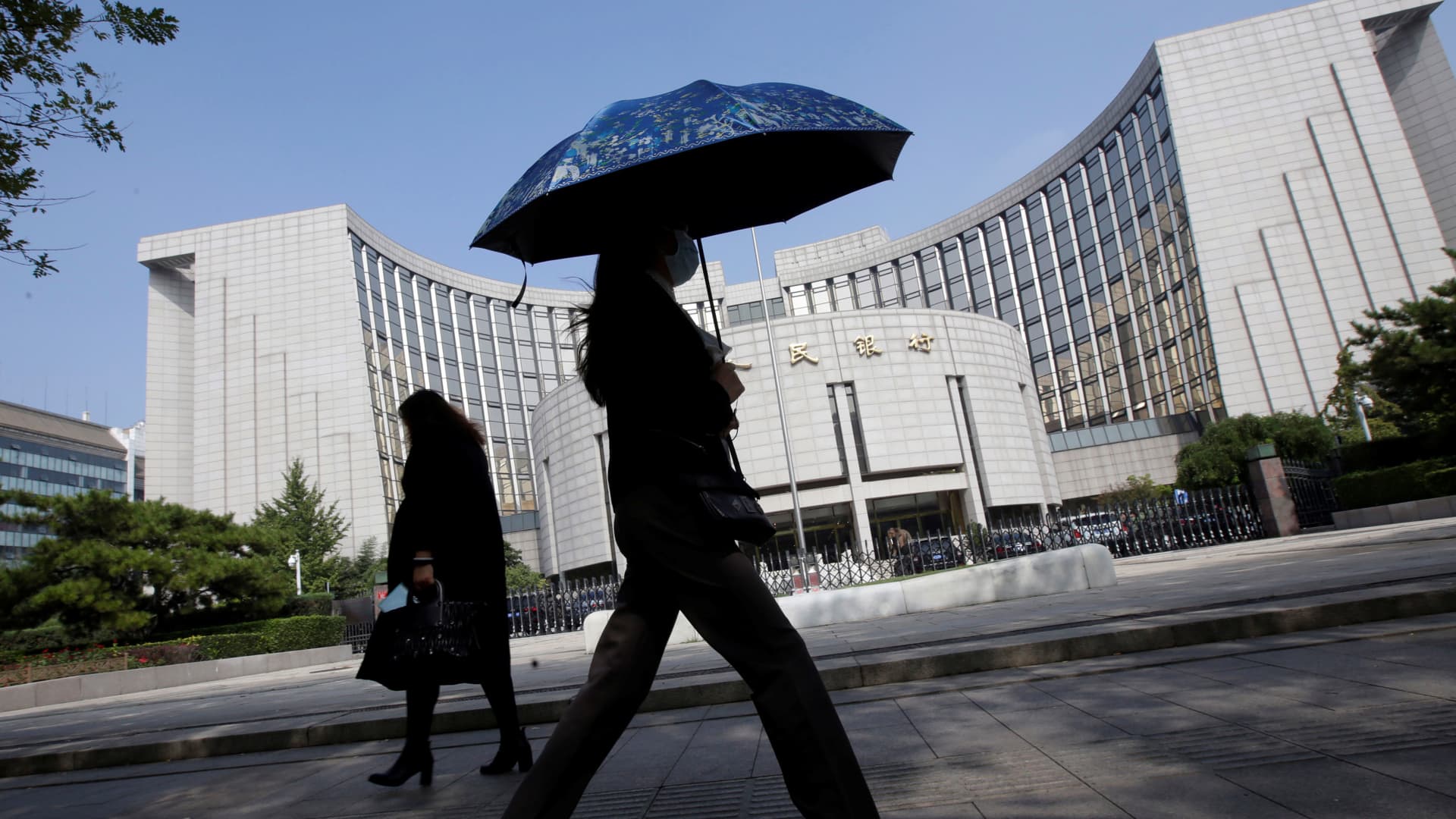
People walk past the headquarters of the People’s Bank of China (PBOC), the central bank, in Beijing, China September 28, 2018.
Jason Lee | Reuters
BEIJING — China’s latest efforts to stem a bond market rally reveals wider worries among authorities about financial stability, analysts said.
Slow economic growth and tight capital controls have concentrated domestic funds in China’s government bond market, one of the largest in the world. Bloomberg reported Monday, citing sources, that regulators told commercial banks in Jiangxi province not to settle their purchases of government bonds.
Futures showed prices for the 10-year Chinese government bond tumbled to their lowest in nearly a month on Monday, before recovering modestly, according to Wind Information data. Prices move inversely to yields.
“The sovereign bond market is the backbone of the financial sector, even if you run a bank-driven sector like China [or] Europe,” said Alicia Garcia-Herrero, chief economist for Asia-Pacific at Natixis.
She pointed out that in contrast to electronic trading of the bonds by retail investors or asset managers in Europe, banks and insurers tend to hold the government bonds, which implies nominal losses if prices fluctuate significantly.

The 10-year Chinese government bond yield has abruptly turned higher in recent days, after falling all year to a record low in early August, according to Wind Information data going back to 2010.
At around 2.2%, the Chinese 10-year yield remains far lower than the U.S. 10-year Treasury yield of nearly 4% or higher. The gap reflects how the U.S. Federal Reserve has kept interest rates high, while the People’s Bank of China has been lowering rates in the face of tepid domestic demand.
“The problem is not what it shows [about a weak economy],” Garcia-Herrero said, but “what it means for financial stability.”
“They have [Silicon Valley Bank] in mind, so what that means, corrections in sovereign bond yields having a big impact on your sovereign balance sheet,” she continued, adding that “the potential problem is worse than SVB and that’s why they’re very worried.”
Silicon Valley Bank collapsed in March 2023 in one of the largest U.S. bank failures in recent times. The company’s struggles were largely blamed on shifts in capital allocation due to aggressive rate hikes by the Fed.
PBoC Governor Pan Gongsheng said in a speech in June that central banks need to learn from the Silicon Valley Bank incident, to “promptly correct and block the accumulation of financial market risks.” He called for special attention to the “maturity rate mismatch and interest rate risk of some non-bank entities holding a large number of medium and long-term bonds.” That’s according to a CNBC’s translation of his Chinese.
Zerlina Zeng, head of Asia credit strategy, CreditSights, noted that the PBoC has increased intervention in the government bond market, from increased regulatory scrutiny of bond market trading to guidance for state-owned banks to sell Chinese government bonds.
The PBoC has sought to “maintain a steep yield curve and manage risks arising from the concentrated holding of long-end CGB bonds by city and rural commercial banks and non-bank financial institutions,” she said in a statement.
“We do not think that the intention of the PBOC’s bond market intervention was to engineer higher interest rates, but to guide banks and non-bank financials institutions to extend credit to the real economy rather than parking funds in bond investments,” Zeng said.
Insurance hole in the ‘trillions’
Stability has long been important for Chinese regulators. Even if yields are expected to move lower, the speed of price increases pose concerns.
That’s especially an issue for Chinese insurance companies that have parked much of their assets in the bond market — after guaranteeing fixed return rates for life insurance and other products, said Edmund Goh, head of China fixed income at Abrdn.
That contrasts with how in other countries, insurance companies can sell products whose returns can change depending on market conditions and extra investment, he said.
“With the rapid decline in bond yields, that would affect the capital adequacy of insurance companies. It’s a huge part of the financial system,” Goh added, estimating it could require “trillions” of yuan to cover. One trillion yuan is about $140 billion USD.
“If bond yields move lower slower it will really give some breathing space to the insurance industry.”
Why the bond market?
Insurance companies and institutional investors have piled into China’s bond market partly due to a lack of investment options in the country. The real estate market has slumped, while the stock market has struggled to recover from multi-year lows.
Those factors make the PBoC’s bond market intervention far more consequential than Beijing’s other interventions, including in foreign exchange, said Natixis’ Garcia-Herrero. “It’s very dangerous what they’re doing, because losses could be massive.”
“Basically I just worry that it will get out of control,” she said. “This is happening because there [are] no other investment alternatives. Gold or sovereign bonds, that’s it. A country the size of China, with only these two options, there’s no way you can avoid a bubble. The solution isn’t there unless you open the capital account.”
The PBoC did not immediately respond to a request for comment.
China has pursued an economic model dominated by the state, with gradual efforts to introduce more market forces over the last few decades. This state-led model has steered many investors in the past to believe Beijing will step in to stem losses, no matter what.
The news of a local bank canceling a bond settlement “came as a shock to most people” and “shows the desperation on the Chinese government side,” said abrdn’s Goh.
But Goh said he didn’t think it was enough to affect foreign investor confidence. He had expected the PBoC to intervene in the bond market in some form.
Beijing’s yield woes
Beijing has publicly expressed concerns over the speed of bond buying, which has rapidly lowered yields.
In July, the PBoC-affiliated “Financial News” criticized the rush to buy Chinese government bonds as “shorting” the economy. The outlet later diluted the headline to say such actions were a “disturbance,” according to CNBC’s translation of the Chinese outlet.
Chang Le, fixed-income senior strategist at ChinaAMC, pointed out that the Chinese 10-year yield has typically fluctuated in a 20 basis-point range around the medium-term lending facility, one of the PBoC’s benchmark interest rates. But this year the yield hit 30 basis points below the MLF, he said, indicating the accumulation of interest rate risk.
The potential for gains has driven up demand for the bonds, after such buying already outpaced supply earlier this year, he said. The PBoC has repeatedly warned of risks while trying to maintain financial stability by tackling the lack of bond supply.
Low yields, however, also reflect expectations of slower growth.
“I think poor credit growth is one of the reasons why bond yields have moved lower,” Goh said. If smaller banks “could find good quality borrowers, I’m sure they would rather lend money to them.”
Loan data released late Tuesday showed that new yuan loans categorized under “total social financing” fell in July for the first time since 2005.
“The latest volatility in China’s domestic bond market underscores the need for reforms that channel market forces toward efficient credit allocation,” said Charles Chang, managing director at S&P Global Ratings.
“Measures that enhance market diversity and discipline may help reinforce the PBOC’s periodic actions,” Chang added. “Reforms in the corporate bond market, in particular, could facilitate Beijing’s pursuit of more efficient economic growth that incurs less debt over the long term.”





S&P 500 September Outlook: Tech Rally Holds Index at 7,600

India Unveils ‘Saptadhara’ Reform Agenda Targeting Technology, Youth Skilling, and Growth

S&P 500 Outperforms Amid Strong Corporate Earnings as Treasury Yields Cap Equity Multiples

Armanino adds Strategic Accounting Outsourced Solutions

New 2023 K-1 instructions stir the CAMT pot for partnerships and corporations

Tax Strategy: Employee Retention Credit update
-

 Technology6 days ago
AI Infrastructure Boom Hits Physical Limits: Power, Financing, and Supply Chain Strain
-

 Economics4 days ago
U.S.- Canada Trade Talks Collapse; Carney Says Retaliatory Tariffs Begin September 8
-
 Stock News12 hours ago
S&P 500 September Outlook: Tech Rally Holds Index at 7,600
-

 Technology4 days ago
Flock Cameras and the Future of Public Security
-
 Finance12 hours ago
S&P 500 Outperforms Amid Strong Corporate Earnings as Treasury Yields Cap Equity Multiples
-

 Insights13 hours ago
Climate Resilience and Offshore Wind and Land Restoration Milestones
-

 Accounting13 hours ago
Mandatory ESG Reporting Standards Demand Standardized Non-Financial Audit Trails
-
 Leaders12 hours ago
India Unveils ‘Saptadhara’ Reform Agenda Targeting Technology, Youth Skilling, and Growth